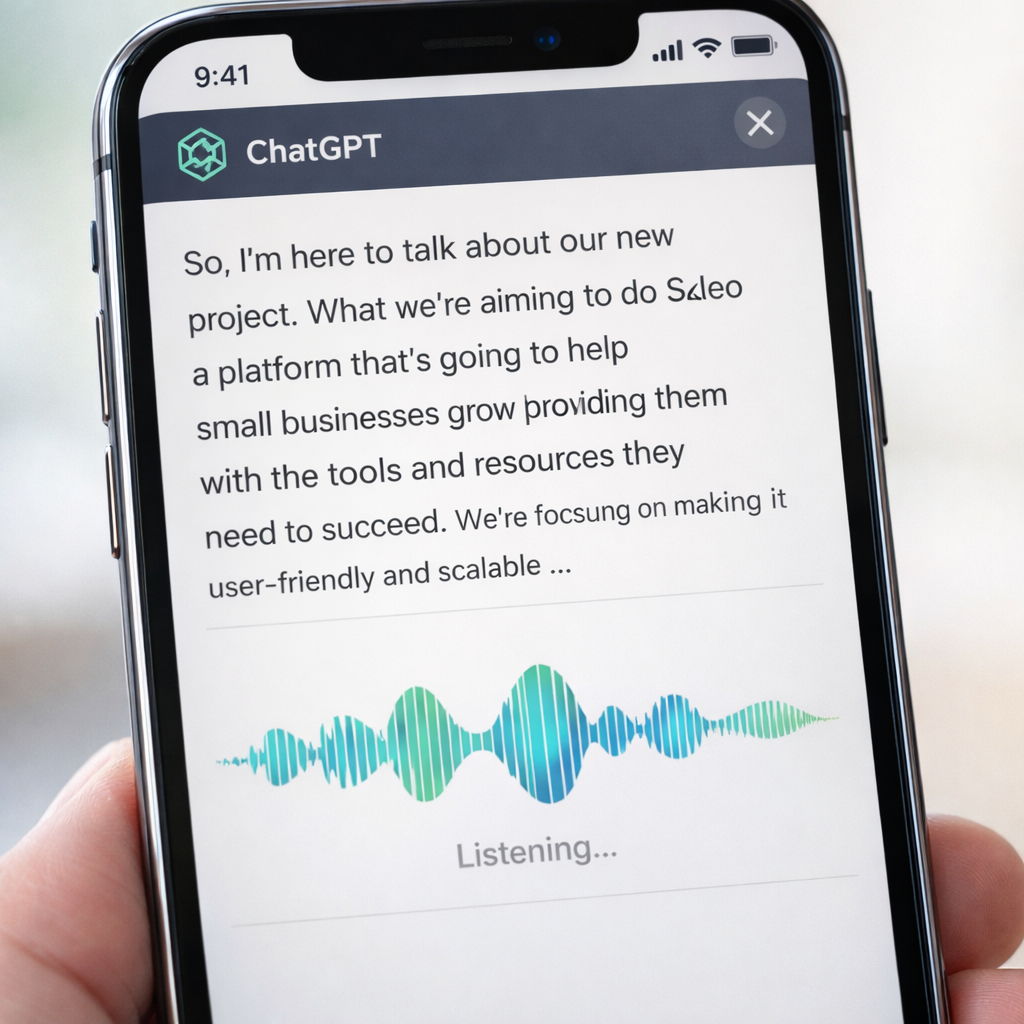
ChatGPT’s Live Dictation feature just got a major upgrade: the speech-to-text tool is now faster, more dependable, and most importantly, the 10-minute cap has been completely lifted. Users can now dictate indefinitely without worrying about time limits or laggy performance.
Previously, ChatGPT shut off its dictation streaming after 10 minutes of continuous speech. That restriction has now been removed with the latest update, giving users uninterrupted dictation for as long as they speak. OpenAI has also tweaked the back-end to transcribe speech in real time — spoken words are now converted to text on the fly rather than after pauses or stops.
How It Works & What’s Improved
The enhancements include reduced latency, meaning transcriptions show up much closer to when the user is speaking. Reliability under varied audio conditions has also received attention — quieter speakers, background noise, or imperfect microphone setups are handled with greater tolerance. The update was announced via OpenAI’s social channels, where the team emphasized the faster, more reliable streaming across both iOS and Android platforms.
Voice expert Atty Eleti confirmed via a post that the 10-minute limit — a long-standing boundary intended to constrain continuous dictation — is now entirely gone. That was part of the same streaming upgrade that brought smoother transcription and greater uptime.
Why This Matters
For anyone using voice features daily — whether for note-taking, messaging, hands-free communication, or assistive tasks — the removal of the time limit can be a relief. It opens up workflows that were previously interrupted or constrained by that cutoff point. Plus, real-time transcription brings ChatGPT more in line with specialized dictation and speech recognition services.
This move also underscores how OpenAI is pushing toward more natural, seamless voice-driven interaction. With advances like these, speech-based AI feels less like a novelty and more like a core way users will interact with their apps.
What to watch: whether this improved Live Dictation competes with built-in OS dictation tools or third-party services like Dragon or Otter, and how well it handles multilingual or heavily accented speech in real-world use.