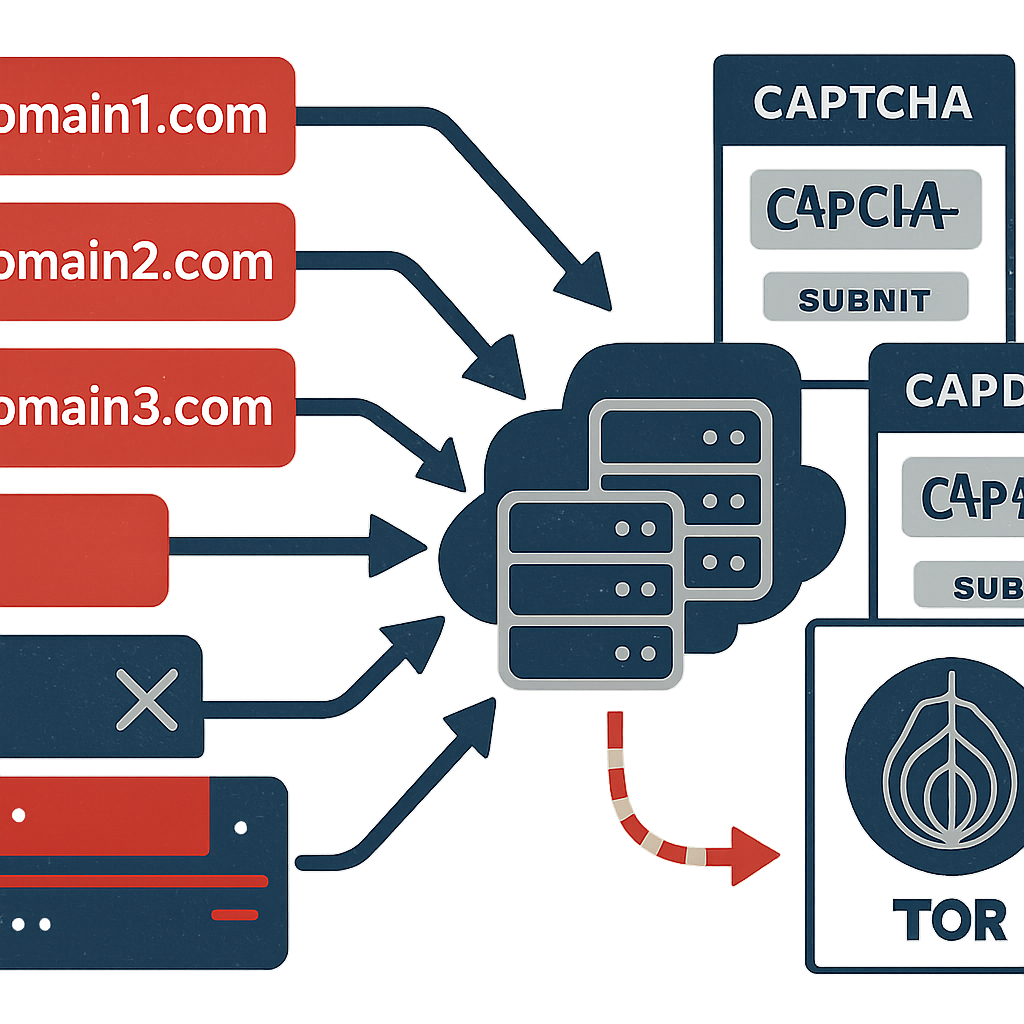
Over a sustained five-month investigation, security analysts discovered a troubling pattern: malware operators repeatedly swap out lure domains even while their underlying infrastructure—hosting networks, servers, command-and-control channels—remains fixed. The tactic undermines conventional domain-blocking defenses and demands more resilient detection strategies.
The Attack Chains Behind the Disappearing Domains
Researchers from a cybersecurity firm analyzed roughly 150 alerts from environments under monitoring and isolated four distinct attack chains sharing a hosting provider network registered in the Seychelles. Although the domain names, download URLs, and command servers shifted frequently, all originated from at least seven entry IPs spread across six address ranges. During the probe, the provider even expanded its announced address space.
Most attacks began with fake CAPTCHAs served via online ads; in one case the user was phished through an email link. Once on the lure page, victims were instructed to copy a command into their clipboard, open the Windows Run box, paste the command, and execute it. That single step could trigger an installation without any obvious file attachments or suspicious behavior.
Impact, Infrastructure, and IoCs
Outcomes ranged from partial contact to full compromise. Among the cases observed, one attack chain installed a stealer with persistence through reboot, another planted a Node.js-based implant active for almost two days. A separate case made use of a cloud storage bucket but had no confirmed second-stage load—highlighting that exposure doesn’t always translate to complete compromise.
The infrastructure consistently ties back to the same Seychelles-based provider. One observed host alone was linked to dozens of lure domains. Attackers even compromised or injected scripts into legitimate retail or restaurant websites to host lures invisible to the human-eye but effective behind the scenes—making simple checks for malicious domain names unreliable.
Indicators of compromise include specific autonomous system numbers (like AS202412), IP ranges (e.g. 178.16.52.101; 158.94.211.92), and a long list of lure domains such as “auth-id-browser[.]info”, “fingerprint-verification[.]info”, “enter-code-cdn[.]info”, as well as less-obvious ones using “.beer”, “.shop”, “.fit” TLDs. Malicious files ranged from trojanized libraries like obs.dll to MSI droppers and implants loaded via Node.js runtimes.
Why Blocking Domains Isn’t Enough
Despite domain takedowns, the attacks persist. The infrastructure does not move, only the surface changes. Blocking a domain only buys time. Researchers observed one user execute the lure-delivered command just 41 seconds after landing on the page—in other words, fast reactions are essential.
In some cases, the next-stage command server was resolved via blockchain rather than a conventional domain. This method removes reliance on DNS records and further complicates defenses. The use of installer sideloading—where a malicious library is placed alongside a legitimate application—grants stealth and persistence. Additional red flags include unsigned DLLs next to signed executables, trusted interpreters (like Node.js or Python) launched from user-writable locations, and processes spawned via Run box commands.
Recommendations for Defenders
Blocking individual lure domains isn’t sufficient. Security teams are urged to monitor outbound traffic for contacts into suspect provider networks before applying blocks. Organizations should collect and update network range blocks dynamically, log denied connections, refresh lists when providers add new address space, and keep payload servers under observation.
Alerts should extend beyond mere site visits. Educate users that any site urging them to copy-and-paste what appears as verification commands into Run or command interpreters is highly suspect. Scrutinize script-injections, runtime behavior of obscure DLLs, and trusted apps unexpectedly invoking untrusted modules.
By exposing this pattern of morphing domains built on static infrastructure, the investigation reveals how attackers evade detection while maintaining consistent delivery backbones. As defenders respond, the arms race shifts: it’s no longer just about deleting bad websites, but tracing back to the infrastructure that remains constant beneath the surface.
Why it matters: Traditional defenses that focus on domain blacklisting are being outpaced. This evolving tactic means security teams must shift their detection to focus on persistent infrastructure, behavior, and host-based Indicators of Compromise. What’s coming next are likely more attacks relying on blockchain for communication, installer sideloading, and tools that blur the lines between legitimate and malicious activity. Stay ahead means looking beyond domains to how things work when everything else has changed.