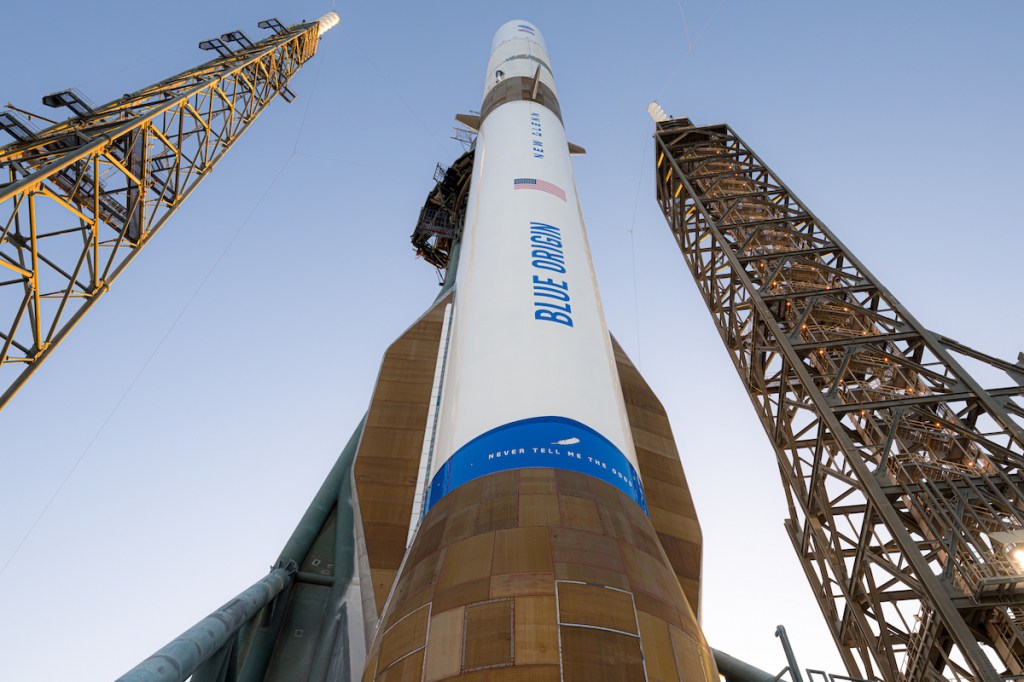
Blue Origin’s New Glenn Rocket Faces Setback in Third Launch Attempt
On April 19, 2026, Blue Origin, the aerospace company founded by Jeff Bezos, achieved a significant milestone by successfully reusing its New Glenn rocket for the first time. This accomplishment underscores the company’s commitment to developing reusable launch systems, a critical factor in reducing the costs associated with space exploration. However, the mission encountered a significant setback when the rocket’s upper stage failed to deliver AST SpaceMobile’s BlueBird 7 satellite into its intended orbit.
Mission Overview
The launch commenced at 7:35 a.m. local time from Cape Canaveral, Florida. The New Glenn rocket, a heavy-lift vehicle designed for a variety of missions, including satellite deployment and potential lunar expeditions, lifted off successfully. Approximately ten minutes post-launch, the rocket’s first stage executed a precise landing on a drone ship stationed in the Atlantic Ocean, marking a significant achievement in Blue Origin’s pursuit of reusability.
Anomaly in Satellite Deployment
Despite the initial successes, the mission’s primary objective—to place the BlueBird 7 satellite into its designated orbit—was not achieved. AST SpaceMobile reported that the satellite was released into an orbit lower than planned, rendering it incapable of sustaining operations. Consequently, the satellite is slated for de-orbiting, leading to its disintegration upon re-entry into Earth’s atmosphere.
Implications for AST SpaceMobile
The loss of BlueBird 7 is a setback for AST SpaceMobile’s ambitious plan to establish a space-based cellular broadband network. However, the company has indicated that the financial impact is mitigated by insurance coverage. Additionally, AST SpaceMobile has a robust pipeline, with successive BlueBird satellites nearing completion and scheduled for launch in the coming months. The company remains committed to deploying 45 more satellites by the end of 2026, collaborating with multiple launch providers to achieve this goal.
Broader Impact on Blue Origin
This incident marks the first major failure for the New Glenn program, which had its inaugural flight in January 2025 after over a decade of development. The program had previously demonstrated success, notably in November 2025, when New Glenn successfully launched twin spacecraft for NASA’s Mars mission and achieved a successful booster landing. The recent anomaly raises concerns about the reliability of the rocket’s upper stage, a critical component for mission success.
Potential Ramifications for NASA Collaborations
Blue Origin is actively vying to become a primary launch provider for NASA’s Artemis missions, which aim to return humans to the Moon and venture beyond. The recent failure could influence NASA’s assessment of Blue Origin’s capabilities, especially given the agency’s stringent requirements for mission success and reliability. CEO Dave Limp has previously expressed the company’s dedication to supporting NASA’s lunar objectives, emphasizing a commitment to accelerating the timeline for returning to the Moon.
Future Prospects and Challenges
Looking ahead, Blue Origin faces the dual challenge of addressing the technical issues that led to the recent failure while maintaining its competitive edge in the rapidly evolving aerospace industry. The company’s ability to analyze and rectify the anomaly will be crucial in restoring confidence among clients and partners. Furthermore, as Blue Origin continues to develop its lunar lander and other ambitious projects, ensuring the reliability of its launch vehicles will be paramount.
Conclusion
The third launch of Blue Origin’s New Glenn rocket encapsulates the complexities and challenges inherent in space exploration. While the successful reuse of the rocket’s first stage signifies a technological advancement, the mission’s overall failure underscores the critical importance of reliability in all phases of a launch. As Blue Origin continues to innovate and expand its capabilities, addressing these challenges head-on will be essential for its future success in the aerospace sector.