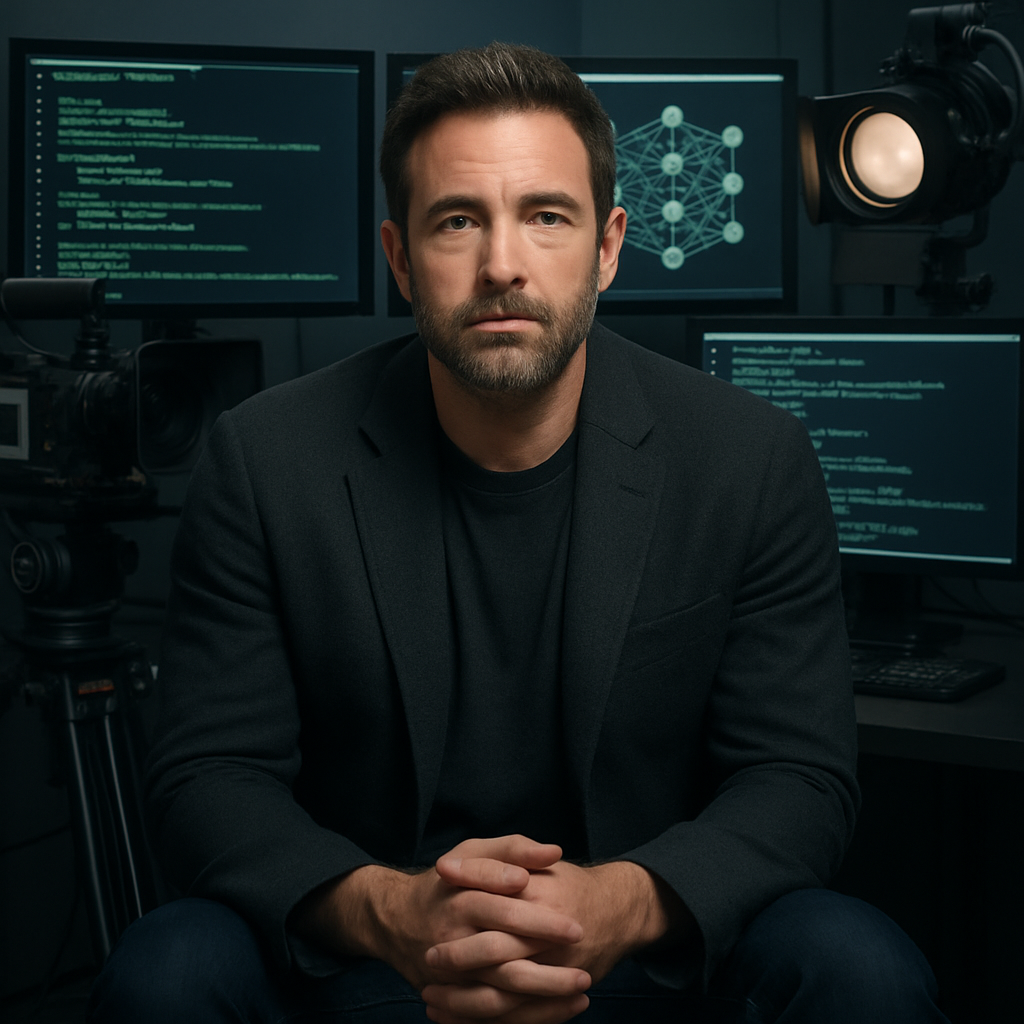
Ben Affleck is breaking out of the “movie star” mold and showing off serious tech chops. In a week of viral clips from his recent interviews, Affleck comes across as deeply versed in AI, machine learning, neural networks and the nuts and bolts of post-production workflows. It’s sparked admiration online and solidified his reputation as more than just a Hollywood name.
How Deep Is His Tech Savvy?
Earlier this year, the actor sold an AI filmmaking startup to Netflix for around $587 million, though he later clarified he didn’t own the whole firm. Now, in a segment from GQ’s “One More Question,” he described growing up as someone who was fascinated by computers, and traced his current work back to the shift from analog to digital film. He doesn’t just drop term after term either—he breaks them down so his conversation partner (and viewers) can follow along.
In that interview, Affleck shared that he can write basic Python code and used it to explore concepts like convolutional neural networks, transformers, tensors and GPUs. He explained how images become numerical data (like RGB values per pixel) and how these models learn to identify features—things like window ledges or green screen boundaries—that are crucial for visual effects and filmmaking. He admits his software chops are modest—“pretty shitty Python scripts”—but his understanding clearly runs deeper.
Blending AI With Filmmaking
Affleck also spoke about how he’s used his standing in Hollywood to gain early access to emerging AI tools, including visits to places tied to generative AI research. His ambition? To steer the tech toward helping artists rather than replacing them. To that end, he raised funds to build a custom dataset over eight months that could train open-source models fine-tuned for cinematic tasks, with both training code and inference code designed for real production needs.
He walks through the process of fine-tuning open video models by unfreezing their weights—meaning, taking pre-existing models and refining them so their last layers deliver cinematic quality. In his own film “Animals,” he applied this model-training approach during post-production. Affleck doesn’t buy into doomsday scenarios around AI; his concerns are more grounded. He worries about how AI is changing education, about grade inflation, learned helplessness, and responsible use of powerful tools—not sci-fi apocalyptic visions. He believes AI in filmmaking will be additive, not a replacement.
Why It Resonates
In an age where celebrity pronouncements about AI often lack substance, Affleck’s technical fluency signals something different. His career trajectory—from filmmaking to AI startup founder to storyteller leveraging emerging tech—aligns with broader trends in generative AI and creative tools. He’s not just commenting; he’s shaping the space.
For artists, technologists and audiences alike, Affleck’s path matters. It suggests that meaningful adoption of AI in media will depend on domain insiders—people who understand art and craft, not just engineering. Watch for how his startup approaches preservation of artistic identity using open models; and for how mainstream filmmaking begins embracing custom model training pipelines rather than off-the-shelf solutions. This feels like more than a celebrity flex—it could be a roadmap for AI’s role in storytelling.