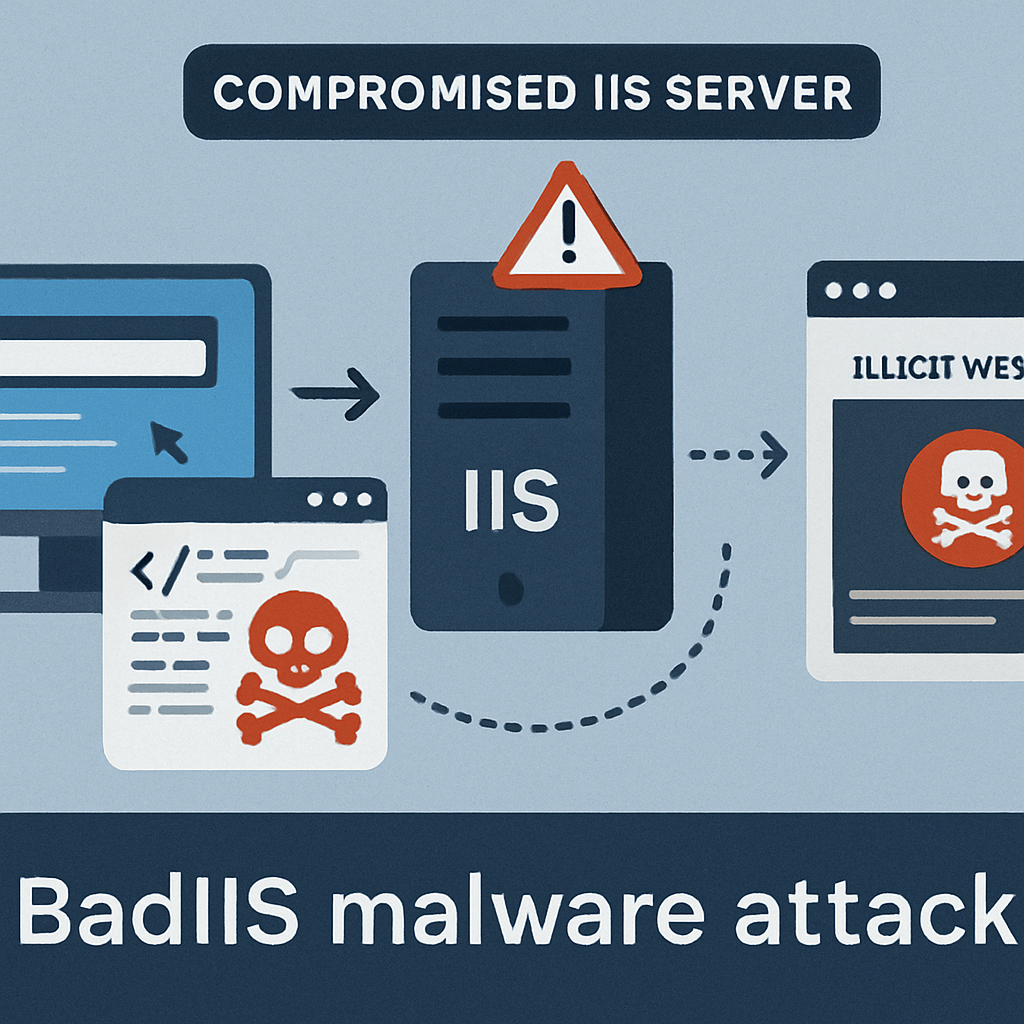
A sophisticated malware known as BadIIS has been actively compromising Microsoft Internet Information Services (IIS) web servers, covertly redirecting visitors to illegal gambling and adult content sites. This campaign has been ongoing for years, primarily affecting regions across the Asia-Pacific and beyond, thereby endangering numerous legitimate websites and their users.
BadIIS operates by embedding a malicious module within the IIS server software, allowing it to intercept and manipulate web traffic without detection. Once installed, the malware reroutes visitors to unauthorized destinations while the server continues to function normally, making it challenging for administrators to identify the breach.
According to Cisco Talos, a specific variant of BadIIS contains embedded “demo.pdb” strings, indicating that the malware functions as a commodity tool likely distributed among multiple Chinese-speaking cybercrime groups. This variant appears to operate under a Malware-as-a-Service (MaaS) model, enabling continuous monetization by its developers.
Investigations reveal that BadIIS has been in active development since at least September 2021, with the most recent compiled sample dated January 6, 2026. The malware undergoes rapid updates and feature enhancements, including evasion tactics targeting specific security vendors like Norton, confirming its ongoing maintenance and evolution.
The individual behind this campaign uses the alias “lwxat,” a handle found throughout the builder tool, authentication mechanisms, and even in live HTTP user-agent strings during active malware communications. Further analysis suggests that this BadIIS variant was custom-built for specific clients, reinforcing the MaaS business model.
BadIIS’s core functionality revolves around a dedicated builder tool that threat actors use to generate custom configuration files, JavaScript redirectors, and PHP backlink scripts, which are then injected directly into BadIIS binaries. The builder offers four main capabilities: traffic redirection to illicit sites, reverse proxying for search engine crawler manipulation, full content hijacking of the compromised website, and internal and external backlink injection for malicious SEO fraud.
Traffic redirection is achieved by injecting JavaScript-based redirectors into the victim’s browser session, forcibly sending legitimate users to spam infrastructure such as illegal gambling platforms and adult content websites. For search engine crawlers, BadIIS acts as a reverse proxy, fetching illicit content from the attacker’s command-and-control backend and serving it as though it originates from the legitimate website.
To mitigate the risks associated with BadIIS, organizations utilizing IIS servers should implement the following measures:
- Regular Patching: Ensure all IIS servers are updated with the latest security patches to address known vulnerabilities.
- Access Controls: Restrict administrative access using strong passwords and multi-factor authentication (MFA) to prevent unauthorized access.
- Monitoring: Continuously monitor IIS logs for anomalies such as unexpected module installations or unusual traffic patterns that may indicate a compromise.
- Firewalls: Deploy firewalls to control inbound and outbound traffic, reducing the risk of unauthorized communications.
- Secure Configurations: Disable unnecessary services and features on IIS servers to minimize potential attack vectors.
The widespread impact of the BadIIS campaign underscores the critical need for organizations to proactively secure their web servers against advanced threats. Failure to do so could result in reputational damage, legal liabilities, and loss of user trust.
Source: CyberSecurityNews