Tools that can act like humans in software environments—so-called AI agents—are among AI’s most exciting advances. But making those agents work reliably across complex, interconnected enterprise software like Salesforce, Workday, or Outlook remains a serious challenge. A new startup called Arga Labs claims to have a better way.
Why current agent training falls short
Most AI agent training setups use stateless APIs: you send inputs, get outputs, maybe tweak something, then move on. That method doesn’t capture all the messy, interdependent behaviors that real enterprise software requires—things like access control, webhooks, data consistency, or the fact that tasks usually span multiple platforms.
For example, think of a sales team using Salesforce to track leads and HubSpot to manage outreach. An agent might add a lead to Salesforce while someone else is emailing the same company via HubSpot. Does the agent recognize they’re the same customer? Does it avoid sending duplicate outreach? Does it know who should respond first? Most systems today wouldn’t.
Arga Labs’ hybrid solution: the digital twin
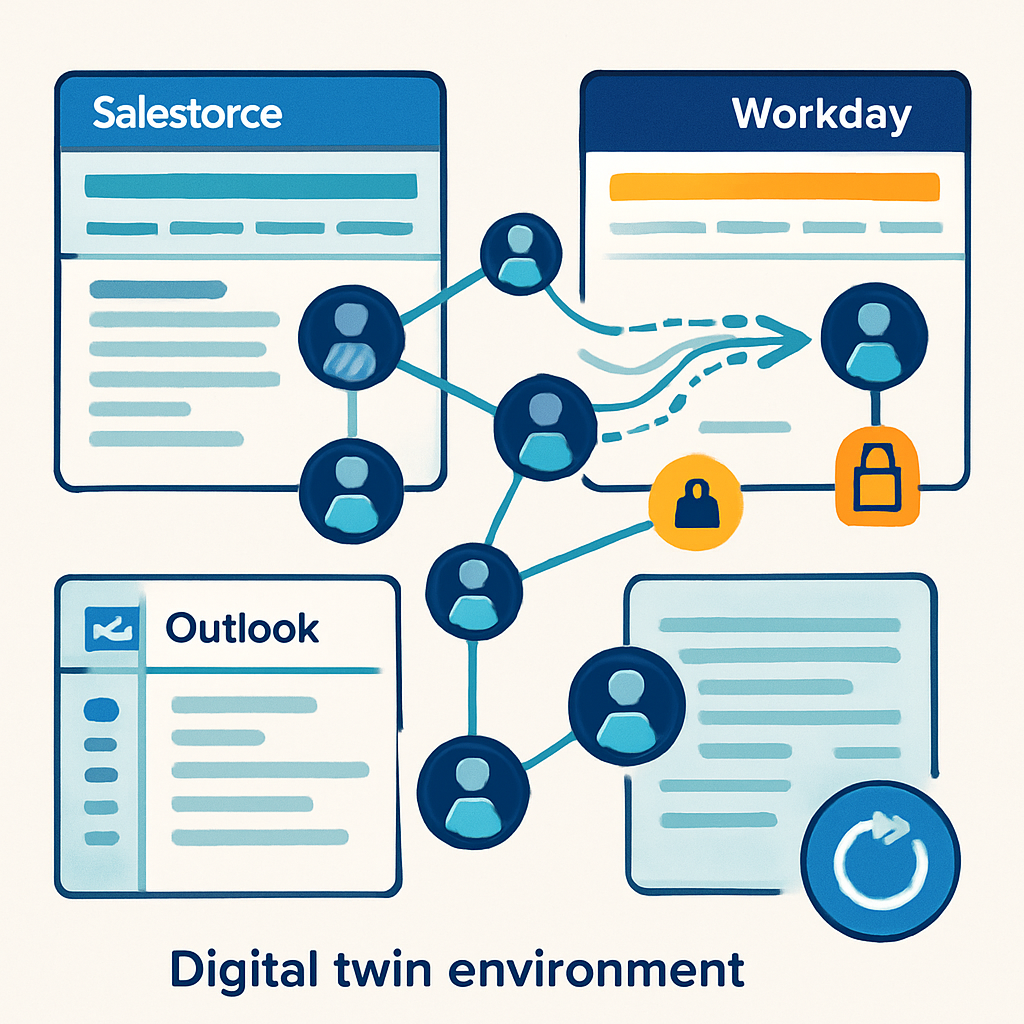
What sets Arga apart is that it builds digital replicas—or “digital twins”—of enterprise software environments. These full-scale clones include permissions, hooks, and other internal workflows. The startup trains agents within those replicas so they can be reset, changed, or run in parallel. That allows for repeated exposure to nuanced, realistic workflows like cross-system lead duplication or email vs. CRM interactions.
That ability bridges what Arga refers to as the “reinforcement gap.” In code-heavy domains, tools exist to spin up test or staging environments, reset them, monitor code execution; agents learn fast. In business software, most of those tools are missing. Arga is trying to change that by giving agents more realistic sandboxes to learn and fail safely.
Backing and market demand
Arga announced a $10 million seed round this week. General Catalyst led the funding, with support from Box Group, Emergence, Gradient, and SV Angel. The cash will help Arga scale up its environment builds, improve its software models, and expand its technical team.
Investors see a growing need for this kind of infrastructure. In enterprise settings, agents won’t deliver value unless they can be tested and trained in a way that scales and closely mirrors real workflows—with different systems talking to each other, permission hierarchies enforced, and edge cases accounted for.
For Arga’s co-founder and CEO, Philip Li, training across real-world workflows is essential. He believes that enterprises must be able to repeat scenarios—resetting environments, modifying states—to truly train agents that don’t just work on happy paths but manage ambiguity well.
What this means for enterprise AI
Enterprises have been eager to adopt AI agents to automate tasks, handle customer interactions, synthesize data, and more. But without the right training pipeline, agents run the risk of making errors or being brittle in production. Arga’s approach offers a path toward more robust deployment—agents that better tolerate complexity.
Challenges remain: building and maintaining accurate replicas of many enterprise systems is a big lift. Security. Data privacy. Integration complexity. Enterprises will want guarantees. Arga will need to prove that its twins map closely enough to live systems and that its models generalize out of sandbox settings.
But if it succeeds, this kind of work could push enterprise AI agents from experiments to reliable tools—much like how tools accelerated progress in software engineering itself. AI’s transformation of business processes may depend just as much on training infrastructure as on the models themselves.