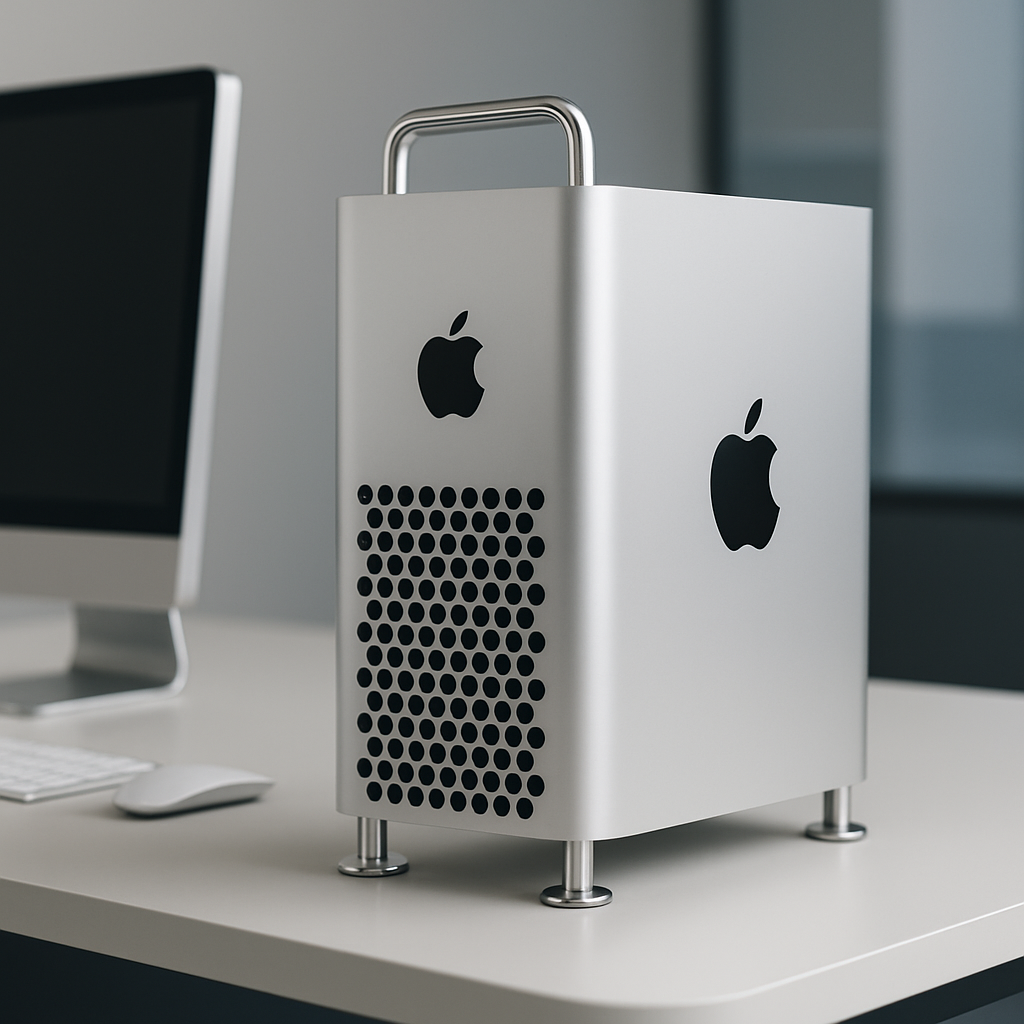
In March 2026, Apple announced the discontinuation of the Mac Pro, signaling the end of its high-end desktop line. This decision followed the company’s earlier move to remove the Mac Pro from its website, redirecting users to the Mac homepage, and confirming that no future Mac Pro hardware was planned.
Recent insights reveal that Apple’s initial strategy for the Mac Pro was more ambitious. The company had developed two unreleased models, codenamed J170 and J190. Notably, the J170 was an Intel-powered Mac Pro, indicating that Apple considered continuing its partnership with Intel even as it advanced its own silicon technology. The J190, on the other hand, was designed to feature the M3 Ultra chip and was intended to launch alongside the M3 Ultra Mac Studio in early 2025.
Apple’s original roadmap also included the development of high-performance ‘Extreme’ chips, positioned above the ‘Ultra’ variants. These M2 Extreme and M3 Extreme chips were in development but were ultimately shelved due to concerns over cost and market demand.
The discontinuation of the Mac Pro marks a significant shift in Apple’s desktop strategy. The Mac Studio, introduced as a powerful and compact alternative, now stands as the primary choice for professionals seeking high-performance desktop solutions. This transition underscores Apple’s commitment to its silicon technology and a streamlined product lineup.
For users, this evolution means adapting to new hardware configurations and performance benchmarks. While the Mac Studio offers impressive capabilities, the absence of a modular Mac Pro may impact workflows that relied on its expandability. As Apple continues to innovate, it will be crucial to monitor how these changes influence professional computing environments and whether future products will address the specific needs once met by the Mac Pro.