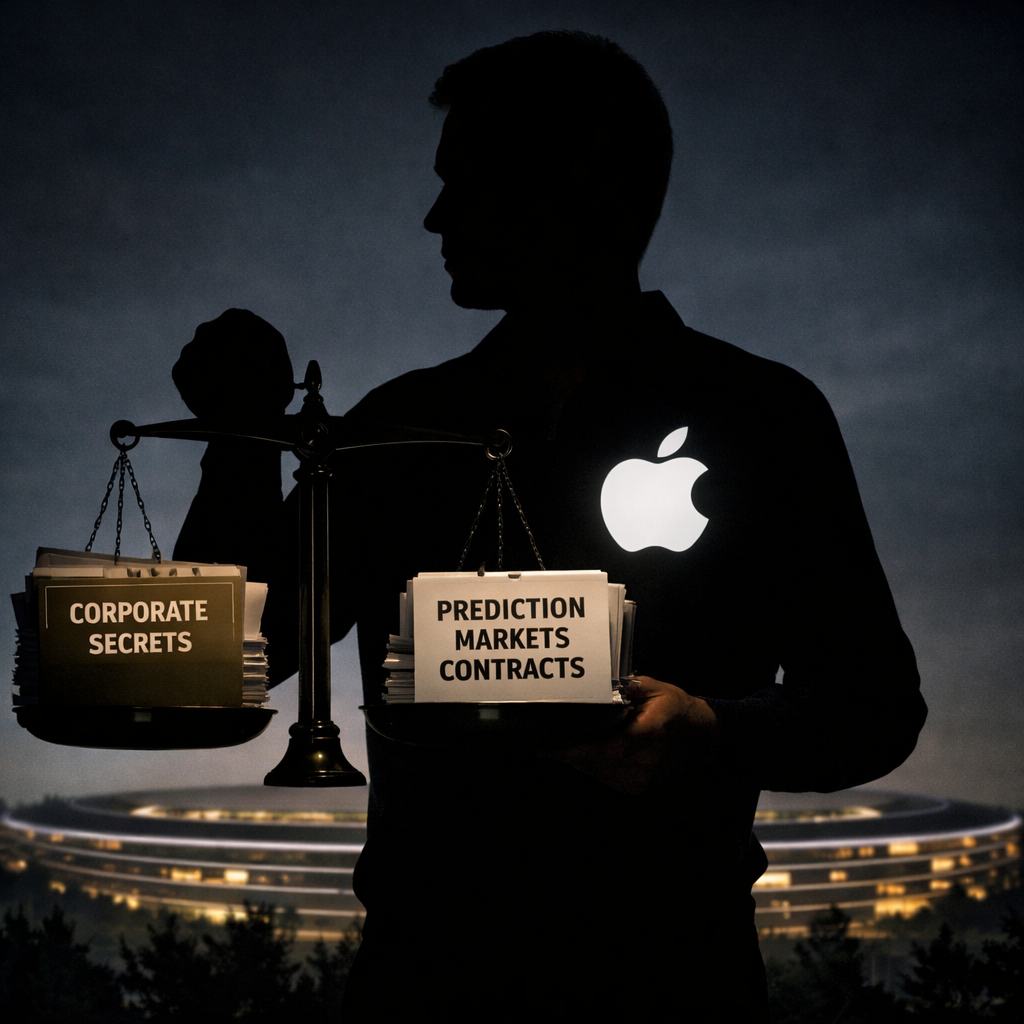
Apple has explicitly expanded its insider trading policy to ban employees and contractors from using confidential information to participate in prediction markets. The change was formalized in Exhibit 19.1 of its fiscal 2026 Form 10-K, filed with the U.S. Securities and Exchange Commission and marked “Updated October 2026.”
What the New Rule Covers
The newly introduced clause—titled “No Trading in Prediction Markets Based on Confidential Information”—makes it impermissible for any covered individual to wager, trade, buy or sell contracts on prediction market platforms when such activity relies on confidential information obtained through their work at Apple. This prohibition reaches beyond Apple alone, encompassing information about its suppliers, manufacturers, vendors, carriers, and customers. The policy also forbids tipped disclosures of confidential information to others who might engage in prediction markets.
This isn’t a narrow restriction. Employees, officers, directors, independent contractors, consultants, and even family members who live with or depend financially on them are all bound by the rule. It applies whether or not the activity would legally qualify as insider trading or securities trading under federal laws.
Closing Gray Areas Previously Left Undefined
Prior to this revision—specifically, versions of the policy filed in September 2024—Apple’s insider trading rules did not mention prediction market contracts. Those earlier filings focused primarily on the unlawful use of material non-public information for trading securities, options, or derivatives but didn’t address event contracts tied to future outcomes. With this update, Apple is aiming to close that gap.
Prediction markets are platforms where users trade event contracts based on predictions around future occurrences—everything from product launches and supplier performance to pricing, features, or even business partnerships. Previously, employees could potentially use insider information to place bets on these outcomes without breaking the letter of Apple’s old policy.
Why It Matters
This move reflects how prediction markets have increasingly skirted existing regulations, particularly by treating event contracts differently from traditional securities. While courts and regulators have long enforced laws around trading stocks based on material non-public information, contracts tied to future events have existed in a regulatory gray area. Apple’s amendment asserts that it doesn’t matter whether an activity is legally considered insider trading: if it uses confidential company info, it’s off-limits.
Effective immediately as of the October 2026 update, any violation of the new rule could bring internal disciplinary consequences for Apple personnel, including termination or other penalties tied to equity or compensation. Even accurate rumors reported in the media don’t count as public disclosure under this policy.
This update follows similar moves across the tech and financial sectors, as companies and regulators grapple with ethical, legal, and compliance implications of prediction markets, particularly for high-profile firms whose internal knowledge can directly affect investor expectations.
What to Watch Going Forward
Apple’s decision signals that prediction markets are no longer viewed merely as speculative or recreational outlets—they are being treated as arenas where confidential information can lead to unfair advantage, with real corporate and legal implications. Other companies may follow suit by adopting similar bans, and regulators—or Apple’s compliance team—may begin actively monitoring prediction market platforms for signs of misuse tied to employees.
For stakeholders, this raises questions about how internal leaks will be tracked, how enforcement will be handled when identification is difficult (e.g., through pseudonyms), and what kinds of platforms and contracts will fall under these bans. As prediction markets evolve, so too will the rules governing what’s acceptable. Apple has drawn a firm line: if it depends on inside information, it’s off limits.