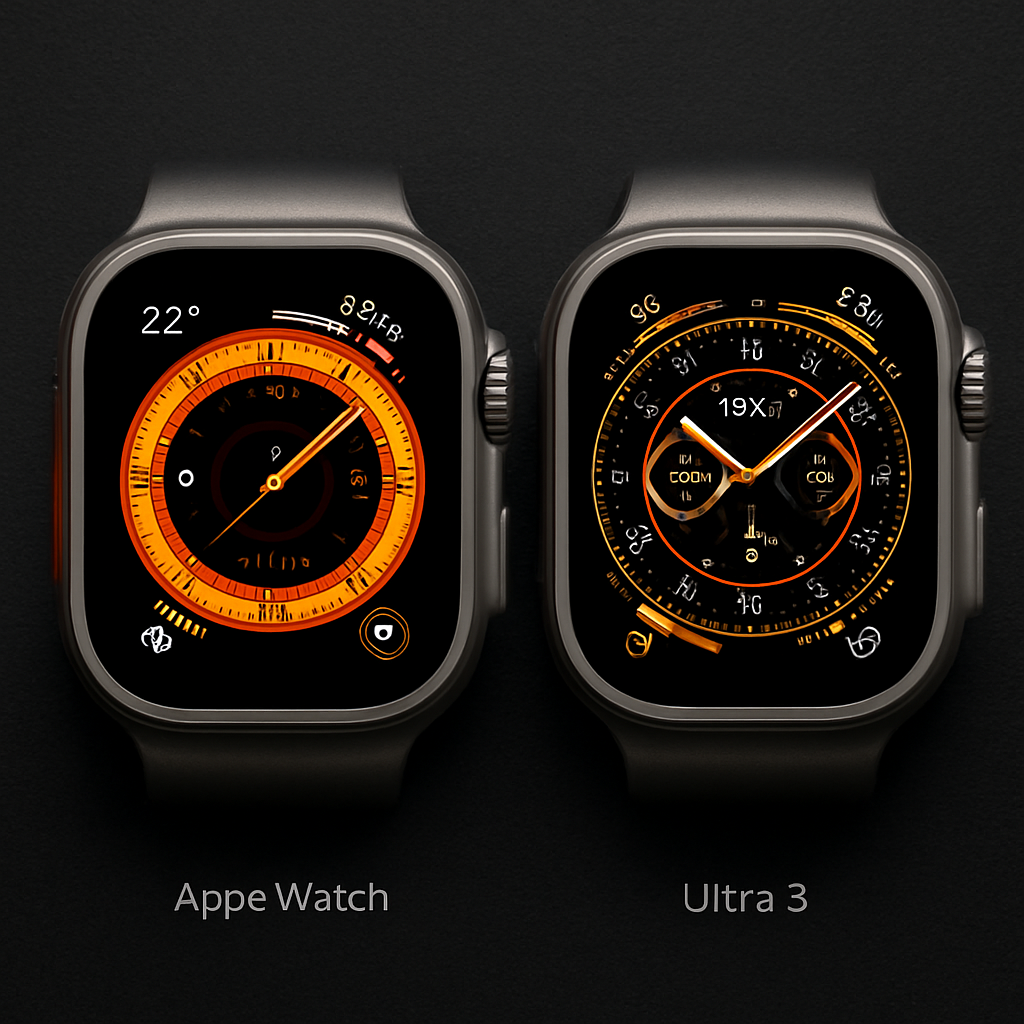
Apple’s freshly announced Watch Ultra 4 packs plenty under its titanium hood—while outwardly it looks nearly identical to the Ultra 3, its internal upgrades span processing, health monitoring, battery life, and AI features. If you’re debating whether to upgrade, here’s how the two stack up and what really moves the needle.
Design, Display & Build
On the outside, the Ultra 4 is nearly a twin to its predecessor. The casing stays at 49mm in size with a flat display, curved edges, sapphire glass up front, ceramic on the back, and a titanium enclosure made entirely from recycled material. Weight nudges up by under two grams depending on color—Natural Titanium vs Black Titanium. Both watches retain the same dimensions and the same rugged certifications: MIL-STD 810H durability, IP6X dust resistance, and 100 meters depth rating. The always-on LTPO3 OLED display stays alike too, still pushing up to 3,000 nits.
Processor, Sensors & Health Monitoring Upgrades
The Ultra 4’s biggest internal jump comes via the new S11 chip, a more powerful and efficient chip borrowed in design from Apple’s A20 Pro line. It offers gains in CPU, GPU, and neural performance, including a 50% larger last‐level cache than the S10. The added horsepower doesn’t just give raw speed—it enables new Apple Intelligence and health features.
On the sensors front, Ultra 4 overhauls its health hardware. ECG electrodes have been resized for better contact; photodiodes are now arranged in a ring formation; green LEDs are larger and more efficient during daytime heart rate monitoring. Sensors now deliver continuous heart rate readings every five seconds—about 60× more frequent than Ultra 3. Heart rate variability (HRV) readings are sampled every five minutes, 24× more often. The Readiness feature now aggregates daily vitals, recent activity, and sleep metrics to help users understand whether they should push hard or recover. In testing with over a thousand participants doing activities like cycling and HIIT, Ultra 4’s HR tracking was found to be the most accurate among comparable wearables.
Battery Life, Connectivity & AI Features
Battery life grows considerably. Ultra 3 could only manage up to 42 hours of typical usage and 72 hours in Low Power Mode; Ultra 4 boosts that to 50 hours normally and 84 in Low Power. New workout modes further stretch runtime: Extended Workout adds up to 25 hours, while Max Extended Workout can go as long as 45 hours, though at the cost of screen always-on and some metric tracking. Ultra 4 also charges faster for quick spurts—18 hours more use from just 15 minutes of charging.
When it comes to connectivity, Ultra 4 keeps GPS, Galileo, QZSS, and BeiDou support but drops GLONASS. It gains Bluetooth 5.3 and Wi-Fi 4, matching but not exceeding what was on Ultra 3 in many respects. Meanwhile, “Audio Intelligence” adds a suite of sound-based features: new sound recognition (sirens, doorbells, etc.), Live Rewind for capturing recent speech snippets without recording them, and Siri Recap for summaries of conversations—all designed to work with privacy protections in place. These features (Live Rewind and Siri Recap) require an iPhone 16 or newer and will arrive in beta later in 2026.
Ultra 4 starts at the same $799 as Ultra 3 did. It’s available in Natural and Black Titanium finishes. Preorders are live now, and it arrives in stores on September 18, 2026. While Ultra 3 inventory is thinning, some third-party sellers are still offering slight discounts.
Bottom line:If you already own Ultra 3, the visual and external features won’t sway you much—but the internal upgrades in health tracking, AI features, and battery life make Ultra 4 a considerable boost. For users upgrading from older Apple Watches or planning to use advanced health and workout features, it delivers real value.