Apple’s latest hardware and software updates deliver major upgrades across its lineup, from laptops to tablets to mobile software. The new MacBook Pros gain OLED screens and touch control; the iPad mini drops size and weight while embracing OLED; and iOS 27.3 is packed with fresh Safari enhancements, smarter Siri AI actions, and StandBy improvements.
MacBook Pro Lands OLED, Touch & Weight Loss
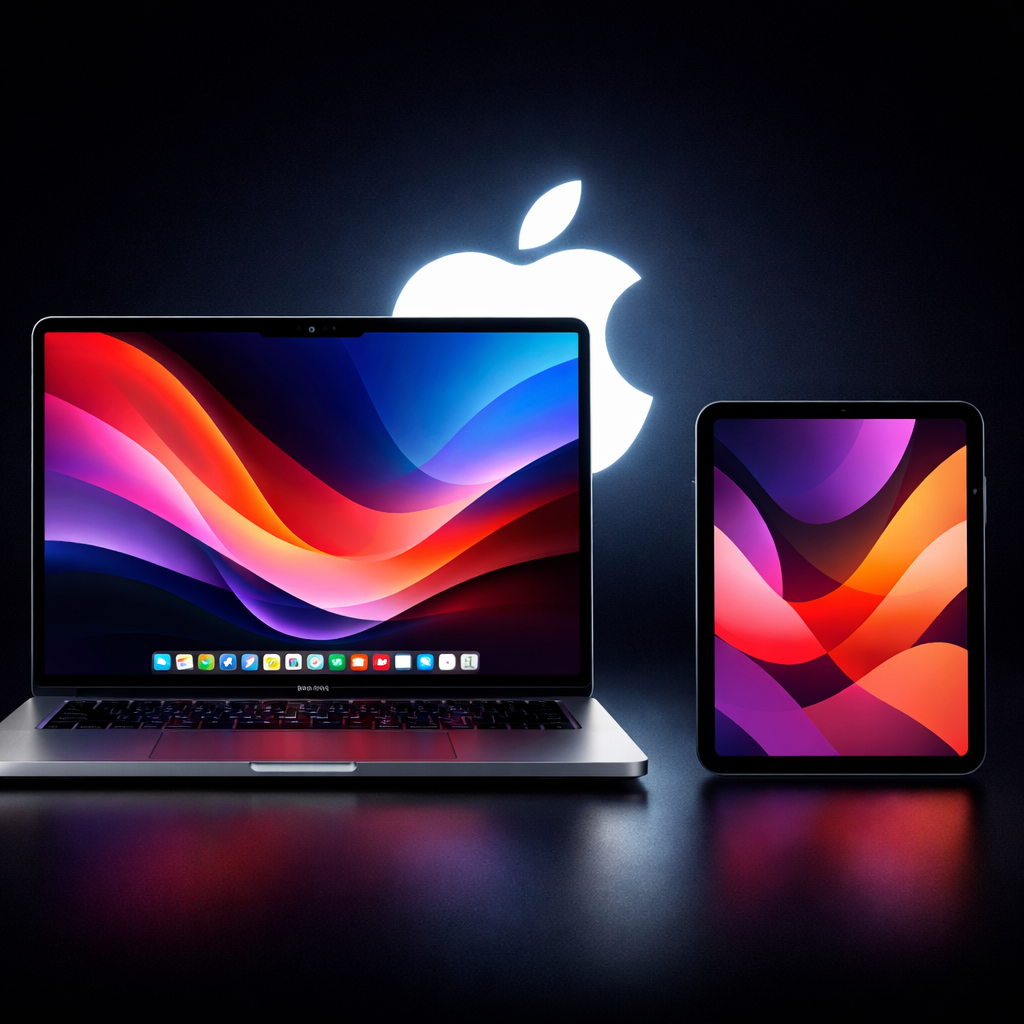
The all-new MacBook Pro with PROLED XDR Display marks a turning point. For the first time, Apple has combined tandem OLED panels with on-cell touch, delivering vibrant contrast and integrated touch sensitivity. Both the 14-inch and 16-inch models have slimmed down: the 14-inch drops from 3.5 to 3.0 pounds while the 16-inch falls from 4.7 to 4.0 pounds, with thickness reduced slightly in both designs. Rounded display corners and thinner bezels—including the removal of the thick lower bezel—also give the units a cleaner, more modern look. A glowing Apple logo returns with these models, lighting up in sync with display brightness and ambient lighting when the lid is open.
Performance remains anchored in the M5 Pro and M5 Max chips introduced earlier this year. In testing, the machines handled writerly workloads—Safari, photo-editing, general productivity—with ease, showing no noticeable jumps in performance or thermal issues despite the thinner enclosures. That said, those waiting for M6—or especially M7—chips might feel this update is more evolutionary than revolutionary. Battery life stays largely consistent with prior non-OLED Pro models, offering up to 22–24 hours of video streaming and 13–17 hours of web browsing depending on size and configuration. Also upgraded are the speaker system—now 6 speakers with ~50% deeper bass—and the debut of Dynamic Island features on macOS for Live Activities and media controls.
iPad Mini Finally Leaps Ahead—Mostly
The new iPad mini delivers its boldest refresh yet. The device is now just 5.4 mm thick (down from 6.3 mm), and its weight falls to 255 grams. Screen size grows modestly to 8.5-inches thanks to 24% thinner bezels, and OLED replaces the LCD stack for far superior contrast, brightness, and color. The tablet supports HDR content with up to 1,200 nits peak brightness in HDR and around 600 nits in SDR.
Other upgrades include water and dust resistance (IP67), the A20 Pro chip, a reoriented front camera now placed on the landscape edge, and a revamped Acoustic Display audio system that integrates woofers and hidden tweeters to deliver richer bass and clearer highs. But there are trade-offs: there’s no 120Hz (ProMotion) display, creating a mismatch between motion smoothness and the OLED visual fidelity. Base storage remains at 128GB, and prices begin at $699—higher than prior models. For those wanting a nano-texture matte screen, that comes at a $100 upgrade on higher storage tiers.
iOS 27.3 Beta Packs Safari, Siri & StandBy Upgrades
The first beta of iOS/iPadOS/macOS 27.3 arrives with long-missing Safari features: a Vertical Tabs layout option that lets tabs live on the left side, and an Adaptive Dark Mode that turns bright websites darker even if their developers haven’t built in native support. Users will find settings to use these features universally or site-by-site. The betas also expand the revamped StandBy experience introduced with the iPhone Duo (new clock faces, customizations, shared photo integration) to all iPhones running iOS 27.
Meanwhile, Siri AI gets more proactive control: it can now manage tabs in Safari by closing duplicates, sorting, opening saved items; handle mailing list unsubscriptions; and tweak weather notifications or locations. The expansion demonstrates Apple’s push toward a more capable voice assistant intertwined across system apps.
tl;dr: OLED, touchscreens, lighter bodies, hotter software. Apple’s pushing the envelope on displays and polish across Mac and iPad, while iOS 27.3 adds usability and AI depth that matter day-to-day.
Analytically, this week’s updates show Apple doubling down on what had long been the company’s deadliest criticisms—lame displays, bulky designs, minimal touch interaction. OLED and touch are no longer optional niceties but core expectations. However, the omission of 120Hz on the iPad mini and use of still-strong but not cutting-edge silicon in the MacBook Pro suggest Apple is pacing itself, holding bigger leaps—AI, chip architecture—for futuras updates. It’s a compelling moment: these upgrades raise the bar, but they also ask consumers to decide how much sooner they want to buy into a changing Apple vision.