Apple is making a major change in how it powers its artificial intelligence tools. With the roll-out of iOS 27starting September 14, the company will begin asking users to explicitly opt in if they want to allow their Siri interactions and other customer data to be used for training its AI models. This represents a sharp pivot from its prior stance, where it emphasized that it did not require user data to improve features like Apple Intelligence.
Until now, Apple relied heavily on differential privacy—a method of collecting aggregate usage data altered with randomness so that no individual user’s inputs could be reconstructed. Under that approach, Apple inserted or “injected noise” into prompts, collected fragmented patterns across many users, and applied thresholds so that individual contributors remained anonymous even if their data helped shape feature behavior.
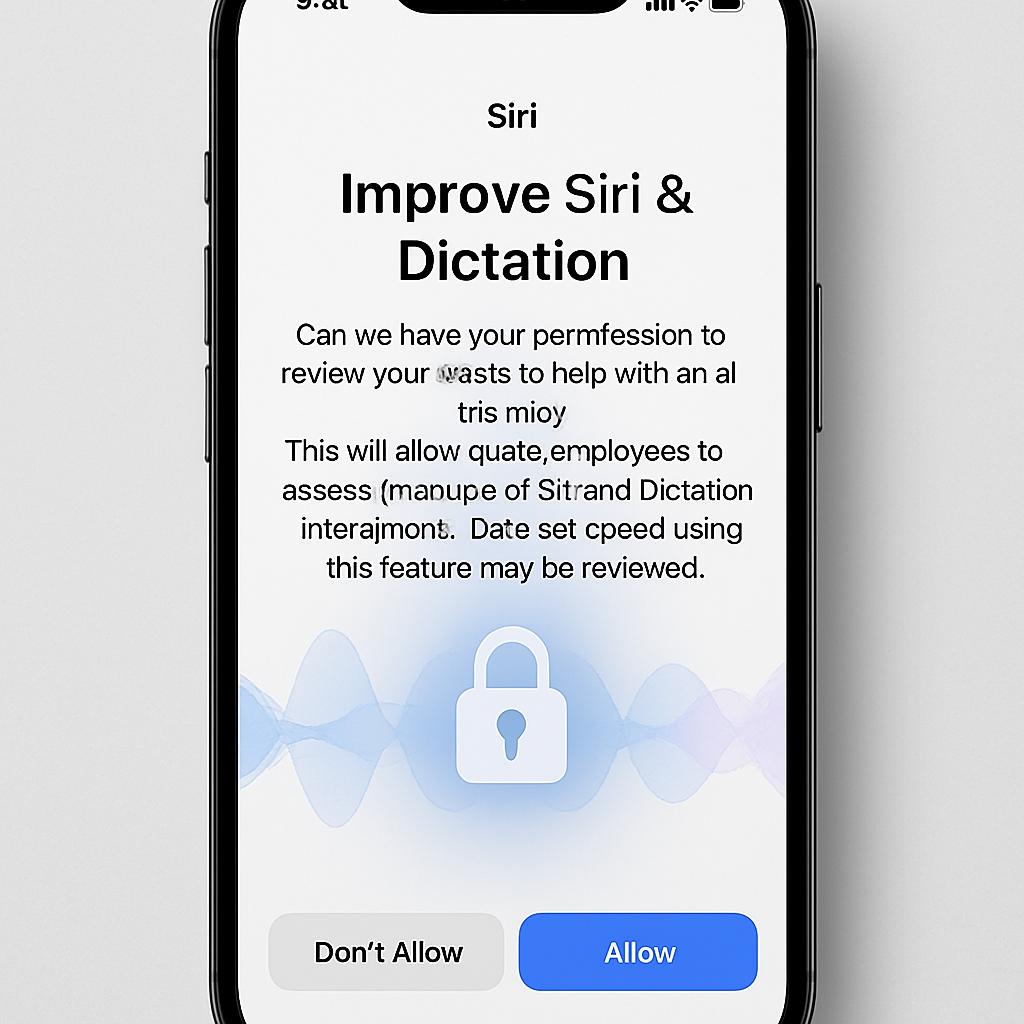
Starting with iOS 27, however, users will see a prompt asking whether they agree to let Apple review their Siri conversations and related usage for purposes of improving Siri AI. Audio recordings or transcripts may be listened to by people—including “review personnel”—after being anonymized. Users who opt in can later revoke that access via their device settings under Analysis & Improvements.
What’s Changing and Why It Matters
This is not just a policy tweak—it’s a signal that Apple believes access to real-world user data is essential to compete in the fast-evolving AI space. While Siri and related features like Siri Recap and Private Cloud Compute still benefit from privacy-centric design, listening to or reviewing actual user prompts provides feedback that statistical analysis alone can’t deliver.
Of note: Apple Watch models can now continuously monitor surroundings to let users request the past 15 seconds of conversation as a transcript, which is then deleted. While this kind of short-term audio capture is distinct from long-term data gathering, it raises questions about what future data streams could be folded into Apple’s training program. Apple hasn’t confirmed whether Watch-acquired audio will ever be part of the training opt-in.
This policy change makes clear Apple is adapting in response to pressure from rivals like OpenAI, Meta, and others who have already been using customer feedback and conversations to refine their chatbots and voice assistants. The expectation is that truly competitive AI needs more than aggregate models—it needs context-specific, user-driven inputs.
Despite the opt-in framework, there’s concern about the eventual trajectory. Will Apple continue letting users say “not now,” or might opting in become a requirement to use Apple Intelligence in full? Will the “review personnel” be internal staff or outsourced contractors? Apple has not provided full clarity.
Why this matters: AI assistants are only as good as the data they learn from. Apple’s shift toward user-provided data reflects the realization that even with strong privacy tools, AI needs real conversations to improve. Users will now have to decide what they’re comfortable sharing—while watching Apple’s next moves closely, especially around control, transparency, and whether opting in remains optional.