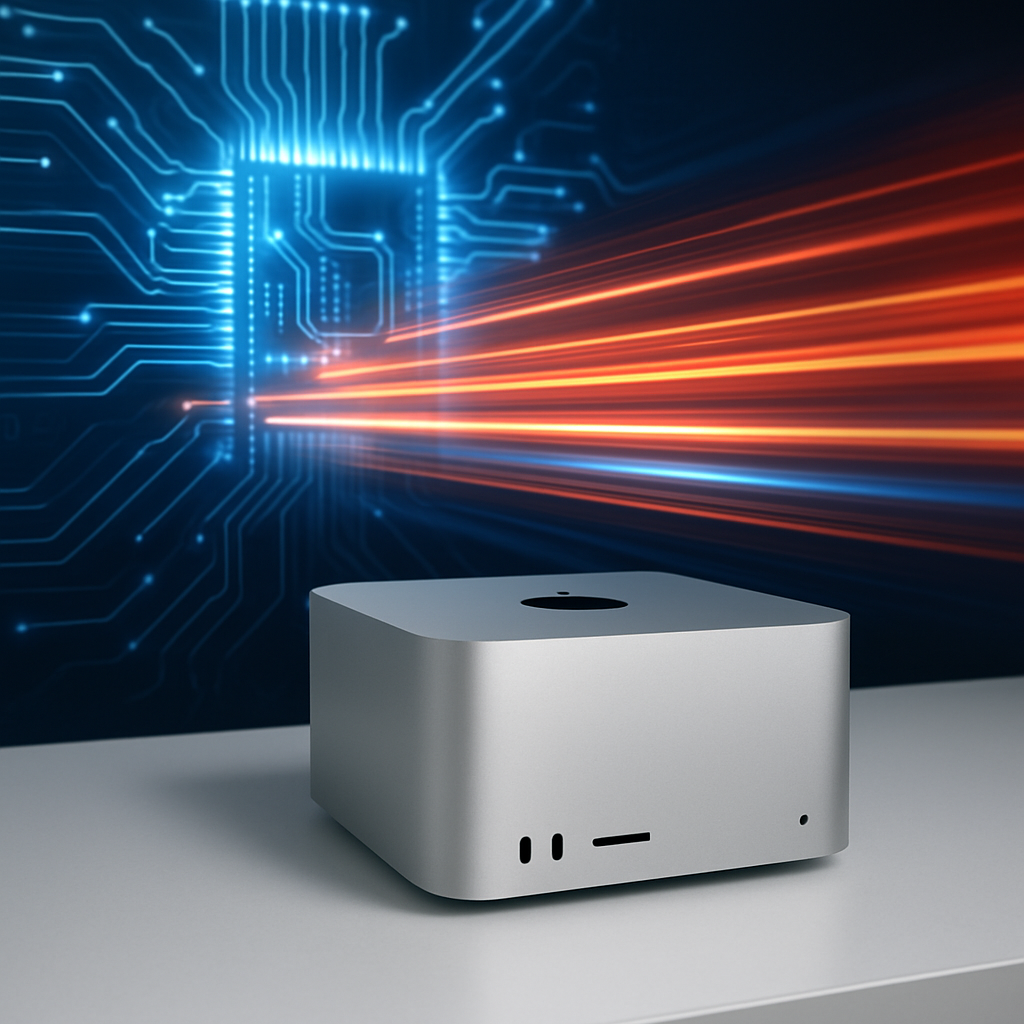
Apple has quietly removed references to PCIe 6.0 from the spec sheets of its newly launched Mac Studio, replacing them with more vague wording around its SSD architecture. The change was spotted in press materials that once described the Mac Studio’s storage connection using PCIe Gen 6, which is no longer specified in the updated English version of the promotional documents. The French version of the same materials still references PCIe 6.0, suggesting the edit hasn’t fully propagated.
What Was Claimed vs. What’s Now Listed
At launch, Apple’s promotional material for the Mac Studio featuring the M5 Ultra chip stated that it used “PCIe 6.0 powering its fast storage.” This precise claim has since been altered to describe the storage interface only as a “next-generation SSD architecture.” The English-language site reflects this change; the French-language page is an exception, retaining the original PCIe 6.0 reference.
Apple hasn’t publicly confirmed which PCIe version is actually being used in the Mac Studio. Speculation points toward PCIe 5.0, which is in line with what’s believed to be present in the M5 Max versions of Apple’s MacBook Pro. While some rumors suggest Apple may have originally intended PCIe 6.0, there’s no indication of a deliberate cover-up—more likely a miscommunication or error in the original materials.
PCIe 6.0 Status & Why This Matters
The PCIe 6.0 standard was ratified in mid-2019. It offers theoretical raw transfer rates of 64 gigatransfers per second, which is double the speed of PCIe 5.0 and four times that of the earlier PCIe 4.0 standard. Despite its potential, no Apple product has officially been confirmed to ship with PCIe 6.0 support. Prior models like the Mac Pro remain on PCIe 4.0 for expansion cards, and even the fast MacBook Pro line uses technology believed to be PCIe 5.0 without explicit confirmation.
This is likely not a strategic omission on Apple’s part, but rather a mislabeling in marketing materials. Someone somewhere appears to have gone to press with premature or incorrect information, which is now being corrected as more accurate wording replaces the original claim.
Apple usually highlights cutting-edge technologies when unveiling new Macs. This kind of error around PCIe version underscores how precise companies must be when promoting hardware details: users rely on these specs when deciding how future-proof a machine is. Apple pulling back on the PCIe 6.0 claim shows an adjustment to align public documentation with what the hardware likely contains.
What this means:The Mac Studio’s storage may offer impressive speeds, but PCIe 6.0 likely isn’t among them—expect something closer to PCIe 5.0 or another mature standard already in Apple’s product lineup. For buyers and system integrators, this matters a lot when estimating performance for workflows, especially if Thunderbolt, external GPUs, or ultra-fast NVMe SSDs are involved.