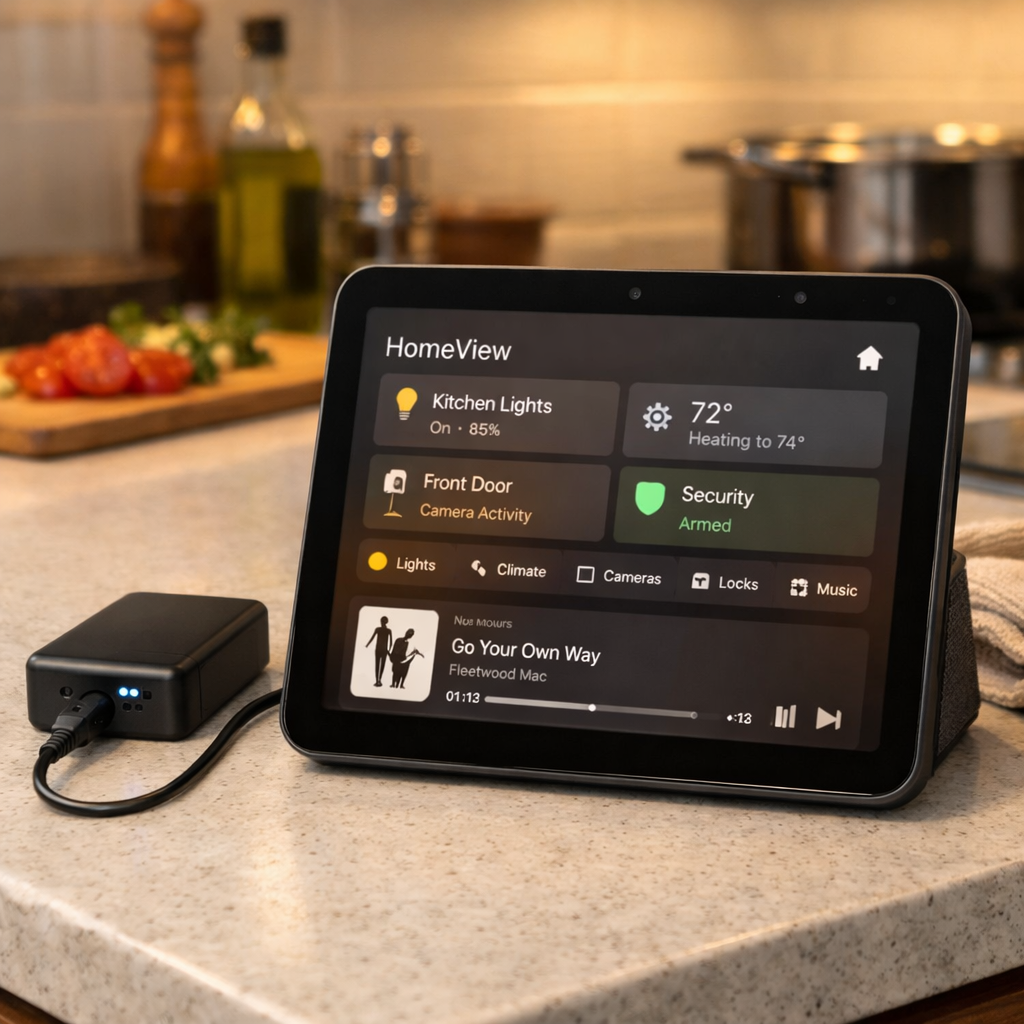
Apple HomeView—Apple’s new bridge between HomePod and a wall display—isn’t built to be carried around your home like an iPad. But a simple attachable battery pack reveals that portability, while not official, is very much possible.
Power Delivered via USB-C Makes Mobility Viable
Instead of using a proprietary power cable, HomeView relies on USB-C. That means it’s compatible with generic battery solutions. Users testing the device found that a standard MagSafe battery—as in those made for iPhones—can run HomeView reliably. For reference: the speaker-base version of HomeView draws around 30W, and the wall-mount model uses about 20W.
Stationary by Design, But Some Situations Call for a Mobile Setup
Apple’s intention with HomeView was never to create a mobile device. The design encourages a fixed placement—like replacing a light switch or acting as a digital display on a counter—rather than being picked up and moved. That constraint forces users to adopt more deliberate use patterns, which seems to align with Apple’s vision.
Still, there are use cases—such as moving it around in the kitchen—where a small battery base makes sense. One user described positioning HomeView behind a sink for visibility across a room and then moving it to a kitchen island when needed. Third-party bases built via 3D printing already exist, though most are bulky. A custom battery base may follow.
Trade-Offs: Slow Booting, Charging Fuss, Limited Battery Life
Even with battery power, HomeView’s simplicity shows: when you unplug it and power it back up, it comes alive in just about 15 seconds. That’s fast enough for occasional repositioning. However, there are downsides. Since it isn’t designed with internal battery storage, downtime occurs during transitions. And constantly charging another device is more hassle than having something always plugged in.
Apple’s lineup already covers mobile scenarios—iPhone, iPad, Apple Watch, Mac—so a fully portable version of HomeView may not fill a large gap. But for multi-tasking households—especially in shared spaces like kitchens—a battery-powered setup could enhance utility without altering what the product fundamentally is.
Ultimately, HomeView appears to strike a balance. It isn’t trying to be a tablet, and Apple seems content keeping it constrained to avoid confusion. But thanks to USB-C, that constraint is looser than it seems—users can add a battery pack and gain flexibility without breaking the design philosophy. In future, third-party accessories may formalize what early adopters are already experimenting with.
What this means: Apple’s HomeView confirms that constraints—fixed placement, simple OS, no App Store—can help define a product’s identity. While battery power isn’t official, this minor hack highlights how users value flexibility. Keep an eye out for accessory makers stepping in—and for Apple possibly embracing greater mobility in version 2.