Anthropic’s Claude Oceanus-v1-p: A New Frontier in AI Testing Amid Security Concerns
Anthropic, a leading artificial intelligence research company, has recently introduced its latest AI model, Claude Oceanus-v1-p, into restricted testing channels. This development marks a significant advancement in AI capabilities but has been overshadowed by security breaches that have compromised the model’s distribution.
Emergence of Claude Oceanus-v1-p
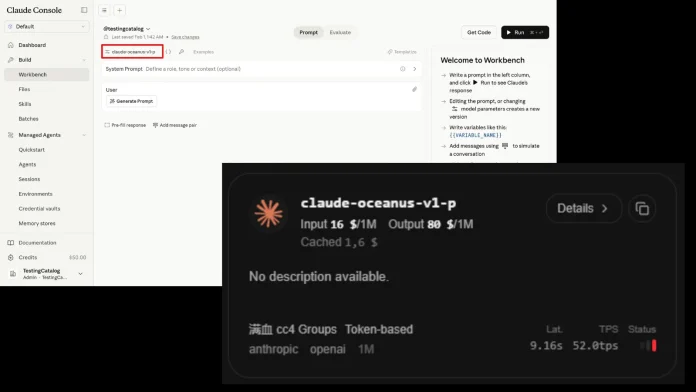
On June 3, 2026, references to Claude Oceanus-v1-p began appearing among AI researchers. The model identifier was discovered within Anthropic’s Claude Console and through unauthorized API proxy services. This led to speculation about the imminent release of a successor to the Claude Mythos line. Red team evaluators, who are tasked with testing the model’s robustness, reported access to Claude Oceanus-v1-p starting the same day.
Security Breach and Unauthorized Distribution
The controlled evaluation of Claude Oceanus-v1-p was short-lived. Within hours of granting access to validated red teamers, reports emerged of an unidentified actor reselling API access to the model through a Chinese-based proxy service. The unauthorized access was offered at a premium rate of $16 per million input tokens, significantly higher than Anthropic’s standard enterprise pricing tiers.
This incident is not isolated. Earlier in 2026, Anthropic accused Chinese AI labs, including DeepSeek, Moonshot AI, and MiniMax, of using approximately 24,000 fake accounts to conduct over 16 million interactions with Claude models through proxy channels. In response to the Oceanus resale incident, Anthropic reportedly paused model access for the broader red team cohort pending an internal investigation.
Advancements in AI Capabilities
Claude Oceanus-v1-p builds upon the foundation of the Claude Mythos Preview, which launched in April 2026. The Mythos Preview demonstrated alarming capabilities, particularly in cybersecurity. Operating under Anthropic’s restricted research track, it was assessed by the company’s Frontier Red Team as capable of identifying and exploiting zero-day vulnerabilities across major operating systems and web browsers. Glasswing partners collectively uncovered over 10,000 high or critical-severity vulnerabilities since the program’s inception.
The Turing Institute further noted that Mythos’ red team found vulnerabilities with a recovery rate exceeding 99% across disclosed test cases. These findings underscore the potential of AI models like Claude Oceanus-v1-p in both advancing technology and posing significant security risks.
Expansion of Project Glasswing
The red team evaluation of Claude Oceanus-v1-p coincides with Anthropic’s expansion of Project Glasswing on June 2, 2026. This restricted AI cyber defense initiative now includes approximately 150 new organizations across more than 15 countries, including India, France, Germany, South Korea, and Australia. The expanded group encompasses critical infrastructure sectors such as power, water, healthcare, and communications, which were not part of the program’s initial focus on Big Tech.
Anthropic stated that a successful cyberattack on most new partner organizations could affect over 100 million people. This expansion reflects the growing recognition of AI’s role in both defending against and potentially facilitating cyber threats.
Challenges in AI Deployment
Anthropic has candidly acknowledged that models with Mythos-level capabilities, and by extension, Claude Oceanus-v1-p, will not be cleared for general public release until the company develops highly robust safeguards to prevent misuse. The company admits that such safeguards do not yet exist in the industry. This highlights the dual-edged nature of advanced AI models: while they offer unprecedented capabilities, they also pose significant risks if not properly secured.
Conclusion
The introduction of Claude Oceanus-v1-p represents a significant milestone in AI development. However, the security breaches associated with its distribution underscore the challenges in deploying such advanced models. As AI continues to evolve, ensuring robust security measures and ethical guidelines will be paramount to harnessing its potential while mitigating risks.