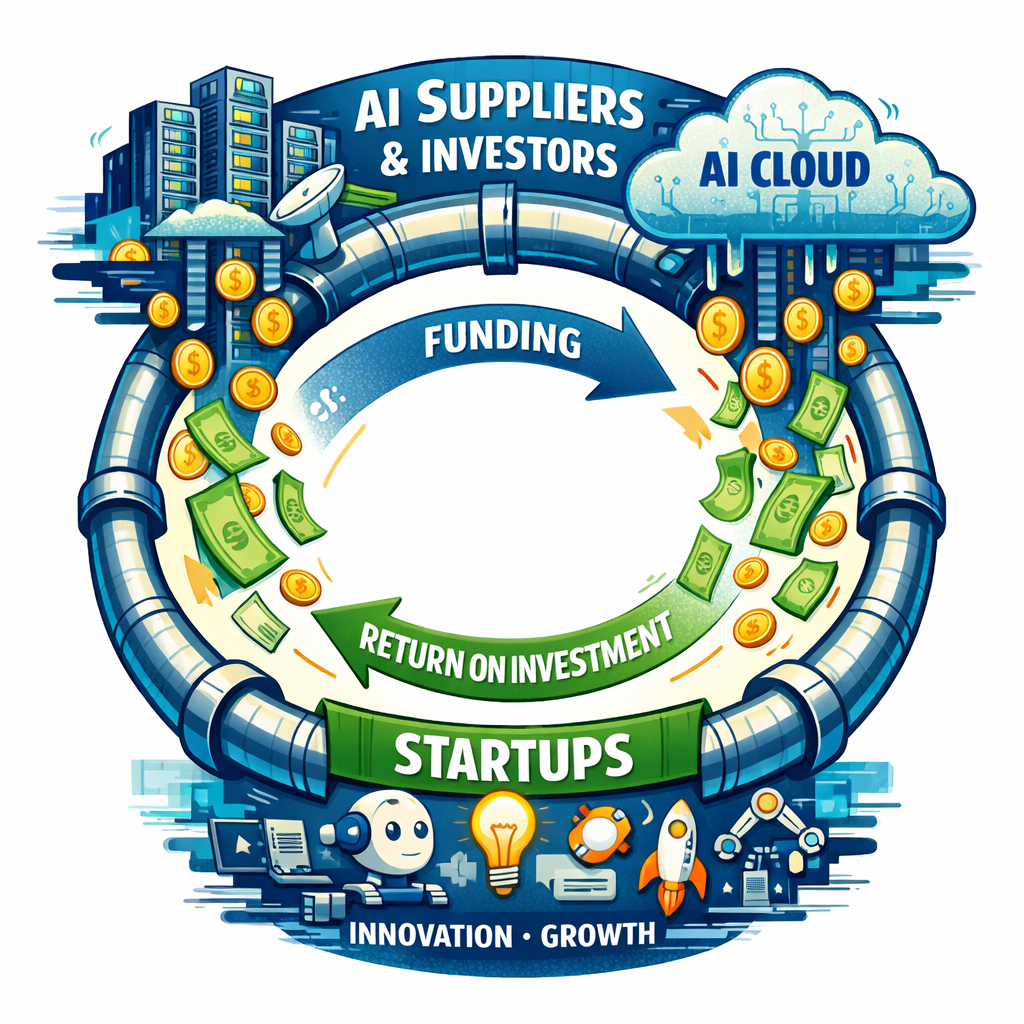
Anthropic’s long-anticipated public debut is here, and it’s more than just a funding event — itʼs a stress test for a newly exposed financial loop that drives much of the AI industry’s expansion. With its IPO priced at $83 a share, the company’s suppliers-turned-investors stand to receive nearly as much from Anthropic’s public listing and contracts as they put in, exposing a circular financing model that has raised eyebrows.
At the heart of the story are Amazon and Google. When Anthropic goes public, Amazon’s 14.7% stake will be worth about $159 billion, while Google’s 13.7% share jumps to nearly $149 billion. Both companies invested billions into the startup, and several other hardware providers — Nvidia, AMD, Broadcom, Micron, TSMC, and Microsoft — took part in a $26 billion private placement tied to the IPO. Most aren’t just investors: they’re the ones supplying Anthropic’s infrastructure guarantees, from cloud services to chips. Anthropic has struck strategic product-purchase deals with all of them except TSMC, locking them in as future suppliers.
The Circular Finance Dynamic
This entwined investment isn’t new. Suppliers of compute or cloud services often put in capital upfront and expect “returns” in two forms: ownership stakes and contracted long-term purchase agreements. In other words, the same companies that fund Anthropic also benefit whenever it spends money on infrastructure. The arrangement underpins fears that AI’s boom is being propped up by players benefiting from their own investments — a financial loop that critics say could mask real metrics of growth or profitability.
Yet today marks a turning point. Thanks to its IPO and the $26 billion in private buyer commitments, Anthropic will now draw capital from public market investors and bond debt, not just from supplier-investors. That shift changes its financial base. For the first time, some profit expectations and performance will be driven by external investors, rather than internal backers whose interests are already deeply tied to supplying the company.
Financials, Risks, and the Road Ahead
Anthropic is still losing tens of billions each quarter, but its balance sheet will be flush post-IPO. It’s expected to hold about $220 billion in cash, equivalents, and short-term investments — including proceeds from the IPO and the private placement. Meanwhile, its projected infrastructure and compute bills are staggering; the company has committed nearly $900 billion in contracts. To break even on those, financial analysts estimate Anthropic must generate roughly $280 billion in revenue over the next four years. Growing demand and revenue trajectory appear strong: the company pulled in $17 billion in revenue in Q3 2026, putting it on pace for a $68 billion annual run rate.
Analysts agree: this IPO gives Anthropic revolutionary leverage. Public market credibility should ease future borrowing; it also distributes financial risk more broadly. But the biggest threat isn’t balance sheet stress — it’s competitive pressure. If rivals like OpenAI, Google DeepMind, or even open-source AI models take lead in performance or adoption, Anthropic’s valuation and future could be sharply reevaluated. Even with such risk, companies selling cloud, chips, and infrastructure — Amazon, Microsoft, Nvidia and the like — are well positioned regardless, since more AI means more data centres and more demand, whoever leads at the top.
Anthropic’s IPO doesn’t just mark another startup going public — it shines a spotlight on the financial fast-loops powering AI’s growth. The question now is whether this economic design can sustain itself under public scrutiny. Investors will be watching not just revenue, but whether Anthropic can deliver model performance, fend off competition, and let the financial model it helped pioneer prove its resilience in a market that demands transparency and results.