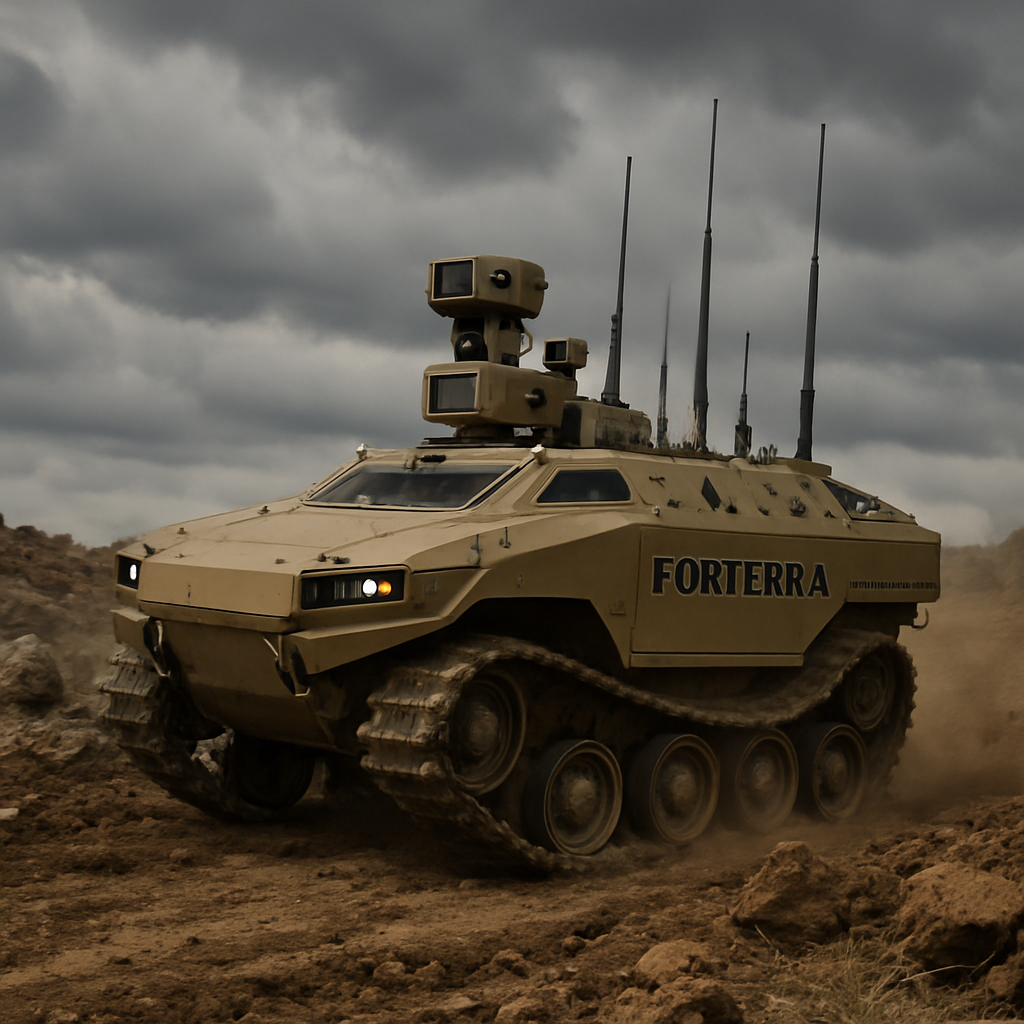
Forterra, a U.S.-based autonomous vehicle manufacturer, has disclosed that over 100 of its self-driving all-terrain vehicles (ATVs) have been operational in Ukrainian conflict zones for the past nine months. This marks the most extensive deployment of American autonomous ground vehicles in combat to date.
Funded by U.S. defense initiatives, this mission aims to modernize military operations by supporting Ukraine’s defense against Russian forces. While aerial drones have dominated recent warfare narratives, their prevalence has created extensive no-go zones due to heightened surveillance and aerial attacks. Consequently, Ukrainian military strategists are increasingly turning to ground-based autonomous solutions to navigate these challenges.
Sergeant Major Corey Wilkens, leading the U.S. Army’s autonomous vehicle development program, highlighted the vulnerability of soldiers in such environments. He noted that the omnipresence of threats like first-person view drones, artillery, and mortars leaves little room for concealment, underscoring the need for autonomous ground vehicles.
Ukraine has been developing its own uncrewed ground vehicles (UGVs) primarily for logistics and casualty evacuation. However, these battery-powered units have a limited payload capacity of up to 250 kilograms. In contrast, Forterra’s gas-powered Lancer vehicles, adapted from Polaris ATVs and equipped with custom sensors and computing systems, can transport up to 750 kilograms. This enhanced capacity has proven invaluable on the battlefield.
Initially, Ukrainian forces were skeptical of Forterra’s technology, perceiving it as tailored for the U.S. Army’s high-end requirements. However, modifications such as integrating Starlink satellite internet antennas have significantly increased the vehicles’ utility. Since their deployment in October, the Lancers have covered over 2,500 miles across more than 1,100 missions, transporting approximately 777,440 pounds of supplies and completing 52 casualty evacuations. Some units have been lost in combat, particularly when immobilized in challenging terrains, making them susceptible to enemy attacks.
Forterra has gained critical insights from this deployment, including strategies for electronic warfare, remote software updates, and maneuvering in difficult conditions. The company, which has secured over $500 million in venture funding from investors like XYZ Venture Capital and Moore Strategic Partners, is now better positioned to compete for national security contracts.
Despite advancements, the vehicles are primarily teleoperated in combat zones due to their high value and the current limitations of autonomous systems in unpredictable combat scenarios. While the Lancers can navigate diverse terrains autonomously, they lack the capability to identify and respond to unexpected enemy threats in real-time. Forterra is actively working to integrate self-driving algorithms with generative AI to enhance the vehicles’ responsiveness to dynamic combat situations. A significant challenge remains in gathering the appropriate data to train these systems effectively.
Competitors in the autonomous military vehicle sector are addressing similar challenges. For instance, Scout AI recently raised $100 million to develop autonomous platforms for the military, including UGVs. Other startups like Field AI and Overland AI are also testing UGVs with the U.S. military.
American military experts are convinced that ground autonomy is achievable and essential. Forterra’s Chief Innovation Officer, Scott Philips, emphasized the importance of firsthand experience in understanding operational challenges and identifying areas for improvement. Ukrainian forces have expressed a desire for more units but stress the need for cost reductions to deploy them more freely, acknowledging that attrition is an inevitable aspect of the battlefield.
The deployment of Forterra’s autonomous vehicles in Ukraine signifies a pivotal moment in modern warfare, highlighting the growing role of ground-based autonomy in combat operations. As technology continues to evolve, the integration of advanced AI and autonomous systems is poised to reshape military strategies and enhance operational effectiveness on the battlefield.