A Russian-speaking hacking group has launched a sophisticated phishing operation targeting Windows users, combining AI-assisted malware with a trick known as “ClickFix.” Active since August 2026, this campaign has already sent nearly a thousand personalized fake document-sharing invite pages in Latin America, Asia, and Europe. Its ultimate aim: gain full control of victims’ PCs.
Components of the Attack Chain
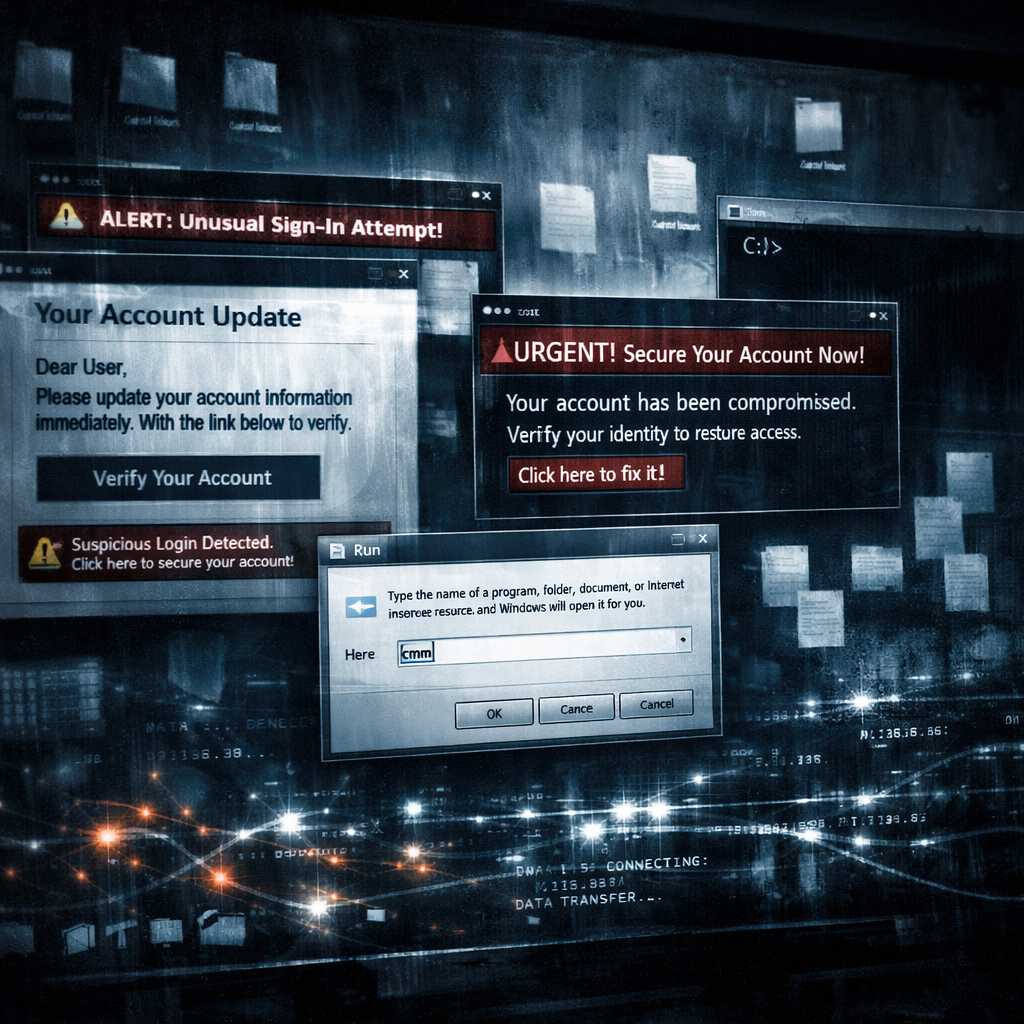
The campaign uses three loosely linked tools. First is XaocMail, a phishing platform built to send customized emails—each one tailored with the recipient’s name, company, and a plausible document type. These emails mimic familiar services like Google Docs, Adobe Acrobat, or Office 365. Victims are led to pages hosted via Cloudflare Workers showing blurred documents. To “unlock” them, they’re instructed to open the Run dialog (Win+R) and paste a command—a core part of the ClickFix deception.
That command—run through PowerShell, mshta, or msiexec—is the installation vector. The MSI implementation is now favored by the attackers. Once executed, the page unblurs the document, reinforcing the illusion of legitimacy. Victims don’t realize the danger until full compromise.
Stealth, Persistence, and Artificial Intelligence Elements
After the MSI installs, it masquerades as tools like Visual Studio, Python, or Node.js. It deploys a private Python runtime and sets up two scheduled tasks. One task sends data (a “beacon”) every 12 minutes; the other monitors the system every three. Communications are hidden using DNS-over-HTTPS (DoH) via trusted resolvers like Google and Cloudflare—protocols that many firewalls overlook. This framework is known as Phantom53. If the malware finds a target deemed valuable, it loads Havoc, a post-exploitation toolkit, directly into memory to avoid writing malicious files to disk.
Evidence suggests that AI tools—particularly Claude agents—were used in building and managing this attack. Attack files include Claude code folders; 143 task files follow Claude’s naming conventions. An architecture document nearly 117KB in size bears signatures of structured AI-assisted design. In one test, operators instructed a Claude agent to install an MSI in a virtual machine labeled “NoAV,” under the false pretense of an authorized red team assessment.
Targets and Impact
Victim profiles stretch across sectors like technology, finance, education, government, logistics, and manufacturing. Countries most affected include Brazil and Peru, with India, Indonesia, and Spain also hit hard. While many phishing lures were in English, others appeared in Portuguese, Spanish, and Indonesian. Attackers seem especially interested in tech, IT firms, and any organization whose compromise could expose supply chains.
If an IT company is breached, its clients may also be at risk. Compromised data could include credentials or secrets related to password managers, VPNs, AI tools, SSH keys, crypto wallets, seed phrases, and messaging apps like WhatsApp, Telegram, and Signal. Traditional signature-based detection tools are unlikely to spot the threat; behavior monitoring is essential.
Indicators & Mitigation Steps
Some signs that systems are compromised include:
- msiexec.exe being launched via the Run dialog from a workers.dev link;
- pythonw.exe running from Task Scheduler via AppData;
- pythonw.exe making DoH connections;
- scheduled tasks with innocent-sounding names like OneDriveSyncTask or WindowsDefenderScheduledScan.
Defenders should train staff never to paste commands from a web page into system dialogs, and always validate instructions out of band. Investigators recommend layering alerts in SIEM solutions for suspicious msiexec usage, pythonw activity, and DoH traffic.
Technical indicators of compromise include a set of IP addresses, domains (such as securedoc[.]makeneg458[.]workers[.]dev and specific Phantom53 C2 servers), and several SHA-256 hashes tied to malicious payloads.
This campaign’s roots trace back to October 2025, when attackers began testing malware and infrastructure. Throughout early to mid-2026, they refined phishing lures and hardened their tools before launching full operations in August.
Analysis & What to Watch
What makes this campaign notable is the convergence of AI assistance, ClickFix social engineering, and covert communication via DNS-over-HTTPS. There’s a clear escalation in attacker sophistication: using AI agents to carry out malware design, running exploit frameworks in memory, and hiding traffic in trusted protocols. For defenders, this heightens the need for behavior-based detection and staff education. The window of opportunity for interception is narrow once the RAT (remote access tool) is installed. Going forward, any large organization serving sensitive sectors in affected geographies should assume it’s only a matter of time before it becomes a target. Vigilance, layered defense, and awareness are now more crucial than ever.