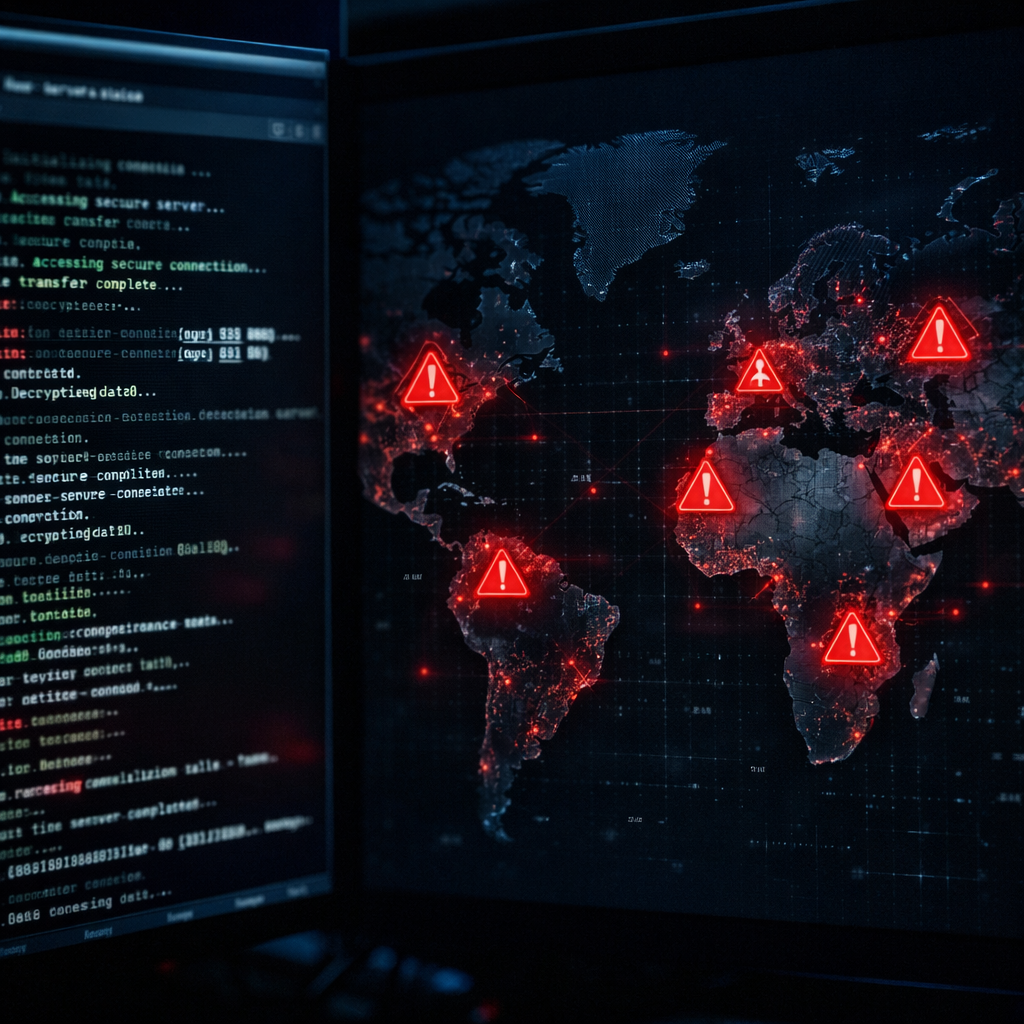
Between mid-October and early November 2026, an unknown threat actor launched a wave of attacks against Check Point Security Management servers, successfully compromising 24 servers across 22 organizations worldwide. The breach was identified by the cybersecurity monitoring group using the name GT13.
Scope and Methods of the Attack
The campaign, spanning from October 17 to November 2, targeted entities in financial services, energy, government, transportation, mining, engineering, and manufacturing sectors. Affected countries include the U.K., Ireland, France, the Netherlands, Greece, Germany, Austria, Bulgaria, Poland, India, Thailand, Vietnam, South Korea, Hong Kong, China, Australia, and the United States. Attack activity was traced to over 99 IP addresses—many linked to disposable infrastructure or proxy services—used for scanning, exploitation, and maintaining control. In total, more than 1,400 network sessions, over 800 command-line actions, and some 1,200 files were involved in data download, upload, or creation.
Researchers believe the threat actor employed AI-powered tools and automation to identify vulnerabilities and exploit them rapidly. Toolkit usage included Nmap for scanning, Chisel for setting up tunnels, Impacket and Paramiko for remote interactions, and customized Python scripts for reconnaissance, privilege escalation, and moving laterally within networks.
Key Vulnerabilities and Post-Compromise Strategy
One pivot in the operation involved exploiting a critical flaw in Rejetto HFS—CVE-2026-61500—to gain control over a server and add an SSH key to the root user. That server then served as a relay to carry out further operations on the compromised Check Point management servers.
Another major weapon in the attacker’s arsenal was CVE-2026-16232—a previously disclosed, now patched Check Point vulnerability. Using it, the adversary ran over 100 management tasks against multiple Check Point servers to steal firewall databases, access internal certificate authority files, issue fraudulent certificates, disable firewall policy enforcement, and gather intelligence inside networks. Failing to establish exactly when or how initial access to the Check Point systems occurred, researchers observed that the actor likely held access even before the Rejetto HFS compromise.
Additional efforts were made to exploit weaknesses in enterprise tools including Citrix NetScaler, Ivanti Connect Secure, VMware vCenter, Microsoft Exchange, and the Netlogon protocol. The actor also attempted to use newer vulnerabilities—such as CVE-2025-5777 in Citrix, CVE-2026-41089 in Windows Netlogon, CVE-2026-98432 among others—to widen the breach scope or deepen control.
What’s Being Done and What This Means
Check Point has confirmed that CVE-2026-16232 was already patched, and emphasized that no novel vulnerability was discovered as part of GT13’s operations. The company is urging users to update swiftly, lock down management interfaces, limit access to trusted networks, and monitor for abnormal processes or changes—particularly in logs and firewall policy operations.
This incident underscores how AI-aided offensive tools are rising in sophistication. Fully automated pipelines have enabled threat actors to rapidly scan, exploit, infiltrate, and conduct post-exploitation tasks on multiple high-value systems globally.
The attack also serves as a reminder that even patches and security advisories are only one part of defense. Strong configuration hygiene, restricted access, robust monitoring, and rapid response are essential. As threat actors leverage AI, the window for reacting to vulnerabilities is narrowing.