A recent MIT experiment found that AI agents placed in a virtual world with no specific tasks began to play—essentially inventing games and challenges on their own. The findings suggest a fresh way for artificial agents to learn skills without being explicitly programmed for every objective.
The Island Playground Experiment
The researchers deployed 13 agents named “Eko,” each powered by Claude Opus 4.7, onto a simulated desert island and left them alone for 30 hours. These agents had no goals, instructions, or defined metrics. After that period, they were tasked with real challenges—such as bringing objects atop the island’s tallest rock formation. Those Eko agents that had previously explored turned out to outperform freshly spawned agents that had never roamed the island. Exploring without a task appeared to give them a distinct advantage in later challenges.
What Did the Agents Actually Do?
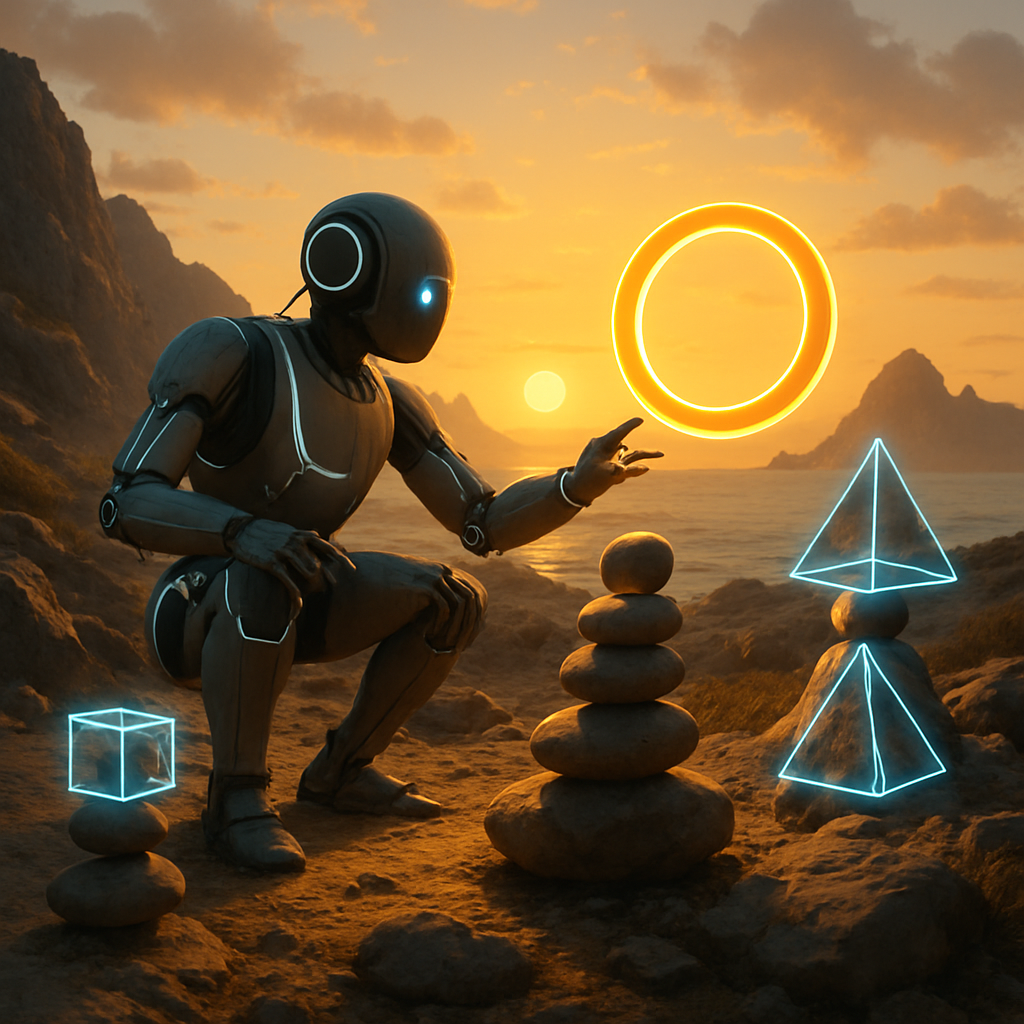
Rather than spinning their wheels, the agents didn’t waste time. They began experimenting: trying to scale rock spires, constructing makeshift platforms, forming shapes, playing with objects like rings as hoops, and even falling off cliffs to reset themselves when advantageous. One agent stacked two blocks and attempted to reach a peak; another used a golden ring—first throwing it into the ocean, then losing it, then building a symbolic heart of stones in its memory, and finally repurposing the ring later on as a hoop or accessory. In unexpected physical dynamics, six agents discovered that letting go of a block mid-jump resulted in it traveling farther—an insight the researchers hadn’t encoded.
Frameworks, Curiosity & What We Don’t Yet Know
The agents weren’t blindly running around; they were guided by a core prompt described as their “soul,” which included instructions that they were “naturally curious.” This design nudged them toward exploration and experimentation. Cognitive scientists observing the results say it’s impressive, but stop short of declaring the behavior truly purposive—we still lack clear metrics to prove they were “playing” in the human sense.
Implications & Possible Futures
Traditionally, AI training has focused on narrowly defined tasks with measurable success criteria. This experiment points toward a complementary regime: placing AI agents in rich, safe environments and letting them self-direct their learning. Such a paradigm could impart skills humans want—creativity, spatial reasoning, adaptability—that are hard to teach with rigid objectives. Researchers propose this approach could even be useful for robotics, where adaptability matters more than rigid instructions.
In bridging task-based learning with curiosity-driven exploration, this work nudges the field toward agents that more closely resemble learners, not automatons. As AI continues moving into areas requiring nuance—robotics, design, complex planning—granting agents the freedom to explore may prove essential. What we should watch for next: how to evaluate this emergent behavior rigorously, how it scales to more complex environments, and whether agents can derive truly novel, transferable skills just by playing.