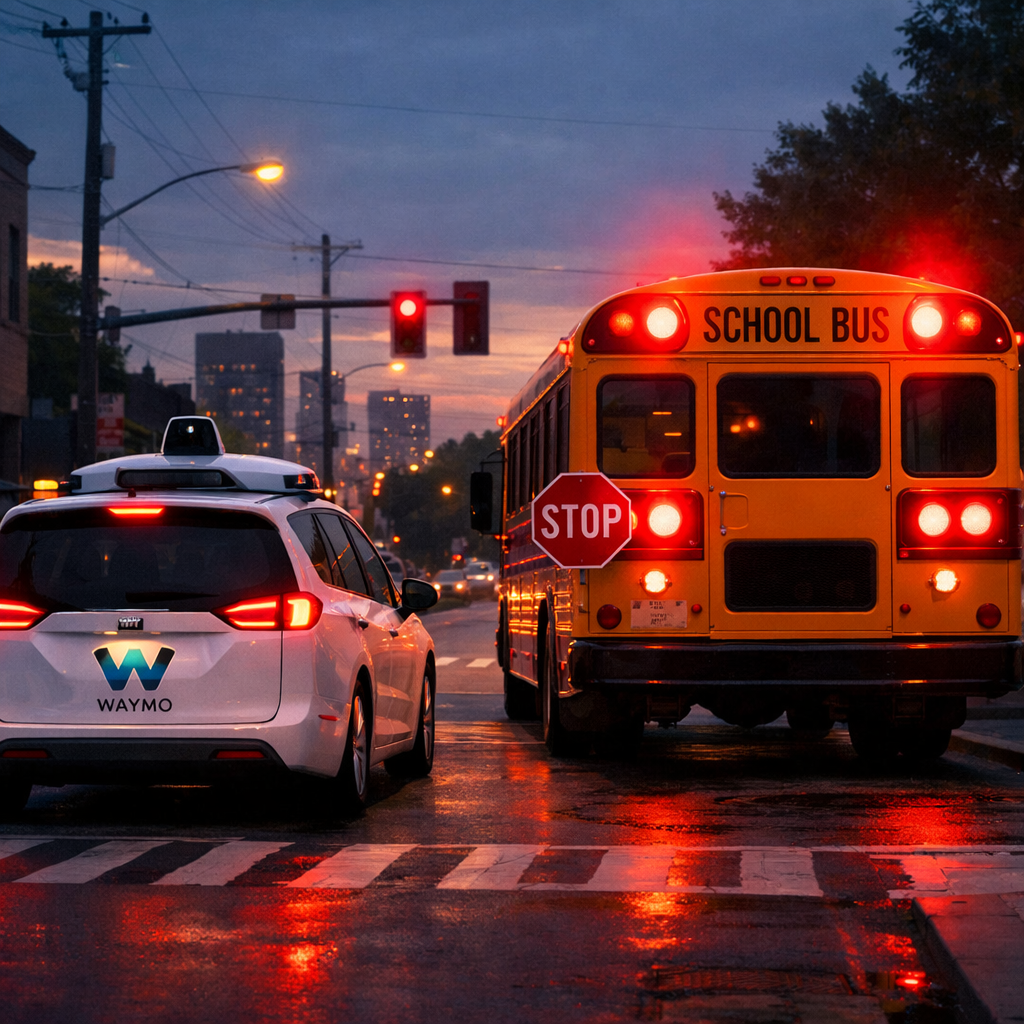
Waymo’s robotaxi service is once again under federal scrutiny after reports show its vehicles are still illegally passing stopped school buses despite a software patch meant to fix that exact issue. The National Highway Traffic Safety Administration (NHTSA) has confirmed it is investigating the matter after receiving new safety complaints.
Update Didn’t Eliminate the Hazard
The incident that triggered this probe dates back to October 2025, when dashcam or bystander video in Atlanta showed a Waymo robotaxi moving around a school bus that had extended stop signs and flashing red lights. The autonomous vehicle crossed in front of the bus after initially passing the right side, then circled around to continue down the street. That led NHTSA’s Office of Defects Investigation (ODI) to open an initial safety review.
Around the same time, complaints emerged from Austin, Texas, where at least five separate instances of Waymo robotaxis failing to stop correctly for school buses were reported in communications between the city school district and federal regulators.
Software Fix Rolled Out — But Isn’t Stopping All Violations
Waymo acknowledged an issue and released a software update for its robotaxis on November 17, 2025. The fix was intended to prevent its autonomous vehicles from passing a stopped school bus displaying flashing red lights. However, NHTSA now reports that most of the recent violations happened after that update — suggesting the remedy may not be working as intended.
Because of the ongoing reports, NHTSA has elevated its investigation into a “recall query.” That means regulators are assessing whether the software fix Waymo provided is sufficient or whether more action — up to a recall — should be required.
Waymo, and officials in Austin’s school system, have been contacted for comment but have not issued public responses yet.
Why This Matters
Self-driving cars are held to high safety and legal standards. In almost every U.S. state, law requires vehicles to stop when a school bus engages flashing red lights to pick up or drop off passengers. Failure to comply isn’t just a legal violation — it endangers children’s safety. Autonomous systems carry added scrutiny because software, sensors, and decision-making systems must correctly recognize and respond to school bus signals.
This issue underscores the difficulty of programming AV (autonomous vehicle) systems to adhere to rules that depend on context — in this case, the visual appearance of lights and stop signs, often under unpredictable environments. A failure here could damage trust in robotaxis, affect regulatory approvals, and raise liability issues.
The ongoing concern from NHTSA also signals that even after fixes are applied, recurring problems demand transparency and iteration. Regulators will want to see logs, test data, and field performance metrics showing that AVs behave correctly in every scenario — including edge cases where buses display partial signals or in low visibility.
What’s Next
The recall query doesn’t automatically mean a full recall will be ordered. It’s an inquiry to judge whether more aggressive corrective action is needed. Possible outcomes include a revised software patch, more stringent operational restrictions, or ultimately a mandated recall.
Lawmakers and regulatory bodies have their eyes on this. If AV providers can’t guarantee compliance with basic traffic laws — especially involving children — public trust and regulatory momentum could stall. This is a crucial test for Waymo and for the broader autonomous vehicle industry.
This episode is a reminder: technological fixes aren’t the end of the journey. They must be tested, proven, and re-verified — especially when it comes to safety and protecting the most vulnerable.