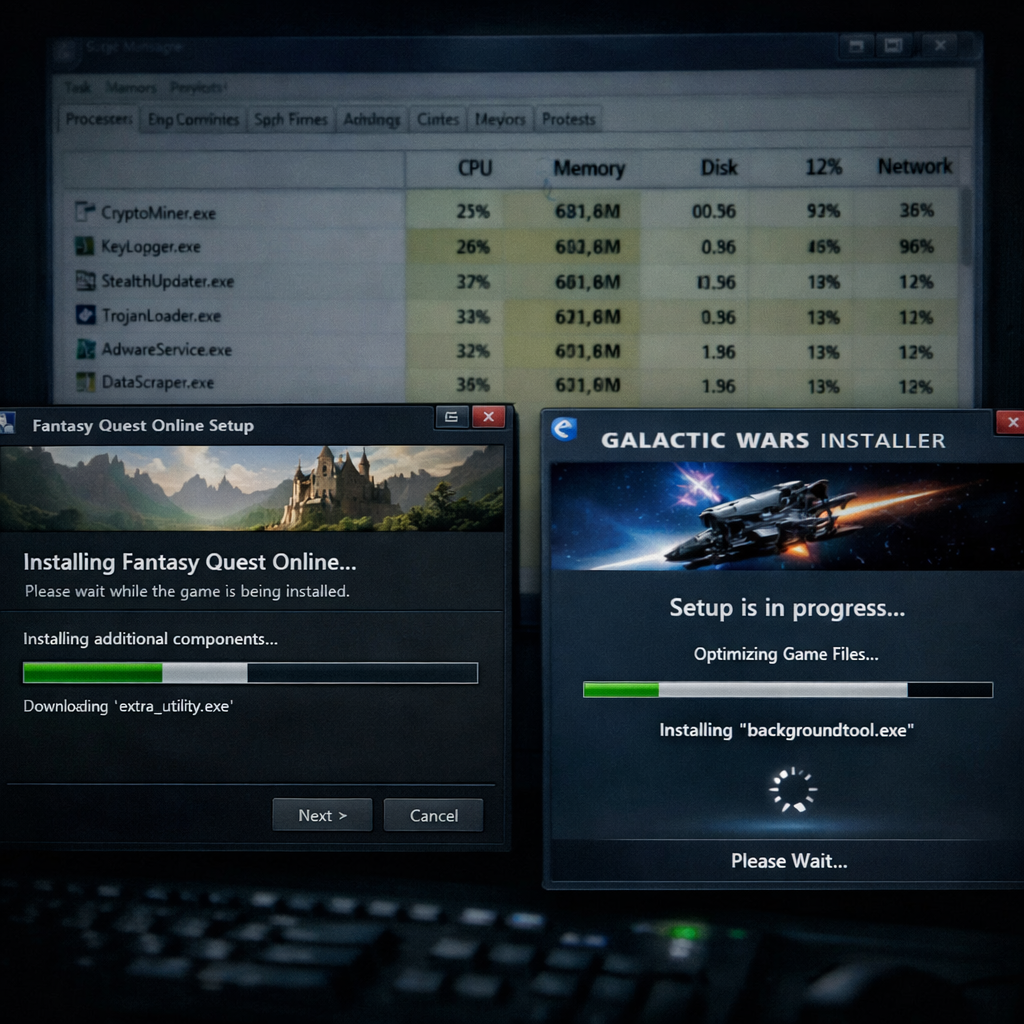
Microsoft has uncovered a widespread campaign wherein fake game installers and cracked software bundles are covertly turning Windows PCs into profit centers for operators—without user awareness. The malicious packages often disguise themselves as games, utility tools, audio plugins, or activators. Rather than stealing credentials, their primary goal is to misuse system resources and network bandwidth. The finding comes from a technical report released November 3 by Microsoft’s Threat Intelligence team.
How the Deception Works
The campaign begins when users download what appears to be a legitimate game or utility. Installers labeled as Roblox executors, auto-clickers, driver tools or cracked applications are being used to lure victims. Upon execution, a multi-stage process kicks off: first a temporary setup component via Inno Setup, then successive executable stages that install hidden software and payloads. Each “offer” within the bundle represents a downstream component, tracked individually. Even if one offer fails, others may succeed—making detecting and stopping the threat more complex.
Three Hidden Branches
Investigators identified three primary malicious branches. The first, called WorldProxyPool, covertly turns compromised PCs into proxy servers—routing third-party traffic through them. Persistent scheduled tasks auto-launch system agents; scripts often run with SYSTEM privileges via hidden PowerShell watchdogs.
The second branch installs distributed computing tools like CharityEngine and BOINC (along with virtualization tools like VirtualBox). While this isn’t categorized as cryptomining, it forces hardware to work for someone else’s gain. The third branch installs Advanced Windows Manager or similar utilities, often slipping in via unattended installations that bypass visible notifications. Together, these installations create persistent, unwanted software footprints and ongoing background processes.
Signs to Spot & Steps to Protect
Microsoft advises steering clear of cracked software, third-party game installers, and activation tools. Key safeguards include enabling cloud-delivered protection, enabling tamper protection, and using reputation-based controls. Organizations are urged to regularly audit their software inventory to detect unauthorized or unexpected installations.
Indicators of compromise listed include specific domains like beliefdesk[.]xyz and companyharbor[.]xyz tied to offer callbacks, file paths under %TEMP% with suspicious executables, scheduled tasks titled “WorldProxyPoolAgent” among others, and SHA-256 hashes associated with payload runners. Tracking network behavior and new tasks or unexpected software provides further clues.
These techniques are less about flashy malware and more about subtle, persistent exploitation—running unwanted services or background processes that eat resources, compromise performance, or reroute bandwidth.
Often such software is dismissed as merely “annoying,” despite its potential for serious misuse. This effort shows how threat actors evolve—when credential theft becomes riskier, resource misuse takes center stage. Microsoft’s findings underscore the importance of informed consent, vigilant oversight, and defensive deployment for individuals and businesses alike. Threat intelligence should be a regular function—not just after something breaks.