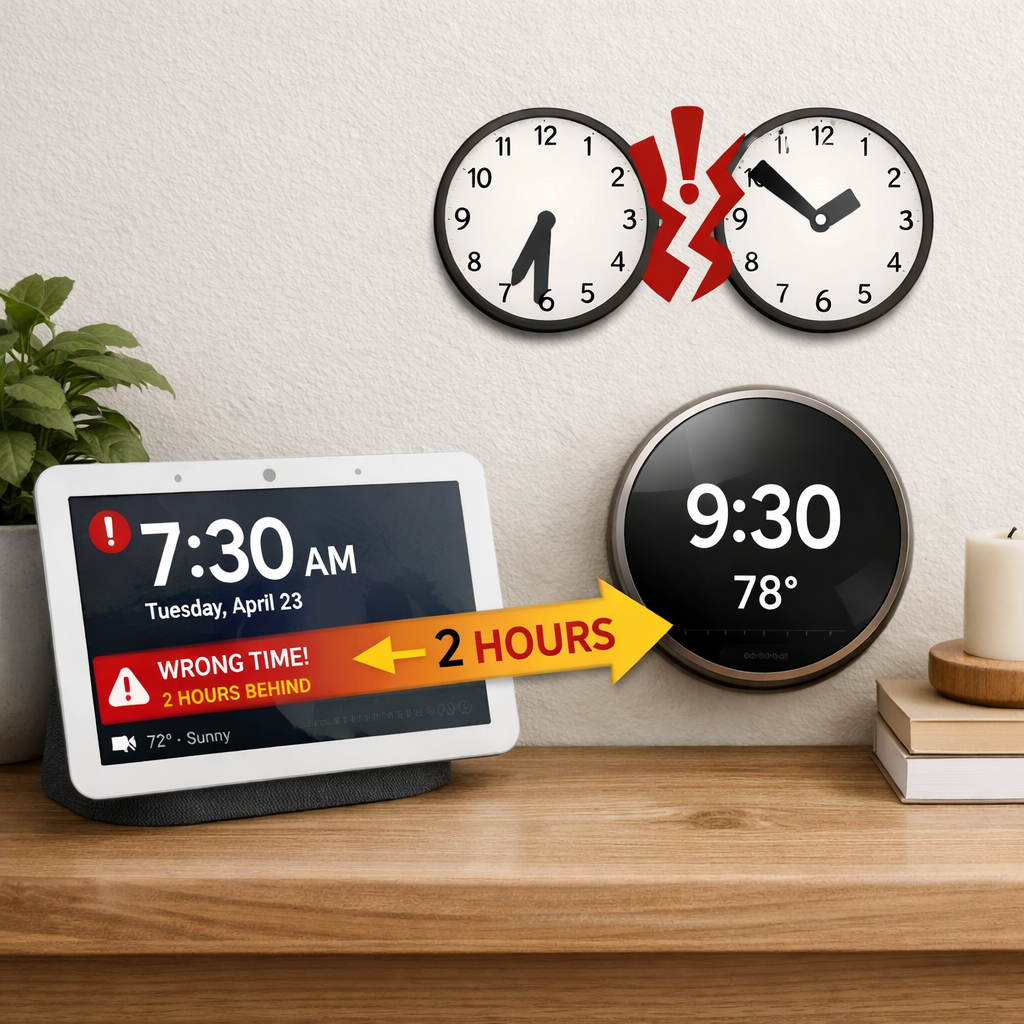
Users in certain Canadian provinces have found that their Nest Hubs, Thermostats, and other Nest devices failed to adjust following recent local changes to Daylight Savings Time. The issue has had knock-on effects: alarms going off late, automations misfiring or failing, and schedules showing incorrect times.
Reports began circulating this week from people in parts of Canada where provincial policy was altered so some regions now observe Daylight Savings while others do not. Devices that rely on consistent time-zone behavior, such as Nest Hub or Nest Thermostat units, have displayed the wrong clock setting once the change took effect.
What Went Wrong and Why
The root of the problem is that Nest devices did not correctly adapt to the updated Daylight Savings rules in certain provinces. Unlike smartphones, which often receive automatic time-zone updates, Nest hardware appears less adept at responding to changes embedded in local legislation. Because some provinces dropped observance and others maintained it, the discrepancy has resulted in time drift across regions.
Affected users have detailed real-life consequences: alarms triggered at incorrect times, smart home routines that depend on accurate scheduling breaking down, and automated thermostat behavior or reminders scheduled at offsets that no longer align with local time. Even display clocks on Nest Hubs are off in some regions.
What Google Is Doing Now
Google has acknowledged that a “small subset of devices in some provinces in Canada where daylight savings is no longer observed” are impacted. The time discrepancy issue is being actively addressed. A fix is being developed and is expected to arrive via software updates.
Although the official notice confirms Google’s awareness, as of November 4, no patch has yet been released for end users. Multiple threads on Reddit show that Google has responded to some affected users, promising that a resolution is forthcoming.
Tips from Google previously guided users of Android phones on how to adapt to the provincial changes; however, Nest devices weren’t covered by those instructions—leaving many homeowners and smart-home users in limbo, especially given the device’s deeper integration with home automation.
What you can do until the permanent fix: Keep an eye out for a firmware or software update for your specific Nest device. You may also manually set time settings where possible, or disable any automations dependent on local time until the issue is resolved.
This problem underscores broader challenges smart devices face when local laws and regulations affecting time observance shift. For connected home systems designed on the assumption of static regional behavior, sudden changes in daylight savings observance reveal vulnerabilities in automatic adjustment systems. As more regions reconsider their time observance rules, manufacturers will need to build more flexible mechanisms into their firmware to adapt automatically to regulatory changes.