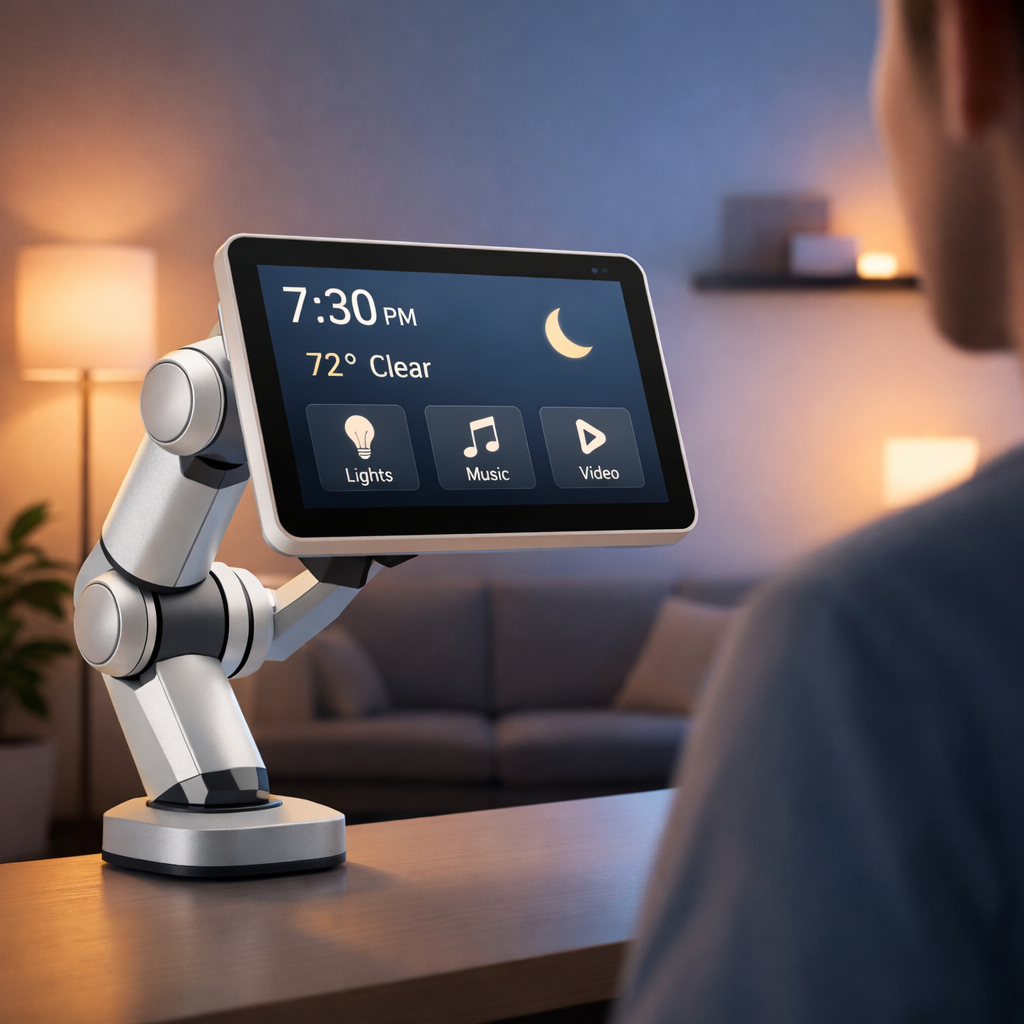
Apple is reportedly developing an upgraded version of its recently announced HomeView smart home hub, tentatively dubbed “HomeView Ultra” or “HomeView Max.” The prototype features a 9-inch screen mounted on a motorized, swiveling arm that provides 360-degree rotation—designed to orient the display toward whoever is interacting with it. While Apple has not confirmed the name or final specs, the larger, autonomous HomeView is expected to arrive in either 2027 or 2028 at a premium price point around $1,000 in the U.S.
What We Know So Far
The current generation HomeView features a 7-inch square display fixed above a speaker base, offering smart home control, Siri AI, FaceTime, and environmental awareness. Though only released in late 2026, a high-end version is already in internal testing. That device breaks from the static design by adapting to the user’s presence: the robotic arm allows the screen to turn automatically based on voice recognition, swiveling fully around the base to avoid forcing anyone to manually adjust it.
According to reports, Apple has had hardware largely finalized for approximately two years. However, there remain divisions internally over which features should be included in the first version versus held off until a second. Among the disputed items are some software features.
Release Timing & Pricing
Apple is aiming for the larger HomeView to arrive sometime during 2027, though some sources believe that delays could push the launch into 2028. In terms of pricing, early indicators suggest a U.S. launch cost of around $1,000—significantly higher than the $299 sticker on the 7-inch model.
During development, Apple has explored other ambitious robotic home devices: some concepts included a rolling base that follows a user, an interior flying robot, and even a self-folding laundry machine. None of these are confirmed to be moving forward beyond prototype stages.
How This Fits with Apple’s Smart Home Strategy
Apple’s current HomeView joins its growing HomeKit ecosystem, operating both tabletop and wall-mounted versions with Siri AI, face recognition for personalized context, native smart home controls, messaging, calendars and more in a privacy-focused hub. The new Ultra/Max model appears to be building on that foundation: integrating more fluid interaction, dynamic positioning, and more immersive presence.
These developments suggest Apple views smart home hubs as not just stationary devices, but interactive companions. By combining robotics with AI and environmental awareness, the HomeView Ultra could raise expectations and pressure for competitor devices to match both motion and intelligence.
Analysts and enthusiasts should watch closely for how well the arm handles real-world conditions—avoiding obstacles, moving smoothly and quietly, handling voice tracking accurately—and whether Apple manages to deliver the promised features without sacrificing reliability or privacy. Pricing will also be key: the premium asks, if justified by performance, will define whether the Ultra is a luxury niche or a mainstream smart home upgrade. This could be the first widely adopted robot-empowered smart home screen.