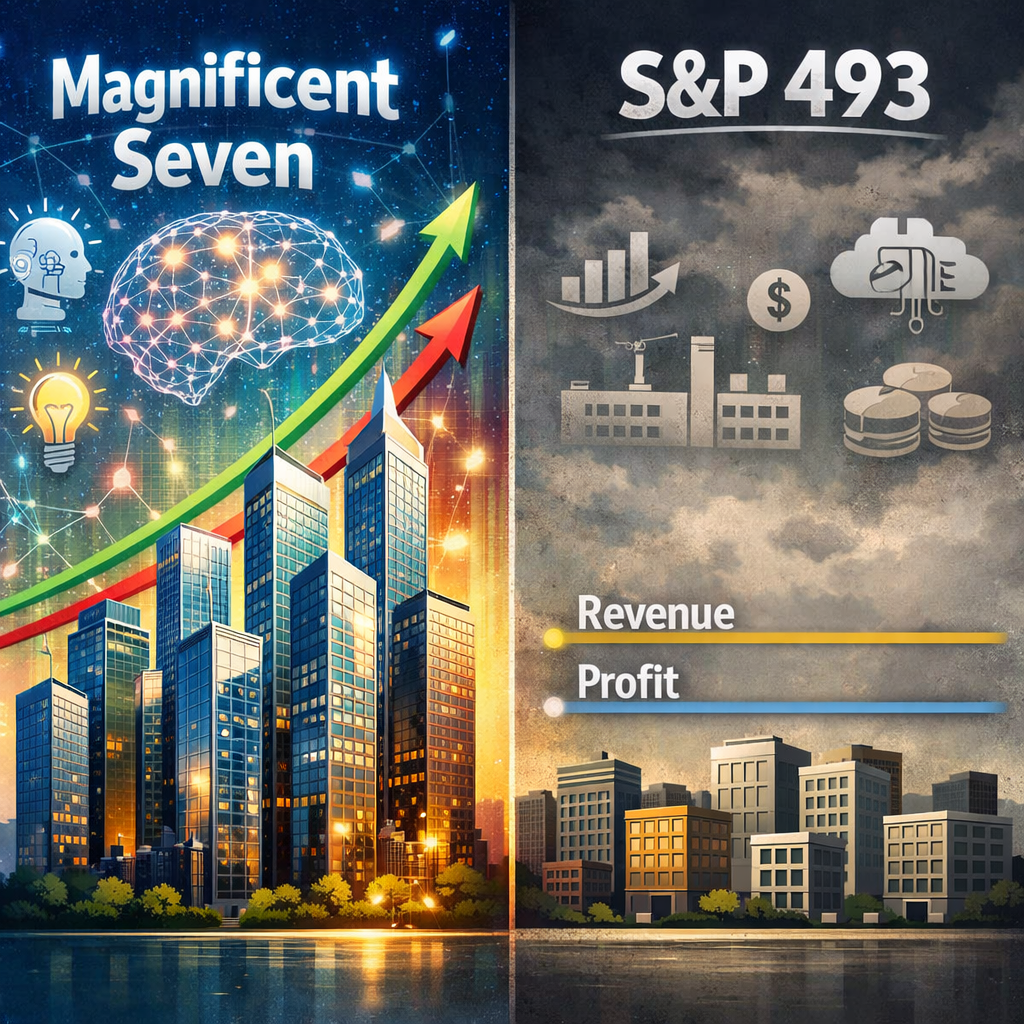
Despite the widespread adoption and investment in artificial intelligence, most U.S. companies outside of the biggest tech names are yet to see financial returns, according to a recent analysis by Apollo Global Management’s chief economist. The report highlights that while tech giants are posting growth in both revenue per worker and profit margins, these gains are not materializing for the majority of firms in the S&P 500.
Separating the “Magnificent Seven” from Everyone Else
The analysis excludes seven powerhouse tech companies—Alphabet, Amazon, Apple, Meta, Microsoft, Nvidia, and Tesla—and examines the remaining 493 public companies in the S&P 500. These non-tech companies are broadly spread across sectors such as finance, healthcare, retail, manufacturing, energy, and more. Despite heavy investment in AI tools and systems, their profit margins and worker productivity remain essentially flat. Apollo’s chief economist finds no evidence so far that AI has lifted revenues or earnings beyond noise levels in these industries. Meanwhile, the “Magnificent Seven” continue to benefit, showing measurable growth in both metrics tied closely to AI usage.
Why the AI Investment Isn’t Paying Off More Broadly
One insight from the report is that outside tech, AI spending is starting to look like a cost rather than an investment—companies are spending heavily on infrastructure, cloud services, software licensing, and internal experimentation, but the expected return hasn’t shown up in financial statements. Issues such as high input costs, regulatory burdens, and slow-moving sectors with complex operations—like healthcare, energy, and manufacturing—are cited as major challenges.
The economist argues that while AI can perform calculations and automate routine tasks, it lacks the capacity for judgment—handling accountability, culture, ethics, trust, and fairness—all of which influence reputation, long-term revenue, and profit growth. These softer factors are proving difficult to quantify or monetize quickly.
Complementing Apollo’s findings are recent academic and industry studies showing similar trends: AI has delivered only modest gains in individual productivity, but these have yet to translate into broader corporate performance boosts. Surveys of workers report time saved, but metrics like output, profitability, and wages haven’t budged significantly in many cases.
If AI doesn’t deliver expected gains soon, valuation risk looms large for many companies. The market’s assumptions often reflect bullish expectations of rapid AI-driven growth. However, if it takes years—not months—for firms outside of tech to realize meaningful returns, those expectations might be due for a reckoning.
The core takeaway: massive hype and capital inflows don’t equal widespread financial gains—at least, not yet. For many businesses, the AI era remains one of potential, not profits.