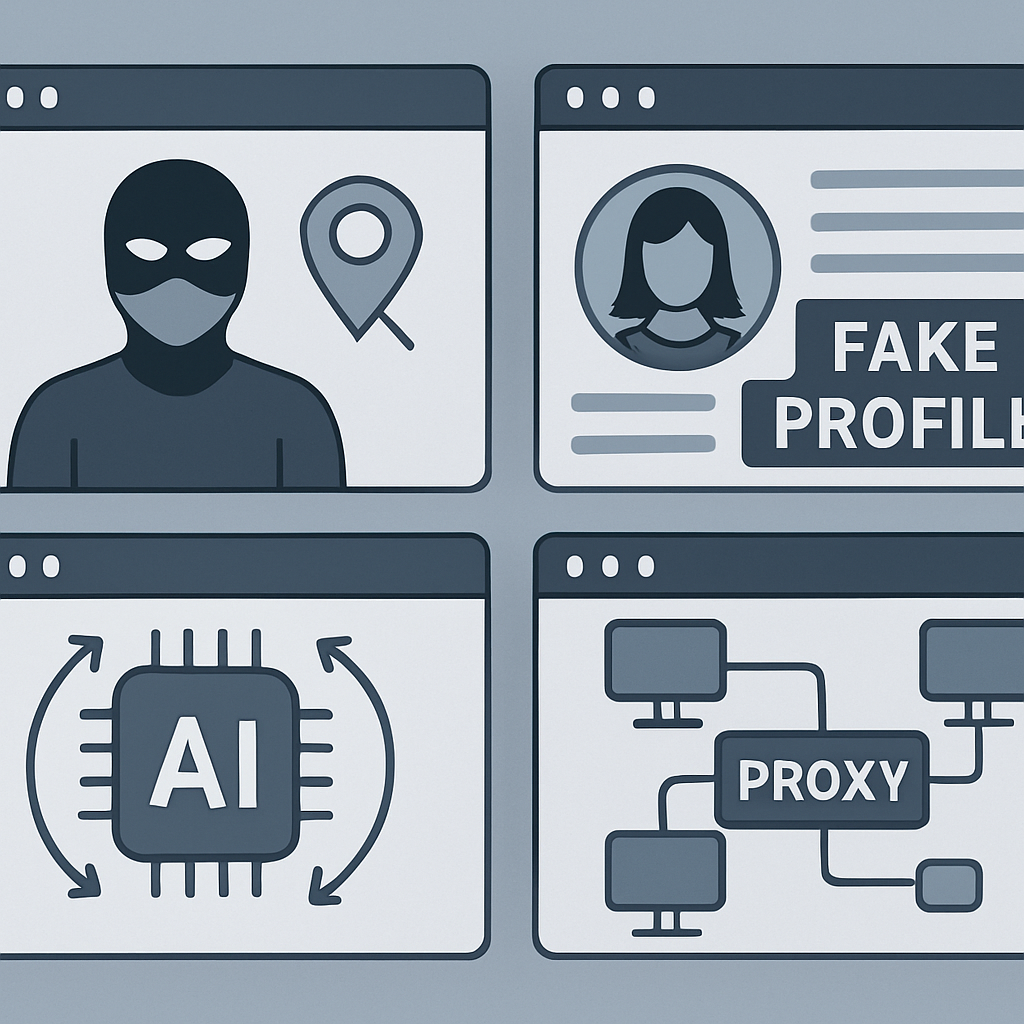
Cybercrime actors are increasingly relying on AI-enhanced “antidetect” browsers to run massive networks of fake online identities that appear to come from distinct people, devices, or geographies. A recent report from Check Point Research outlines how tools like Kameleo, AdsPower, and MultiLogin enable single operators or small teams to deploy thousands of accounts across social media platforms while evading detection systems. It warns that this automation doesn’t require custom malware—standard commercial software, when misused, becomes a powerful evasion tool.
How Antidetect Browsers Obscure Fingerprints
Websites commonly gather device and browser data—elements like screen size, language, timezone, and graphics settings—to build digital fingerprints and detect suspicious activity. Antidetect browsers mask or randomize these details, making it much harder for systems to link accounts to one another. They separate browser profiles’ cookies, local storage, and session info, and often route traffic through proxies to simulate multiple locations. Such features complicate conventional checks based on IP or device identifiers.
AI and Automation: Fueling Rapid Scale
Most of the tools flagged by Check Point combine profile isolation with AI capabilities and heavily automated workflows. For example, AdsPower supports server-side integration with large language model tools, enabling auto-generation of content for account activity. Templates help simulate profile history—“warming” new accounts to appear established. Pairing these with identity masking means that large-scale misuse may delay detection until fraud, phishing, or other types of abuse are already underway.
Antidetect browsers are linked with a broad spectrum of abuse: fraudulent payments, fake loan applications, advertising fraud, phishing campaigns, malware distribution, account takeover, and even coordinated influence operations. Of particular alarm is when attackers gain stolen session cookies—these can allow access without additional credential checks. Once injected into a profile, stolen sessions make compromised accounts blend in as though nothing was amiss.
What Defenders Can Do
Detecting abuse demands more than looking at account behavior alone. Security teams are urged to monitor infrastructure-level signals: high volumes of residential proxy activity, sudden or frequent changes in device fingerprints, cookie injection or reuse indicators, and prolonged use of authenticated sessions from unexpected devices or networks. Organizations should ensure session monitoring is granular and capable of flagging irregular access, even without new logins.
When an account is confirmed compromised, invalidating active sessions is a critical response—even if no password was changed. Defenders must link signals across devices, networks, and accounts, rather than relying on single indicators like session login attempts or IP discrepancies. Although antidetect browsers aren’t inherently malicious, their tools are being repurposed by bad actors, making traditional defenses insufficient.
Signs of compromise include large scale use of residential proxies, unusual browser fingerprint shifts, and suspicious patterns related to session-cookie reuse or pre-authenticated sessions. These should be treated as potential leads rather than definitive proof; forensics and behavioral analytics play a key role.
It’s become clear that threat actors are on pace to exploit legitimate tools in highly coordinated schemes. As AI, automation, and browser fingerprinting evasion continue to evolve, defenders must broaden their lens. Monitoring infrastructure signals and session behavior across accounts will be vital. Moving forward, expect platforms and organizations to invest more heavily in detection systems that can spot hidden connections—because the best disguise might just be distributed indicators across many profiles.