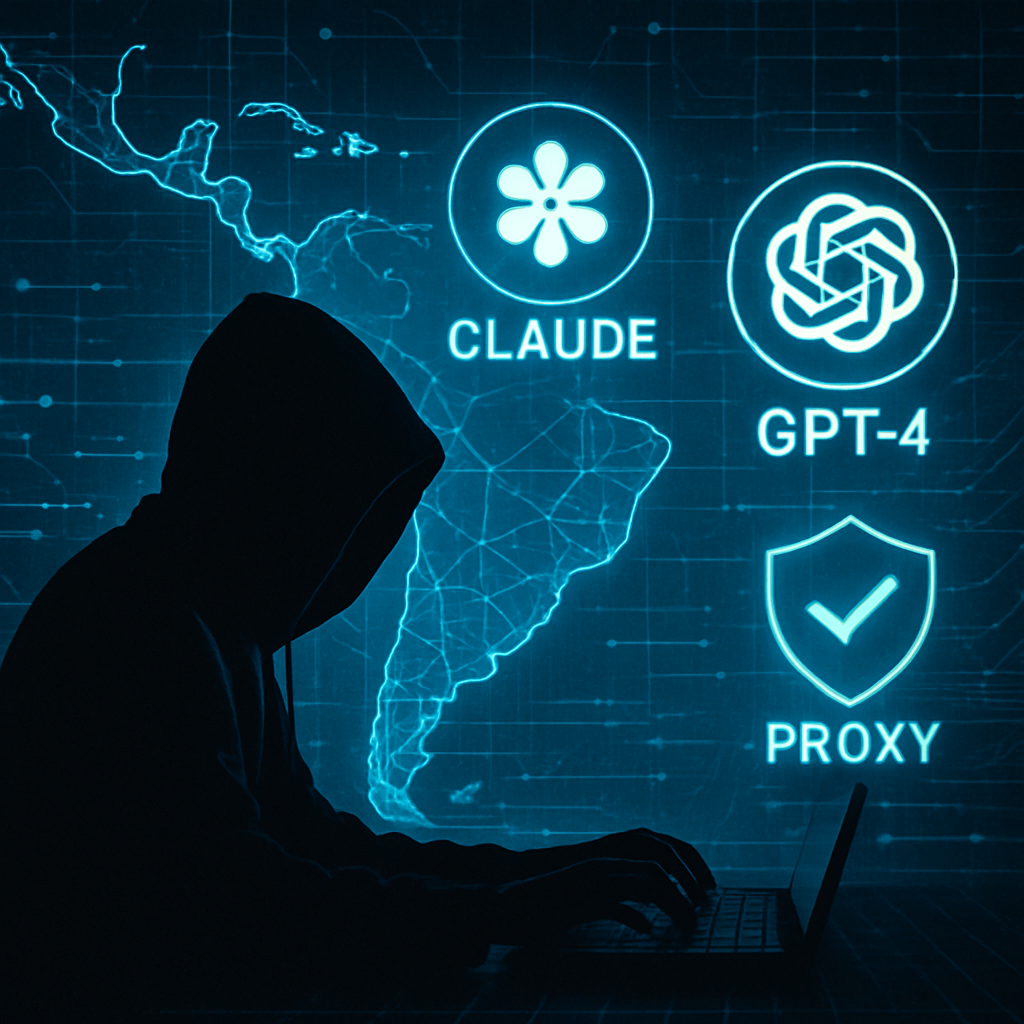
Recent investigations reveal hackers are using advanced AI models like Claude and GPT-4.1 to accelerate cyber intrusions in government, financial, and infrastructure networks across Latin America. These operations don’t rely solely on novel malware—they combine conventional techniques with AI-assisted scripting and troubleshooting.
Security analysts uncovered two related threat clusters, dubbed CL-CRI-1131 and CL-CRI-1163. Both share SOCKS5 relay infrastructure and a common modus operandi: deploying large language models to refine attack tools and maintain momentum when their initial commands fail. Among their targets are federal ministries, transportation agencies, municipal water utilities in Mexico and Ecuador, and financial institutions in Brazil.
How AI Is Making Attackers More Efficient
In one instance, attackers attempting to access Windows data pivoted to creating volume shadow copies and using batch scripts when direct data access was blocked. Their trial-and-error loop was sped up with models like Claude and GPT-4.1, made accessible through a self-hosted NextChat interface. The AI tools helped modify scripts, manage permission hurdles, and adjust their tactics dynamically once they’d gained a foothold.
In Brazil, the group launched a phishing campaign disguised as job applications, later deploying custom remote access trojans and installing multiple versions of a SOCKS5 tunneling tool called SockTz. A key strategy was compromising a WordPress site before migrating to their own infrastructure to host malicious payloads. The rapid updates—nine versions of SockTz in just hours—suggest AI-assisted development, though not every file was necessarily AI-generated.
Detection, Disruption & Defense
Defenders are being advised to look beyond phishing emails and file attachments. Security teams should scrutinize what happens after a link is clicked or a file is opened—monitoring execution failures, script behavior, and proxy patterns. Interestingly, some AI staging systems and admin servers were exposed publicly, offering visibility into prompt histories, target lists, and script repositories.
Indicators of compromise include specific IPs, domains, TLS certificates, and file-hashes tied to these campaigns. Organizations impacted should patch internet-facing web servers, restrict access to directories used for staging, block suspicious resume-themed attachments, and monitor for remote shells, proxy traffic, and unusual outbound connections. Strong network monitoring, access controls, and vigilant email filtering remain essential, especially as AI tools empower cyber adversaries to automate repetitive tasks.
The broader lesson: while AI doesn’t yet replace the human threat actor, it’s a force multiplier. When it comes to campaign infrastructure—with misconfigured servers, exposed directories, and shared certificates—defenders often have the upper hand. If leveraged properly, those oversights can betray entire operations.