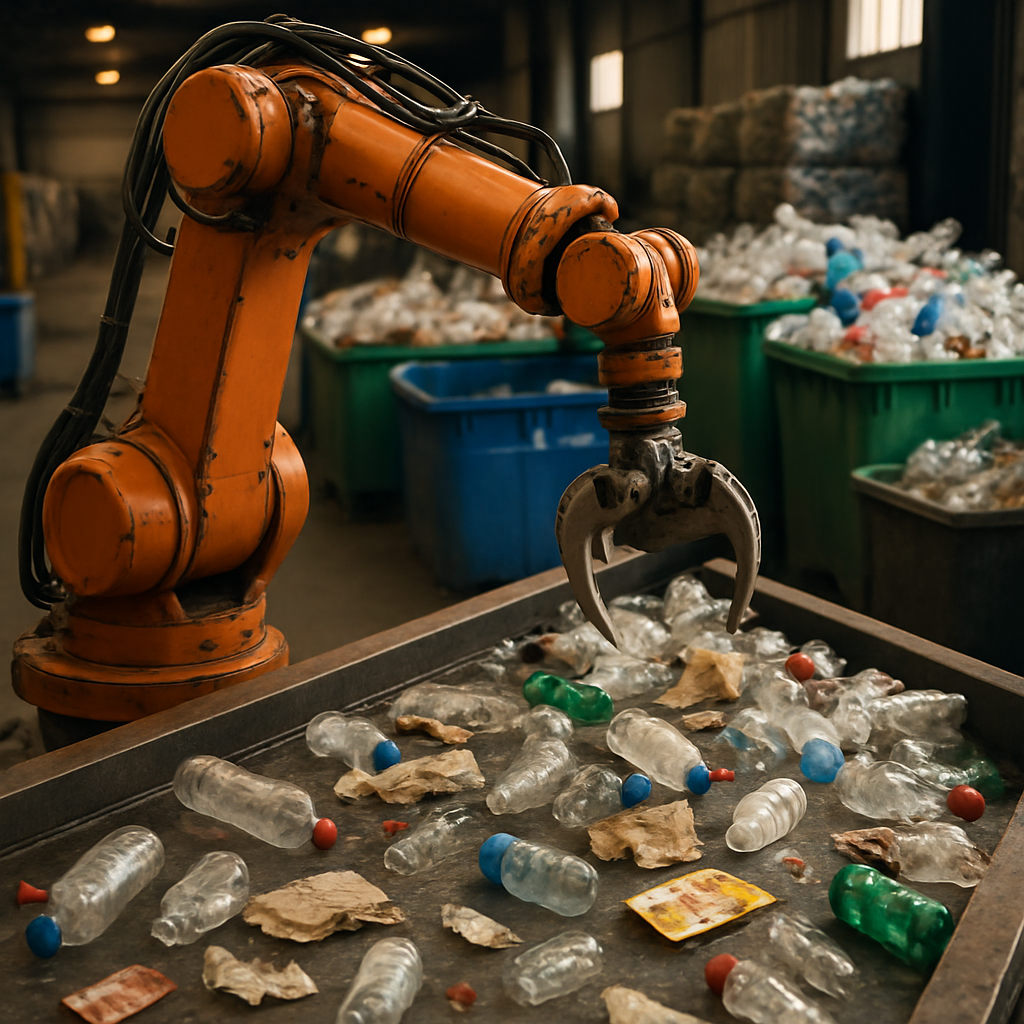
Danu Robotics, based in Edinburgh and founded by engineer and environmental advocate Amy Ma, is on a mission to overhaul the recycling industry’s reliance on costly and error-prone manual sorting. Frustrated by seeing all types of recycling matter tossed into the same landfill despite being separated at the source, Ma set out years ago to create a smarter, more efficient solution. After six years of development, Danu has begun rolling out its first commercially viable robot, dubbed H.E.R.O. (High-performance, Environmentally friendly, Reconfigurable Operator).“
A New Take on Waste Picking with Artificial Intelligence and Novel Hardware
Unlike many current systems that use suction-based grippers, H.E.R.O. instead uses a pincer-type claw to pick up recyclable items. The system couples that hardware choice with continuously learning AI and computer vision software, allowing it to improve through field data. It’s designed to identify materials, measure success at the bin rather than just at the robotic gripper, and monitor both performance and material outputs. The robot is also built for low energy consumption and recyclability: around 90% of its hardware components are recyclable, and its “plug-and-play” design is meant to retrofit into existing sorting lines with minimal disruption. Series 2 models require under one meter of conveyor length, enabling deployments in facilities with limited space.
Danu already has footholds in the market. It has received signed contracts worth $500,000, and over 200 customers have expressed interest in its technology. The market it targets—recycling sorting across North America and Europe—is valued at approximately $20 billion in potential. According to internal projections, a single site using H.E.R.O. could generate $485,000 in additional annual revenue, offsetting an initial investment of $160,000 and yearly upkeep costs around $24,000. That cost-benefit profile is pitched as substantially cheaper than many current robotic recycling systems.
Funding, Growth, and Strategic Moves
To capitalize on growing traction, Danu has secured $5 million in late-seed capital to scale its production and deployment efforts. The funding will go toward making the robot sturdier, more compact, and versatile. One of the goals is to shrink H.E.R.O. enough to be used outside of traditional waste facilities—such as in airports, hospitals, shopping malls, and at large events—allowing more localized sorting at the point of waste generation.
While competitors like Glacier and RecycleEye already ship suction-based systems, Danu’s thesis is that its AI-driven improvements plus hardware innovations offer both cost savings and performance gains. Lower capital expenditures and maintenance combined with strong revenue upside make the offer more attractive to potential customers who currently rely heavily on manual labor to sort recyclables.
Why this matters: Waste sorting today still depends heavily on human labor and inefficient systems. Robotic automation promises not only speed and scale, but also the possibility of more accurate recycling—less contamination, better recovery of materials, and reduced landfill loads. For Danu, shrinking and simplifying its system could open new use cases and help build out a recycling infrastructure that works closer to where waste is generated. Watching how the robot performs at scale, how maintenance holds up, and whether it truly achieves lower cost of ownership will be key indicators for whether this will be a turning point for recycling robotics.