A Mac App Store app called AI Chatbot- Chat Ask Assistant uses a near-copy of OpenAI’s logo and puts “ChatGPT” in its subtitle. It is not made by OpenAI, and it sells plans of up to $159.99. The same developer account runs two more overlapping chatbot apps, and none of the three is registered as a trader under the EU Digital Services Act.
An OpenAI-style icon and a ChatGPT subtitle
The icon of AI Chatbot- Chat Ask Assistant is a black, six-lobed interlocking knot. It is a near-copy of the “Blossom” logo on the official ChatGPT app, redrawn with heavier lines.
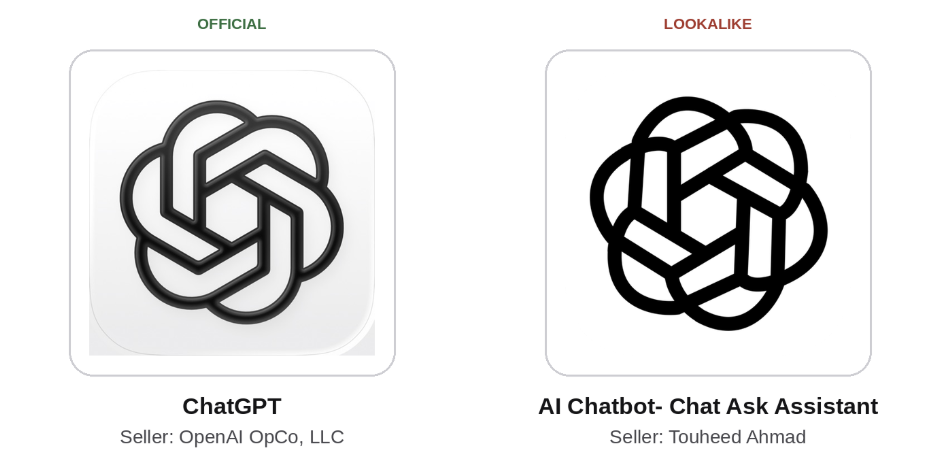
The subtitle reads “Powered by ChatGPT,gpt 5,4 API”. The description promises “the trusted intelligence behind ChatGPT”.
The listing names the seller as Touheed Ahmad, not OpenAI. A disclaimer in the second paragraph of the description says the app “IS NOT THE OFFICIAL OPENAI CHATGPT APPLICATION” and “IS NOT ENDORSED OR DEVELOPED BY OPENAI”.
Free to download, “fully paid” to use
The listing is labelled “Free · In-App Purchases”. The developer’s own description calls it “a fully paid app” in which “Only the OCR tool is free”, after two free trials.
In the US the plans are $5.99 a week, $12.99 or $13.99 a month, $34.99 or $49.99 a year, and $159.99 for “Life Time IAPs”. On the Irish App Store they run from €6.99 a week to €179.99.
Billed weekly, the app costs $311.48 a year. ChatGPT Plus, a monthly plan, is listed at $19.99 in the official iPhone app, which is $239.88 a year, and ChatGPT also has a free tier.
Security firm Sophos calls this model “fleeceware”: apps that overcharge for functions available free elsewhere. In May 2023 it reported a ChatGPT-themed app charging $6 a week, or $312 a year. This app’s weekly plan sits at the same price point.
What OpenAI’s brand rules say
OpenAI’s brand guidelines say the OpenAI logo and the “ChatGPT” and “GPT” brands are its property. Developers who use its API “may choose to reference a specific model”, provided they are “precise and accurate”.
The guidelines’ list of don’ts includes:
- “Incorporate the logo into your own branding, trademark, or design a similar logo.”
- “Misrepresent your relationship with OpenAI, imply endorsement, or confuse users about sponsorship.”
The usage terms on the same page add: “Do not feature our Marks more prominently than your own company’s name or marks.” They also say: “We do not permit model names in app titles because there is concern that it confuses end users.”
In our reading, the icon is the clearest breach: it is a similar logo. The subtitle is a closer call, because OpenAI lets API customers name the model they use but bars model names in app titles. The listing also has no brand of its own to put first: its name is generic, and its distinctive marks are OpenAI’s.
Apple’s copycat rule
Apple’s App Review Guidelines, last updated on 8 June 2026, cover the same ground. Guideline 4.1(c), added in November 2025, reads: “You cannot use another developer’s icon, brand, or product name in your app’s icon or name, without approval from the developer.”
Guideline 2.3.7 tells developers not to pack metadata with “trademarked terms” or “popular app names”, and says subtitles should not “reference other apps”. Guideline 5.2.1 bars the use of “protected third-party material such as trademarks” without permission.
The listing’s own disclaimer says OpenAI does not endorse the app. Apple says it rejected over 371,000 submissions in 2025 that copied other apps, were spam or misled users. This one is still on sale: its version history shows 15 releases since 26 February 2025, the latest on 19 July 2026.
One developer, three chatbot apps
The same developer account sells three chatbot apps, each with its own listing, bundle ID and subscription plans. The table lists them, newest first.
| App | Subtitle | Runs on | First released | US price, weekly to lifetime |
|---|---|---|---|---|
| AI Chat bot for Unlimited Chat | Powered by & Built on Top AI | Mac | 10 Mar 2025 | $5.99 to $79.99 |
| AI Chatbot- Chat Ask Assistant | Powered by ChatGPT,gpt 5,4 API | Mac | 26 Feb 2025 | $5.99 to $159.99 |
| Ask AI Chatbot Assistant: Chat | Built on Top ChatGPT Model API | iPhone, iPad, Mac | 17 Sep 2024 | $3.99 to $79.99 |
Guideline 4.3(a), Apple’s spam rule, tells developers not to “create multiple Bundle IDs of the same app”. Guideline 4.3(b) adds: “Opportunistically creating variants of existing app categories or popular apps degrades App Store discovery, reduces overall app quality, and harms both users and developers.”
The three apps are not identical. The oldest also runs on iPhone and iPad, and the newest uses DeepSeek’s API instead of OpenAI’s, according to its description.
But all three are subscription chatbots from one seller, with overlapping features and names built from the same few words. In our view that is the duplication Guideline 4.3 targets. The decision is Apple’s.
“Not a trader”: what EU buyers lose
On the Irish App Store, all three listings carry the same notice from Apple: “Touheed Ahmad has not identified itself as a trader for this app. If you are a consumer in the European Economic Area, consumer rights do not apply to agreements between you and the provider.”
Apple’s developer documentation says Articles 30 and 31 of the Digital Services Act require it to verify and display a trader’s address, phone number and email. The status is self-declared: “Apple can’t determine whether you’re a trader.”
The same documentation names revenue from in-app purchases as one factor to weigh. This developer offers plans of up to €179.99 in the EU and has not identified as a trader.
The official ChatGPT listing shows the difference. OpenAI OpCo, LLC is identified as a trader, with a street address, phone number, email address and D-U-N-S number.
Apple removed apps with no declared status from its EU stores in February 2025. A non-trader declaration keeps an app on sale with no contact details published and no DSA document check.
A “website” on free Google Sites
Apple’s lookup data shows no developer website for any of the three apps. The support, privacy and terms pages their listings link to sit on two free Google Sites addresses: sites.google.com/view/touheed-ahmad-apps and sites.google.com/view/ai-assistant-image-chatbot.
The pages we opened give no company registration, email address, phone number or postal address. The only contact route is a Google Form.
The listings’ copyright lines read like domain names, such as “AI Chatbot: Ask Anything.com” and “AI Chat bot for Unlimited Chat.com”. They contain spaces, so none is a valid web address.
The lookalike’s privacy policy is dated “21 Augest 2024”, six months before the app was released. It does not mention OpenAI, ChatGPT or DeepSeek.
The policy says the developer may collect a device’s “unique identifier”, usage data and crash reports through third-party analytics. The App Store privacy label for the same app says “Data Not Collected”.
How lookalikes (the new way to scam users) get through App Review
During our investigation we noticed the same three steps on one lookalike listing after another:
- The developer submits an app whose name, icon and screenshots infringe no trademark. App Review approves it.
- After a few weeks the developer sends three or four updates. Along the way the name, icon or screenshots change to the lookalike, and Apple approves each update.
- A five-star review appears soon after launch. We believe the developers write these themselves.
The App Store keeps no public history of a listing’s name, icon or screenshots. Outsiders cannot replay these steps, so they rest on what our team saw. What Apple has published is consistent with them.
Every change in step two has to pass review. Apple’s App Store Connect help says a published app’s name can be changed “when you create a new version”. To change an icon, “you must create and upload a new version of your app. Then, submit it for review.”
Apple knows the tactic. Its fraud report for 2025 describes apps “initially approved as standard games or utilities” that “then modified their software post-review”. It says it removed nearly 59,000 apps that year for such “bait-and-switch maneuvers”.
We think updates get a lighter, largely automated check than first submissions. Apple does not say so. The same report says App Review “has always combined human expertise with machine learning”, and that AI is used to “flag potentially problematic changes in app updates” so that human reviewers can “focus their expertise where it matters most”.
Apple says it reviews “all apps, app updates, app bundles, in-app purchases, and in-app events”. The same page is lenient on one kind of update. If a bug-fix update raises “additional issues” in review, the developer may resolve them “with your next submission, as long as there are no legal or safety concerns”.
A bundle ID that says PDF converter
The store’s own records for AI Chatbot- Chat Ask Assistant fit the first two steps, without proving them.
Apple’s lookup data gives the app’s bundle ID as com.AI.PDF.Converter. Apple’s help says of bundle IDs: “You can’t change this property after you upload a build.” The ID therefore dates from the app’s first upload, and it names a PDF converter.
The first review points the same way. Posted in the US on 1 March 2025, three days after launch, it praises version 1.0 because “I can create assignments and export them as PDFs effortlessly”. It does not mention ChatGPT.
The copyright line carries another name again: “AI Chatbot: Ask Anything.com”. On the developer’s newest app, the same line repeats the app’s name word for word.
The version history shows five updates in the 22 days after launch, and 14 in all. Their notes say little, such as “fix Bugs.Updated Version” and “Bugs removed”. None mentions a new name, icon or subtitle, although Guideline 2.3.12 says “more significant changes must be listed in the notes”.
Reviews show when buyers began to react. In the 37 storefronts we checked, the app has 58 written reviews. Three date from its first 17 months; the other 55 were all written on version 2.5, released on 19 July 2026.
What the record does not show is the icon and subtitle Apple saw when it first approved the app, or which update brought the OpenAI-style icon.
What buyers wrote
Most buyers who left a review gave one star: 37 of the 58 in Apple’s review feeds. Fifteen gave five.
Twelve reviewers call the app fake, a scam, an imitation or not the official ChatGPT. One US buyer wrote on 29 September 2026 that “copying the GPT logo is what grabbed me to this app thinking its the real one, at the end it charged me for over 150 $”.
Eight more write as if the app were ChatGPT itself. They ask how to log in to an account they already have, or why a purchase on their phone has not carried over. “I bought ChatGpt on my phone and it is not transfering to my computer with the same apple ID”, one wrote.
The developer replied to one of them. A buyer who wrote “already have an account… no where does it make it easy to just log in” got this answer on 21 September 2026: “We have identified the issue and fixed it in the upcoming update.” The reply did not say the app is not ChatGPT.
Step three is the hardest to check from outside. The app’s first three reviews are all five-star: the one of 1 March 2025, then one each in May and June 2026. The public record does not show who wrote them, and we do not claim the developer did.
Buyers have their own suspicions. “It’s a fake app. Fake reviews”, one US reviewer wrote on 26 September 2026. Another complained of “review pop ups constantly coming” before using the app.
Apple bans the practice. Guideline 5.6.3 says: “Manipulating any element of the App Store customer experience such as charts, search, reviews, or referrals to your app erodes customer trust and is not permitted.” Apple says it blocked close to 195 million fraudulent ratings and reviews in 2025, out of more than 1.3 billion it processed.
What a wider check shows
The lookalike is not a one-off. On 2 October 2026 we searched Apple’s Mac App Store catalogue for Ireland for six brands: Dropbox, Google Drive, Google Docs, TradingView, TikTok and Discord. The searches returned 665 apps.
Fifty-four of them come from third parties and carry one of those brand names in their own name or subtitle. They are listed in Apps checked. Of the 54:
- 33 (61%) have not identified as traders, and 29 of those 33 charge for the app or sell in-app purchases.
- 21 (39%) link to no domain of their own. Their support and privacy pages sit on Google Sites, Google Docs, GitHub Pages, a policy generator or a similar platform.
- 19 are in both groups, the same combination as the lookalike.
Non-trader status alone proves little. It applies to 345 of the 665 results (52%), including the official WhatsApp and Telegram apps. The combination is what stands out: 19 of the 21 brand-name apps with no domain of their own are non-traders, against 14 of the 33 that have one.
Store data cannot say where most of these developers are based, because Apple shows a country only for registered traders. Across all 665 results, 93 non-trader apps have no domain of their own. We could read the linked pages of 66 of them, and eight say where the developer is based: five in Pakistan and one each in Italy, China and Canada.
The same searches returned 14 registered traders with addresses in Pakistan, so developers there appear on both sides of the line. The developer of AI Chatbot- Chat Ask Assistant states no country on any page we opened. Its terms of use are governed by “the laws of the country”, without naming one.
Lookalikes from developers on record in Pakistan
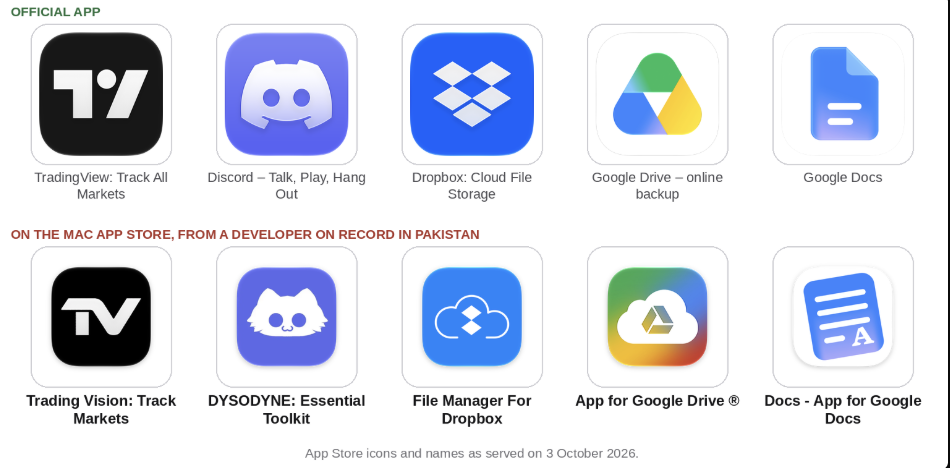
Nine lookalikes in those search results come from developers whose country is on record as Pakistan. For four, Apple publishes a Pakistan address in the trader details. For the other five, the developer’s own policy or support page names Pakistan.
| App | Resembles | What it borrows | EU prices | Pakistan on record in |
|---|---|---|---|---|
| Trading Vision: Track Markets | TradingView: Track All Markets | Name pattern; white “TV” on a black icon | €9.99 a month to €99.99 lifetime | Apple trader details |
| App for Discord | Discord | Discord’s name; a face icon in Discord’s colour | €9.99 a month to €69.99 lifetime | Apple trader details |
| DYSODYNE: Essential Toolkit | Discord | Icon close to Discord’s logo; subtitle “Community Chat, Fun & Games” | €7.99 a week to €59.99 lifetime | Apple trader details |
| Community Toolkit | Discord | Discord’s subtitle, word for word: “Group Chat That’s Fun & Games” | None listed | Apple trader details |
| App for Google Drive ® | Google Drive | Google Drive’s name with an ® sign; Drive-style triangle icon | €9.99 to €22.99 | Own policy page; not a trader |
| Docs – App for Google Docs | Google Docs | Google Docs’ name; blue document icon | €9.99 to €22.99 | Own policy page; not a trader |
| File Manager For Dropbox | Dropbox | Dropbox’s name; Dropbox-style mark on a blue icon | €5.99 a week to €34.99 lifetime | Own policy page; not a trader |
| App for Google Apps ℠ | Google’s name with an ℠ sign; Google’s four colours | None listed | Own policy page; not a trader | |
| ChartGPT・Ai Trading Bot Signal | ChatGPT | A name one letter away from ChatGPT | €9.99 a week or €39.99 a year | Own support page; not a trader |
All nine link only to pages on Google Sites or TermsFeed, with no domain of their own. Listings and pages were opened on 3 October 2026.
These are examples, not a measure of a country. Four of the nine are registered traders, so Apple has checked their contact details. By Apple’s trader records, the 21 brand-name apps from registered traders come from 14 countries, led by Poland and the United States with three each.
The developer of AI Chatbot- Chat Ask Assistant is not in this list. No country is on record for it.
The same profile on 59 chatbot apps
The lookalike’s profile is common among chatbot apps. On 3 October 2026 we ran four more searches of the same catalogue: chatgpt, gpt, ai chatbot and ai chat. They returned 381 apps from 342 developer accounts.
Fifty-nine of them, from 58 accounts, share three traits with the lookalike: support or privacy pages on Google Sites, a weekly plan and no trader status. All 59 are listed in Apps checked.
- 58 are sold under a person’s name, not a company’s. Apple lists an individual developer under their “personal legal name” and a company under its “legal entity name”.
- 44 name another company’s AI model in their own name or subtitle. Of those, 27 name ChatGPT, GPT or OpenAI, and 11 name Claude or Anthropic.
- 55 were released in 2025 or 2026.
- Their weekly plans cost €2.99 to €9.99, most often €5.99 or €6.99.
The traits travel together. Of the 71 chatbot apps with Google Sites pages and a weekly plan, 59 (83%) are non-traders. Of the 69 with a weekly plan and a domain of their own, 28 (41%) are.
Three more of the 59 repeat the lookalike’s bundle-ID story. They are sold as AI chatbots, and their IDs read com.facerate.app, com.am.ai.calorix and coin.identifier.app.h.account.
Public data does not confirm the other steps as general patterns. A burst of early updates is ordinary: 17 of 50 profile apps with a complete version history shipped three or more updates in their first 30 days. So did 47 of 164 other chatbot apps.
Early five-star reviews are no more common on these apps either. US listings show up to eight reviews each. On that evidence, three of the 58 profile apps on the US store have a five-star review within 30 days of launch, against 43 of 321 other chatbot apps.
Single listings do show clusters. On ChartGPT・Ai Trading Bot Signal, all eight reviews shown in the US are five-star and were posted on 11 and 12 August 2026, 26 days after launch. We do not know who wrote them.
The profile is a pattern, not a verdict. None of the three traits breaks a rule on its own.
Apple shows no country for the 59. Twelve more apps have the same pages and plans but did register as traders, so Apple publishes their addresses: eight in Pakistan, two in Australia and two in India.
How to spot the real ChatGPT
OpenAI’s developer account has no app on the Mac App Store, according to Apple’s lookup data. OpenAI offers its Mac app as a direct download instead.
On iPhone and iPad, the real app is named ChatGPT, carries the subtitle “Your everyday AI assistant” and is sold by OpenAI OpCo, LLC. On EU stores, its listing shows OpenAI’s address, phone number and email.
If you subscribed to a lookalike, cancel it under Subscriptions: in Settings on an iPhone, or in the App Store on a Mac. You can request a refund at reportaproblem.apple.com.