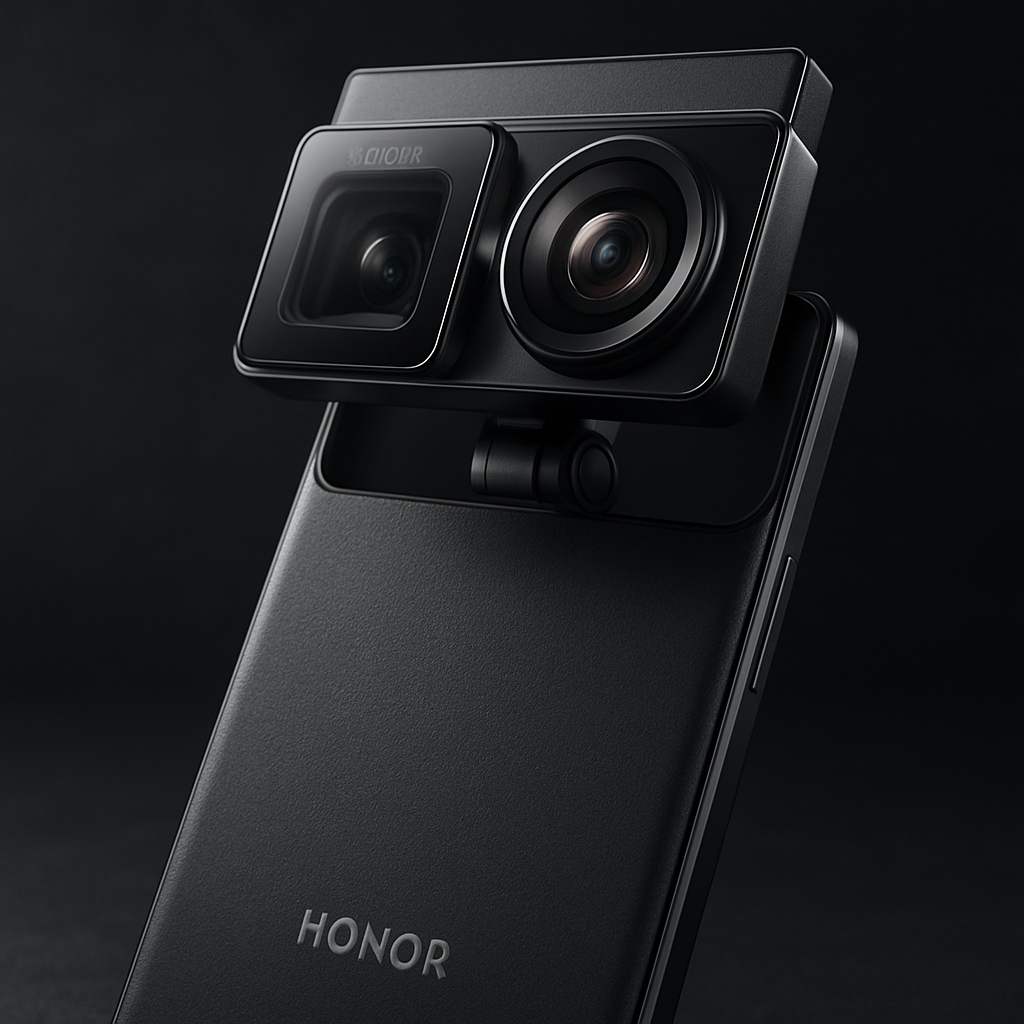
Honor has unveiled what might be the slickest smartphone you’re unlikely to own anytime soon. The newly released Robot Phone blends a 200-megapixel main camera with a built-in gimbal, extending camera hardware, and a design that pushes the boundaries of what phones can do—especially for content creators.
A Camera Bar That Comes Alive
On the back, the Robot Phone’s camera bar hides its centerpiece: a 200MP sensor tucked under a protective cover. When using the dedicated camera app, hitting a physical trigger makes the cover retract and the main camera lift out—dramatically transforming the phone’s rear. It mimics horror-movie vibes, but for photo and video work. Also onboard: a fixed 50MP ultrawide lens and a 200MP periscope lens.
Once you’re using it, the controls expand. Users get full pan/tilt control, plus auto-spin and panning tools, ideal for shots you’d normally reserve for tripods or specialty rigs. Selfies are accommodated too: the main sensor flips 180 degrees so you can shoot yourself with everything this hardware allows. The integrated gimbal stabilizes well—better than expected.
AI Features & Smart Tools
The software side lives up to the gear. The phone runs MagicOS 10, which introduces an assistant called YOYO that can “look around” to gather environmental context—think of it as some of the ambition of smart glasses built into a phone. Tracking of objects and people worked solidly in testing, though English prompts sometimes caused hiccups.
These AI tools are packaged with creator-focused film modes and formats to really lean into video, plus settings for things like motion tracking and stabilization that make pro-style video more accessible.
Price, Market, and Availability
The Robot Phone is priced from RMB 9,999 (around $1,500) for the 12/512GB version. Move up to 16GB/1TB and you’re near the $2,000 mark. Those aren’t budget numbers, but are in line with what this setup brings.
Here’s the rub: Honor launched the device only in China, with no global release in sight. Despite that, the company says it met its initial sales targets immediately—supply already tight and demand strong. Getting one abroad currently depends on knowing someone in China or navigating import channels.
The Robot Phone doesn’t just riff on existing phones—it reimagines how creators might shoot. The spring-loaded camera, mechanical stabilization, and AI tools traversed a lot of what’s possible in mobile video and content production. It’s fun to use, technically impressive, and far from ordinary.
Why this matters: phones nowadays can feel interchangeable—same screens, selfie cutouts, chipsets. Honor’s Robot Phone challenges that with hardware and features that turn the camera into an experience. It shows what’s possible when ambition meets engineering. If this signals a trend, we might see more devices that blur the line between phone and pro video rig. The big question: when (or if) these ideas reach a wider market, and how competitors respond.