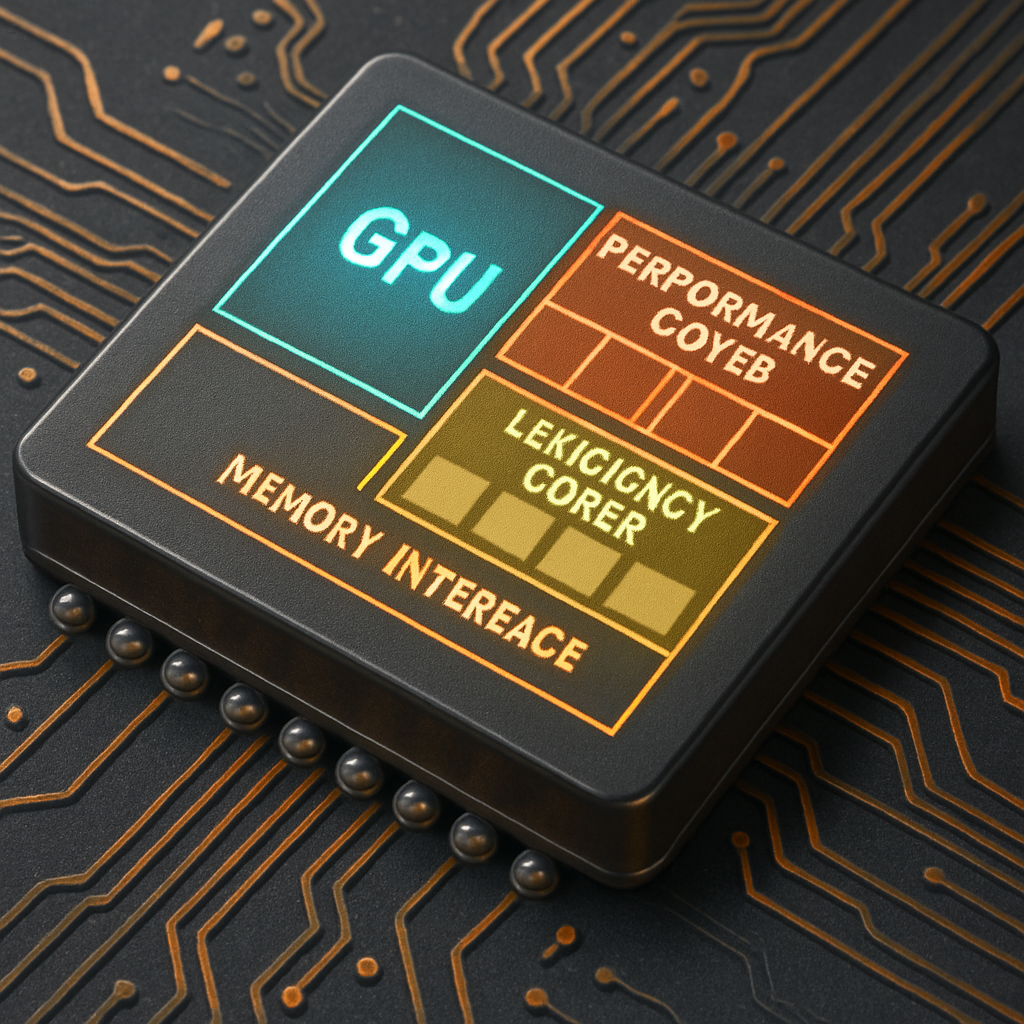
Today’s leaks suggest Apple’s A20 Pro chip, expected in the upcoming iPhone 18 Pro and Pro Max, could deliver substantial upgrades across graphics, memory, and efficiency cores. A reconstructed layout—based on solder joint positions and die images—points toward a larger shift under the hood. Major changes include a 7-core GPU, a wider memory interface, and a bigger L2 cache shared by the efficiency cores.
Graphics and Memory Boosts
Compared to the current A19 Pro, the GPU of the A20 Pro appears to gain one extra core—moving from six to seven. That’s about a 16% boost in raw core count alone. At the same time, the chip seems to jump from a 64-bit to a 96-bit memory interface for its LPDDR5x RAM. That’s a 50% wider path for data, which could significantly accelerate graphics performance by enabling higher memory bandwidth.
CPU Cache and Architecture Tweaks
On the CPU side, efficiency cores are expected to share an 8 MB L2 cache, up from the 6 MB seen in the A19 Pro, while performance cores retain their existing 16 MB L2 cache. The layout also shows that the CPU might be organized in a 2-core performance block alongside a 4-core efficiency cluster. A new image signal processor and upgraded neural engine are also likely present, though the size of the shared system-level cache hasn’t been confirmed and is thought unlikely to drop.
Product Implications
The A20 Pro is widely believed to be the driving chip behind the iPhone 18 Pro and iPhone 18 Pro Max, expected to make their debut in the coming week. Some rumors even suggest Apple may tap this same silicon for its first foldable iPhone model—sometimes referred to as the “Ultra.”
These enhancements align with what users expect: better graphics performance for gaming and video, improved efficiency for battery life, and more headroom for AI and camera tasks thanks to the neural engine improvements. If Apple can deliver all this within its usual power and thermal constraints, the iPhone 18 Pro line could represent one of the most balanced performance leaps we’ve seen.