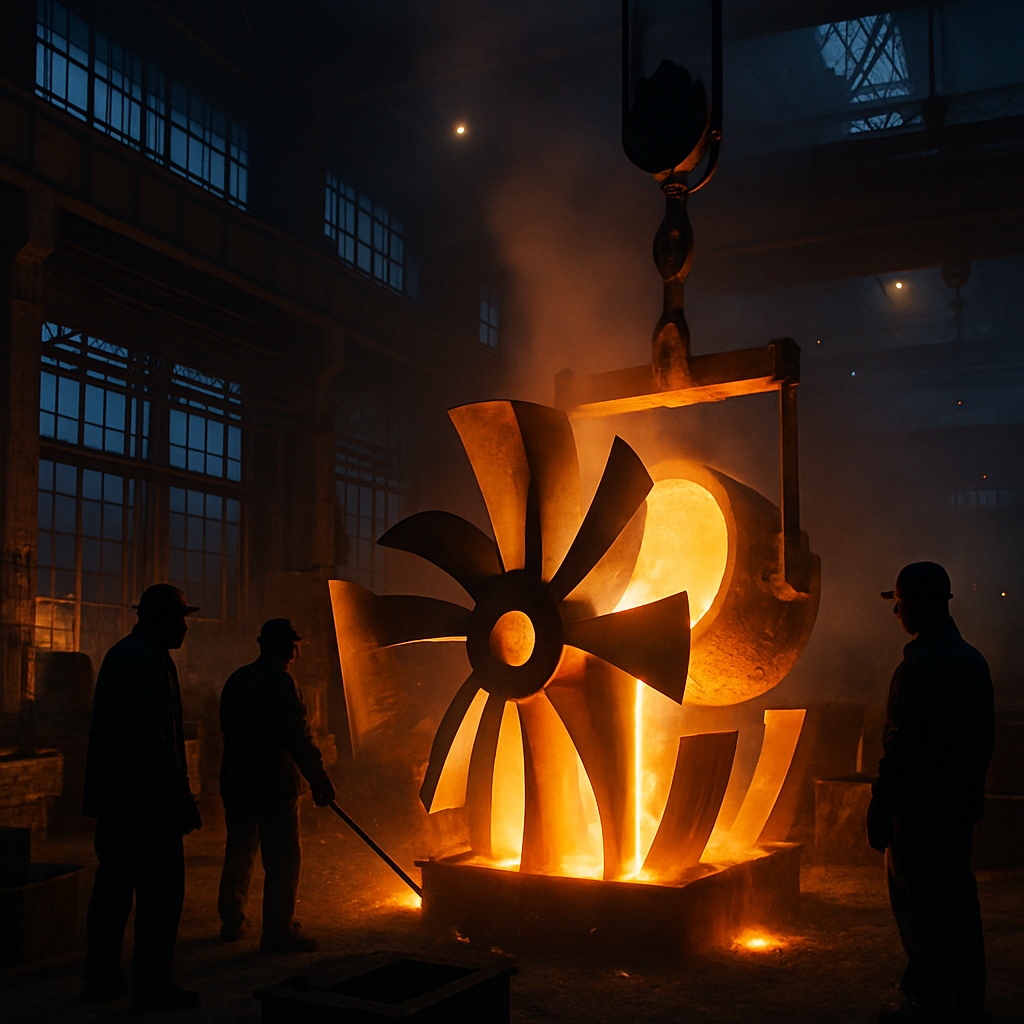
Elon Musk has revealed that SpaceX is creating its own foundry in Bastrop, Texas, to cast one of the most difficult components in natural gas turbines — the blades and vanes. Musk says this move could cut up to 18 months from the production time of gas-fired turbines, a critical piece in providing power for expanding AI infrastructure. What he did not hide: this accelerated path also carries real environmental and health risks tied to turbine emissions.
Why turbine blades are the choke point
As AI demand surges, data centers are squeezing power grids that were never designed for this kind of load. Natural gas turbines are emerging as a fast backup or supplement solution. However, one of the biggest hurdles in scaling up turbine deployment is manufacturing blades and vanes that can survive extreme heat. These parts must run at temperatures up to 3,600°F—about 800°F above the melting point of their alloy—and must be precision-cast as single crystals inside a vacuum furnace to avoid cracks. Only four manufacturers globally currently control that process at scale, and all are booked solid through 2030.
Musk argues that by bringing casting in-house at SpaceX, turbine production can be sped up significantly. He frames it as a catch-up move: solar and AI growth are outracing gas turbine availability, and turning the manufacturing bottleneck into an internal capability could be a “game-changer.” But for companies building hyperscale data centers, the trend toward natural gas isn’t new — Amazon, Google, Meta, Microsoft, and OpenAI have already adopted gas-fired power on-site to offset grid limitations.
Emissions and the communities in the crosshairs
Natural gas turbines emit smog precursors and hazardous air pollutants such as formaldehyde. Health impacts include higher risks of asthma, respiratory ailments, and certain cancers. In Memphis, where SpaceXAI has been operating turbines for its Colossus data centers since 2024, regulators and civil rights groups like the NAACP are challenging the lack of air permits and pollution controls for turbines already in place. Local researchers noted that air pollution in surrounding neighborhoods—already overburdened by industrial emissions—worsened slightly after the data center began operations.
Virginia offers another case study. A study commissioned by a regional environmental council used the EPA’s COBRA health-impact model to assess emissions from a site with eight full-time natural gas turbines. It found that emissions could affect over 2.5 million people across multiple counties. The study estimated 3.4 to 6.5 premature deaths per year attributable to these emissions, and quantified health damages between $53 million and $99 million annually. The burden, as in many cases, falls heaviest on marginalized and low-income communities already exposed to elevated levels of industrial pollution.
The tension is clear: artificial intelligence infrastructure demands speed and scale, and the fastest path to power may involve doubling down on fossil-fuel based gas turbines for heating, cooling, and backup. These turbines are currently viewed as the bridge fuel, despite their climate and health impacts.
Looking ahead, Musk’s plan, if executed, would give SpaceX a rare vertical integration in this supply chain — controlling a vital bottleneck that has constrained others. But solving for power supply through gas can go only so far without robust oversight and mitigation. If natural gas turbines become widely deployed near data centers, expect escalating regulatory and community pushback, especially in regions already bearing disproportionate environmental burdens. The coming debate will force a choice between short-term gains in AI infrastructure vs. long-term community health and environmental justice.