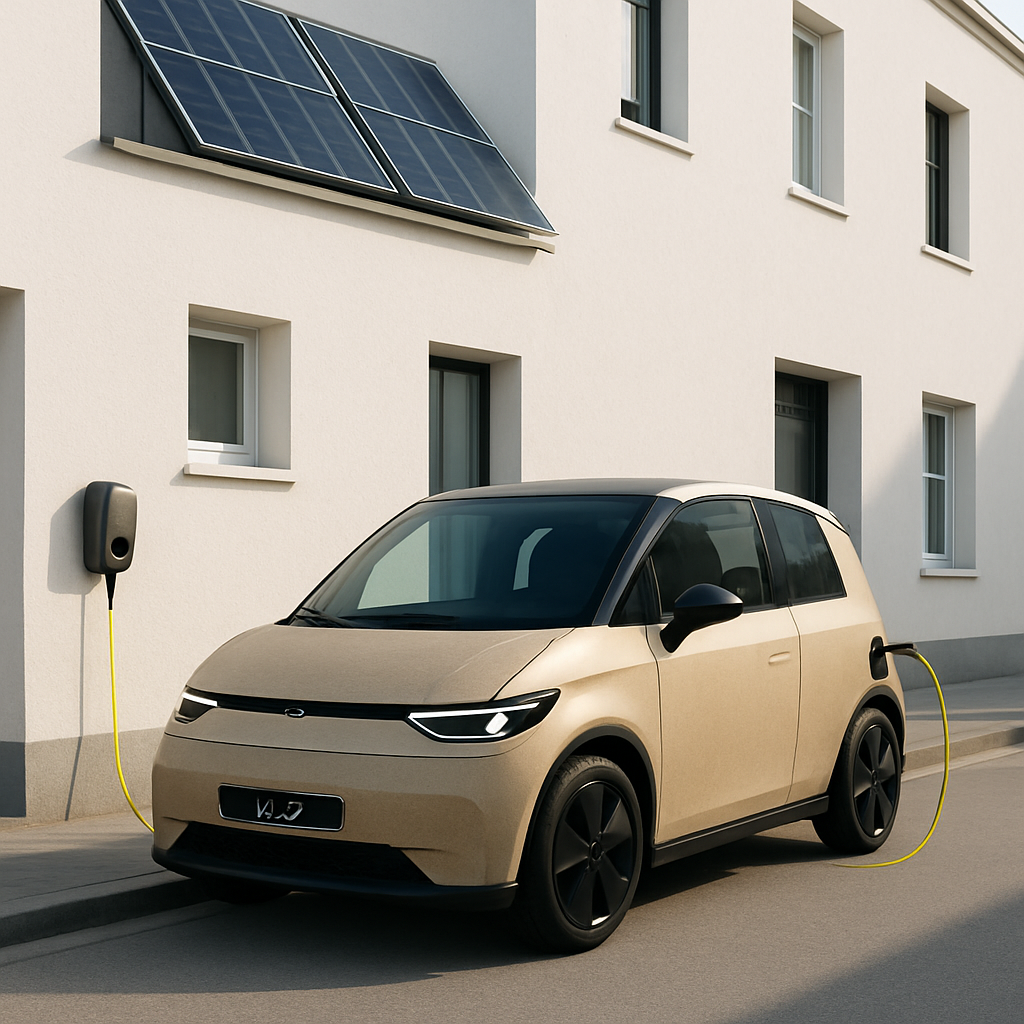
Europe is falling for microcars all over again. Outside tiny Italian bubble cars, the market has been dominated by compact EVs built in China. But Spanish startup Liux plans to break that trend with its new microelectric called the Big, built with sustainability at its core. It may be small enough to park perpendicular to the curb, but its ambitions are far larger.
Born from circularity and design
Liux opened Spain’s first new car factory in over three decades, located in Azuqueca de Henares. While the company doesn’t strive for a totally sovereign supply chain—acknowledging that European batteries still need to be imported—it aims instead for radical sustainability. Every aspect of the Big, from material sourcing to future recyclability, has been engineered with long-term environmental integrity in mind. The vehicle’s body uses a linen-based biocomposite that can be more easily separated and recycled, and its EV batteries are compatible with home solar setups.
Early prototypes included a five-seat electric SUV, built almost entirely with plant-based or recycled parts. But after realizing homologation would be simpler for a smaller vehicle, Liux shifted to its microcar strategy in 2022. The Big has now secured type-approval across Europe and is planned to launch in the first half of 2027. The startup currently employs about 65 people and is preparing production across three Spanish plants.
Fit for city lanes, built for comfort
The Liux Big falls under Europe’s L7e homologation, which allows slightly higher weight limits than its ultralight L6e predecessors. While the capsule-sized frame keeps size tight, the startup squeezed in a 260-liter trunk—enough room for groceries or small baggage—while ensuring car-like safety and driving feel. Testing shows the Big can handle slalom maneuvers, braking challenges, even off-road trims.
The offer includes two battery configurations—15 kWh or 20 kWh—and a cargo-focused version is in development. The Big does more than just meet specs; it tries to redefine what microcars can be, with more than €16 million (roughly $18.5 million) raised so far to fund the effort. Sales will go through dealerships across Europe, and while the precise price hasn’t been locked in, it’s expected to fall under €18,000 before subsidies—higher for this category, but still aiming to deliver value.
Looking ahead
So far 7,500 potential buyers are on Liux’s waiting list—no deposit required—giving the company early insights into who wants what. Most are city-adwelling buyers in their mid-50s, considering the Big as a second household car. Liux also plans extensions: fleet partnerships, autonomous versions, and cargo variants are all on the roadmap. Branding and design are part of its pitch too—a showroom with eco-textile materials, linen nods, and 3 colorways (more than classic cars had) reflect Liux’s effort to stand out.
This is Liux’s chance to prove that micro-EVs can be European, sustainable, and dignified—not just compact, cheap, and status-quo. With competitors from China usually leading on price, Liux is betting that materials innovation, manufacturing location, and driving experience will tip the scales.
Why this matters: Liux’s journey highlights a coming inflection point for EVs in Europe. The Big could set a benchmark for circular design in microcars, redefining what city-friendly EVs look like when sustainability isn’t optional. Keep an eye on its homologation progress, manufacturing ramp to 20,000 units by 2030, and whether consumers are willing to pay for greener materials.