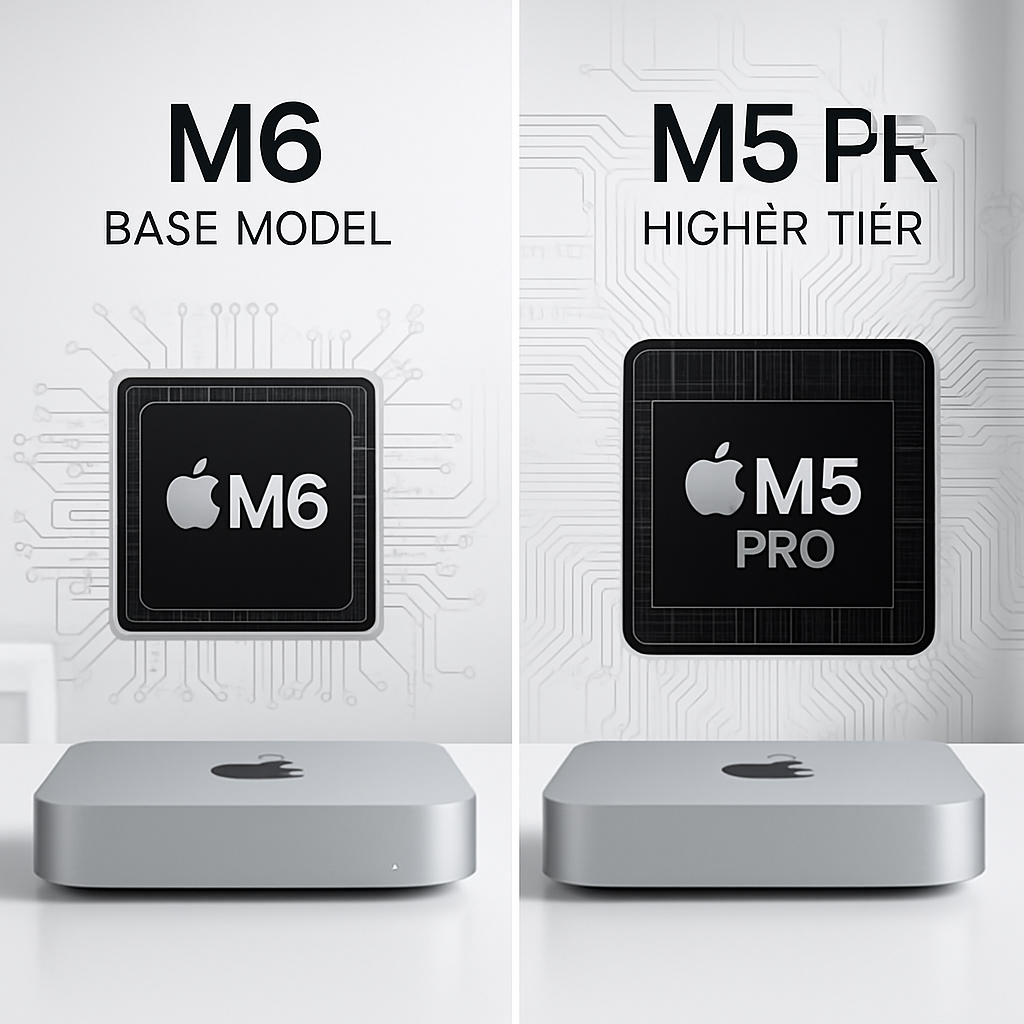
Apple’s latest Mac mini launch has turned expectations on their head: the $899 base model is now powered by the fresh-off-the-line M6 chip, Apple’s first processor built using a cutting-edge 2nm manufacturing process, while the higher-end $1,699 version continues with the previous-generation M5 Pro chip. These differences reflect more than just performance tiers—they stem from Apple’s shifting strategy around chip lineups and release timelines.
What changed in Apple’s chip roadmap
Rather than following a familiar path of rolling out an M6 Pro, M6 Max, and even Ultra variants, Apple has opted to skip those entirely. Instead, it’s leapt ahead to the future, focusing on the M7 family. Neural-processing and AI enhancements planned for Apple silicon were deemed significant enough during development to justify advancing to the next generation rather than expanding the M6 chips. As such, the M7 chip will debut in the first half of 2027, with M7 Pro and M7 Max versions expected later that year, and an M7 Ultra possibly arriving in 2028.
In having its newly released base Mac mini adopt the M6, while the pro version retains M5 Pro, Apple ends up offering two different generations of silicon in the product line simultaneously. Though unusual, this is not without precedent: last year’s Mac Studio refreshed models included mismatched pairs like the M4 Max alongside M3 Ultra.
Why the M6 on the cheaper model?
There are clear implications for consumers. The entry-level Mac mini now benefits from improvements inherent to the M6 chip—faster speeds, enhanced efficiency, upgraded neural processing—boosting value at the lowest price. Meanwhile, the $1,699 model, using the M5 Pro, still targets the segment where multitasking, higher GPU core counts, and heavier workloads are the focus, though it forgoes the cutting-edge process advantages of the M6.
This approach suggests Apple is preserving its high-end silicon for more premium or larger systems that demand broader performance capabilities. The M6’s absence in more powerful Pro or Max variants underscores where Apple sees the next leap in performance coming—from the upcoming M7 line, expected to bring major AI and neural enhancements.
The mixed chip strategy also impacts how buyers should choose. For someone who needs the latest features and efficiency gains but doesn’t require the maximum power, the new base Mac mini presents a compelling choice. But for those doing GPU-intensive work, content creation, software development, or demanding tasks, the M5 Pro version still holds merit—though at a cost in future-proofing.
Apple’s chip transition history shows a pattern of overlapping generations to smooth new launches. The decision to skip M6 Pro/Max/Ultra likely condensed Apple’s development cycle, enabling it to introduce AI-centric upgrades sooner via the M7 roadmap. Care has to be taken in how performance, compatibility, and price align moving forward.
In short, the newest Mac mini lineup reflects Apple’s recalibrated priorities: push forward aggressively on AI, neural processing, and manufacturing gains—even if that means the base model bores the lead in silicon innovation. The eventual arrival of M7 Pro and Max should clarify that advancement. What to watch next: benchmarks of the M6 compared to M5 Pro in real-world tasks, early demos of M7’s AI chops, and whether Apple applies this “skip-a-step” approach elsewhere.