Apple has introduced new commission structures for the App Store across the European Union, and the European Commission has indicated it is satisfied the changes comply with bloc-wide rules. These reforms represent a major shift in Apple’s terms, particularly for third-party app sales and purchases made outside its own In-App Purchase (IAP) system. For many developers, the new rates are materially lower.
What’s new: Updated commission tiers
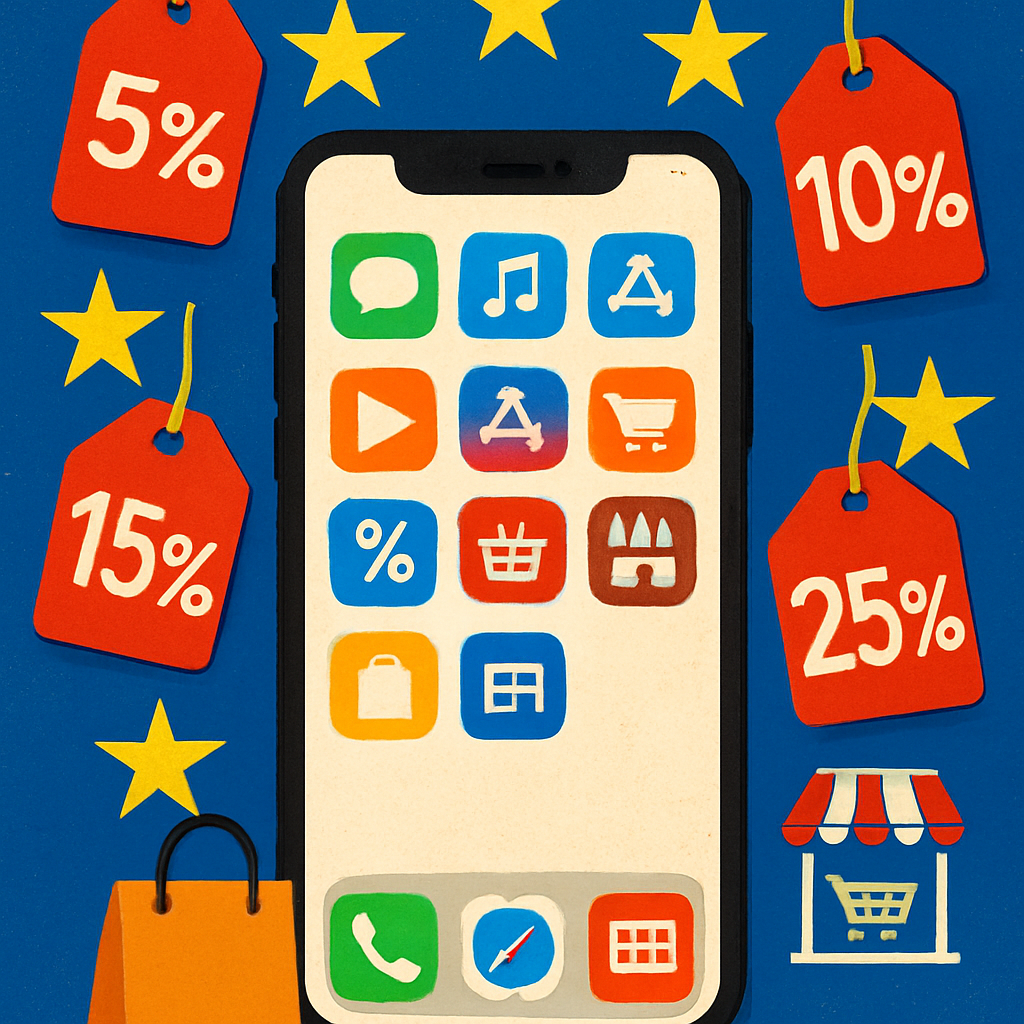
For apps that rely on Apple’s IAP system, the commission has been set at 26%. Developers in certain programs—like the App Store Small Business Program, Mini Apps Partner Program, and Video Partner Program—or those managing auto-renewing subscriptions after their first year will pay a reduced rate of 15%. ([9to5mac.com](https://9to5mac.com/2026/08/20/apples-long-running-app-store-battle-with-the-eu-appears-to-finally-be-over/))
If developers accept alternative payment processing (outside Apple’s IAP), the commission drops: it’s now 20%, or just 10% for those qualifying under the special programs mentioned above. For apps that provide a link out of the app (steering users to complete purchases elsewhere), a 15% commission applies, with a 10% discount for eligible participants. ([9to5mac.com](https://9to5mac.com/2026/08/20/apples-long-running-app-store-battle-with-the-eu-appears-to-finally-be-over/))
Perhaps most significantly, apps distributed via alternative marketplaces or on the web are subject to only a 5% “Core Technology Commission.” These updates reflect Apple’s response to prior complaints regarding excessive fees on third-party sales. ([9to5mac.com](https://9to5mac.com/2026/08/20/apples-long-running-app-store-battle-with-the-eu-appears-to-finally-be-over/))
EU response & broader impact
The European Commission welcomed the revisions, citing its 2025 non-compliance ruling and earlier findings connected to Apple’s “steering terms” and rules for alternative app distribution. It stated ongoing oversight to ensure Apple adheres fully to the new terms. ([9to5mac.com](https://9to5mac.com/2026/08/20/apples-long-running-app-store-battle-with-the-eu-appears-to-finally-be-over/))
These changes come in the wake of Apple already making various adjustments under the EU’s Digital Markets Act (DMA). Among them: giving users choice over default browsers and uninstalling pre-installed apps, and legal action over anti-steering provisions that prevent developers from pointing users to non-Apple payment options. ([digital-strategy.ec.europa.eu](https://digital-strategy.ec.europa.eu/en/news/commission-closes-investigation-apples-user-choice-obligations-and-issues-preliminary-findings?utm_source=openai))
The US front: Apple vs Epic Games
While the EU battle may be winding down, Apple remains embroiled in its legal dispute with Epic Games in the United States. Apple has asked a court to initiate settlement talks, but Epic has expressed doubts about the potential outcome. That case is now awaiting further proceedings under court order. ([9to5mac.com](https://9to5mac.com/2026/08/20/apples-long-running-app-store-battle-with-the-eu-appears-to-finally-be-over/))
These changes represent a critical inflection point. For years developers in the EU criticized Apple for what they saw as unfair fees and restrictive policies. With the DMA in force—and EU institutions leaning on compliance—the company is reworking foundational elements of its App Store model. What remains to be seen is how quickly the new terms are implemented in practice, and whether they will withstand legal scrutiny. Developers should monitor enforcement and how Apple handles edge cases like multi-marketplace distribution, subscription renewals, and steering disclosures. The App Store model globally may depend on how well this reset works in Europe.