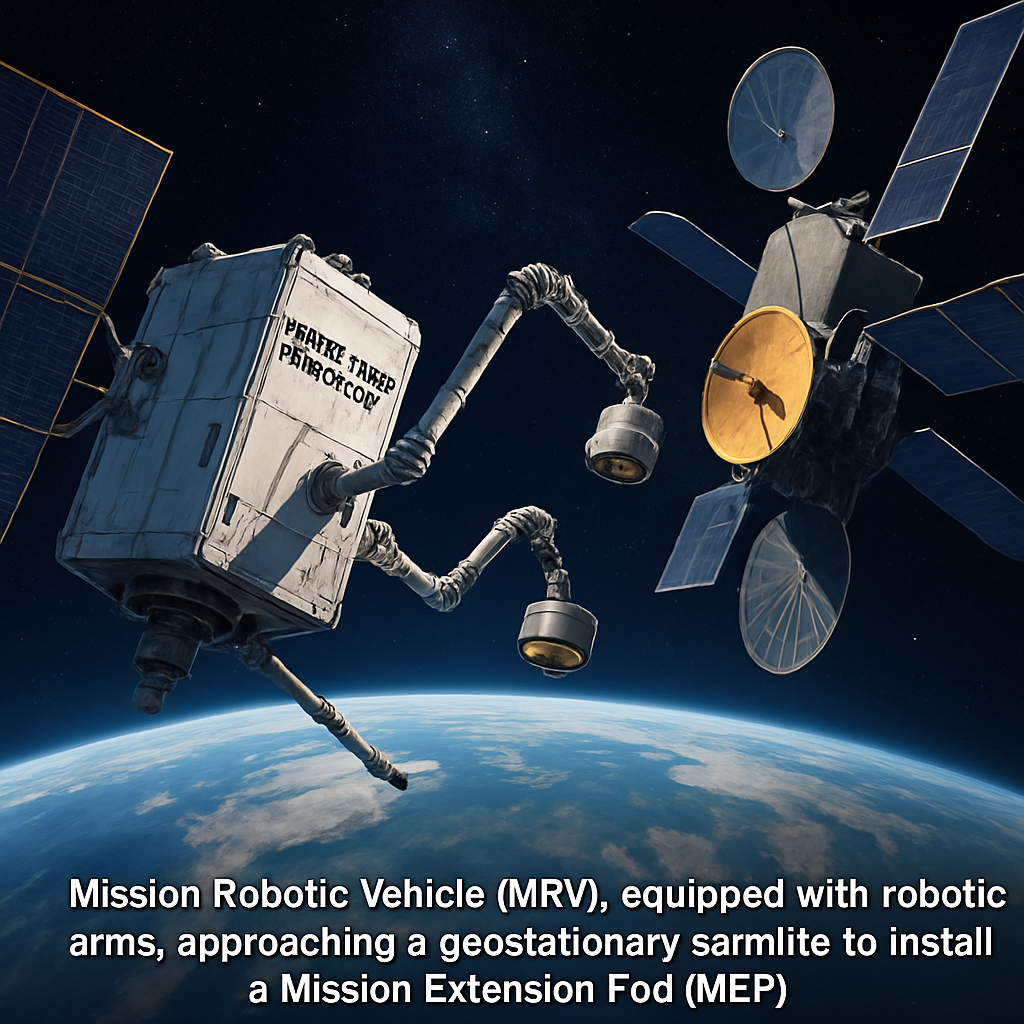
Northrop Grumman is advancing satellite servicing with its Mission Robotic Vehicle (MRV) and Mission Extension Pods (MEPs), aiming to prolong the operational life of geostationary satellites. This initiative marks a significant evolution from their earlier Mission Extension Vehicle (MEV) program.
Traditionally, satellites become inoperative when they deplete their onboard fuel, even if their other systems remain functional. To address this, Northrop Grumman developed the MEV, which docks with aging satellites to provide propulsion and attitude control, effectively extending their service life. Notably, MEV-1 and MEV-2 have successfully serviced Intelsat’s IS-901 and IS-10-02 satellites, respectively, adding years to their operational timelines. ([investor.northropgrumman.com](https://investor.northropgrumman.com/node/37941/pdf?utm_source=openai))
Building on this success, the MRV introduces advanced robotic capabilities. Equipped with two sophisticated robotic arms, the MRV is designed to perform a range of tasks, including installing MEPs, conducting repairs, and relocating satellites. The MEPs are modular propulsion units that, once attached to a client satellite, provide the necessary thrust to maintain its position and orientation. This modular approach allows satellite operators to purchase and control MEPs, while the MRV handles their installation, thereby streamlining the servicing process. ([northropgrumman.com](https://www.northropgrumman.com/wp-content/uploads/Mission-Robotic-Vehicle-MRV-fact-sheet.pdf?utm_source=openai))
In July 2026, Northrop Grumman launched the MRV along with three MEPs aboard a SpaceX Falcon 9 rocket. These spacecraft are en route to geostationary orbit, approximately 35,786 kilometers above Earth. The MRV’s first mission, scheduled for 2027, involves attaching an MEP to an Optus communications satellite, which has been operational since 2009. This intervention is expected to extend the satellite’s service life by several years, ensuring continued revenue generation and service provision. ([northropgrumman.com](https://www.northropgrumman.com/wp-content/uploads/Mission-Robotic-Vehicle-MRV-fact-sheet.pdf?utm_source=openai))
The MRV’s design includes the capability for in-orbit refueling, a feature that underscores the potential for sustainable space operations. By enabling refueling, the MRV can undertake multiple missions without returning to Earth, enhancing the efficiency and cost-effectiveness of satellite servicing. ([northropgrumman.com](https://www.northropgrumman.com/wp-content/uploads/Mission-Robotic-Vehicle-MRV-fact-sheet.pdf?utm_source=openai))
Northrop Grumman’s advancements in robotic satellite servicing reflect a broader industry trend towards sustainable space operations. By extending the life of existing satellites, these technologies reduce the need for new launches, thereby decreasing costs and minimizing space debris. As the space industry continues to evolve, such innovations are likely to play a crucial role in maintaining and enhancing the functionality of the global satellite infrastructure.