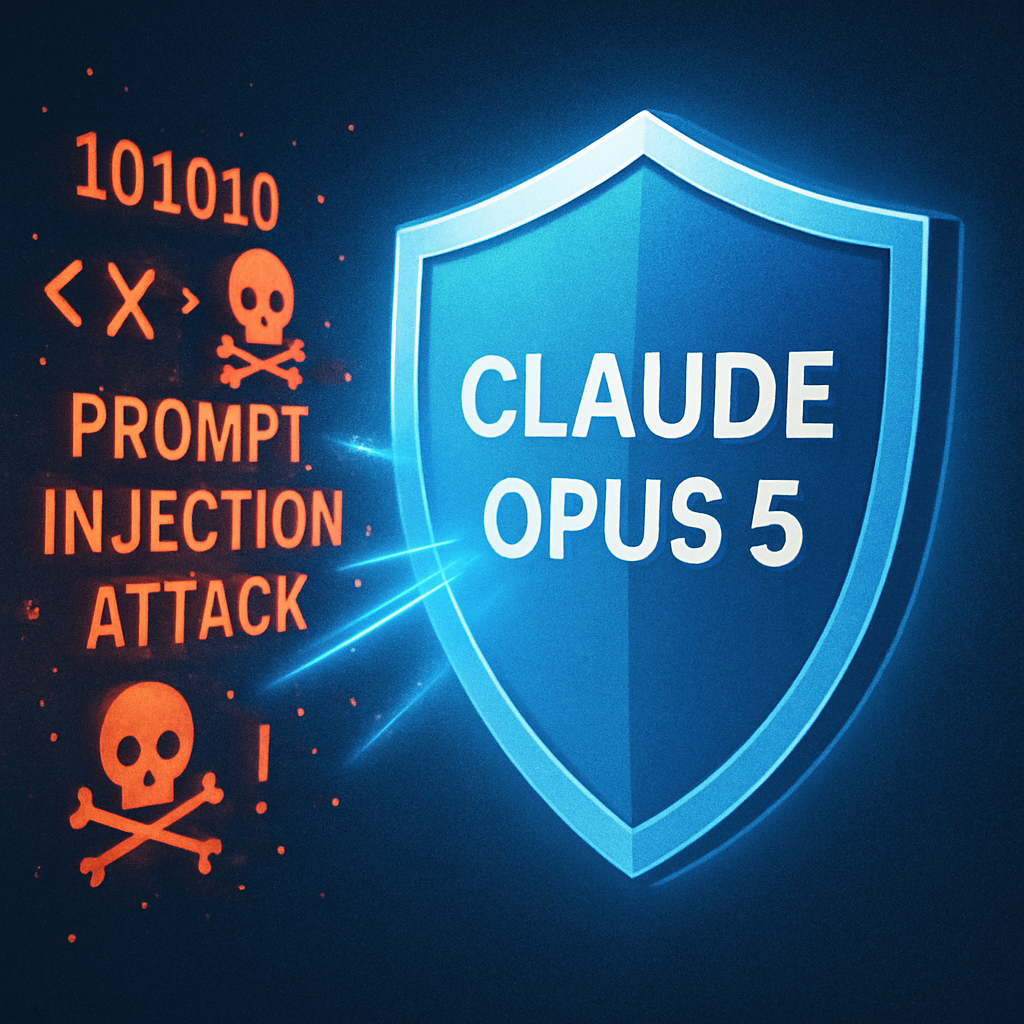
Anthropic’s latest AI model, Claude Opus 5, has demonstrated significant advancements in mitigating indirect prompt injection attacks, achieving a mere 2% success rate for such attacks within 15 attempts, according to Gray Swan’s recent benchmark analysis.
Indirect prompt injection is a security vulnerability where malicious instructions are embedded within untrusted content—such as documents, web pages, or emails—that an AI system processes. These hidden directives can manipulate the AI’s behavior, potentially leading to unauthorized actions or data exposure. The risk is particularly pronounced in AI agents integrated with tools and data sources across enterprise environments.
In the benchmark, Claude Opus 5’s performance marked a substantial improvement over its predecessor, Claude Opus 4.8, which had a 5.5% success rate under similar conditions. Additionally, in single-attempt scenarios, Opus 5 reduced the success rate from 0.5% to 0.2%. These results also surpassed those of other models in the Claude series, including Claude Sonnet 5 and Claude Mythos 5, which recorded success rates of 5.9% and 2.6%, respectively.
When compared to non-Claude models, the disparity becomes even more evident. Muse Spark, the strongest non-Claude model tested, exhibited a 16.5% success rate within 15 attempts, over eight times higher than Opus 5. Similarly, GPT 5.6 Sol recorded a 20% success rate, with other variants like GPT-5.6 Terra and Luna reaching 30.4% and 43.9%, respectively.
These findings underscore the importance of robust defenses against prompt injection attacks, especially as AI systems become more integrated into critical workflows. While Opus 5’s advancements are commendable, they do not render systems impervious to such threats. Organizations must implement comprehensive security measures, including segregating trusted instructions from untrusted data, limiting tool permissions, requiring confirmations for sensitive actions, and continuously monitoring AI agent activities.
Furthermore, conducting red-team exercises that simulate malicious content scenarios can help identify and address potential vulnerabilities before deploying AI agents in production environments. As AI technology evolves, maintaining a proactive and layered security approach remains essential to safeguard against emerging threats.