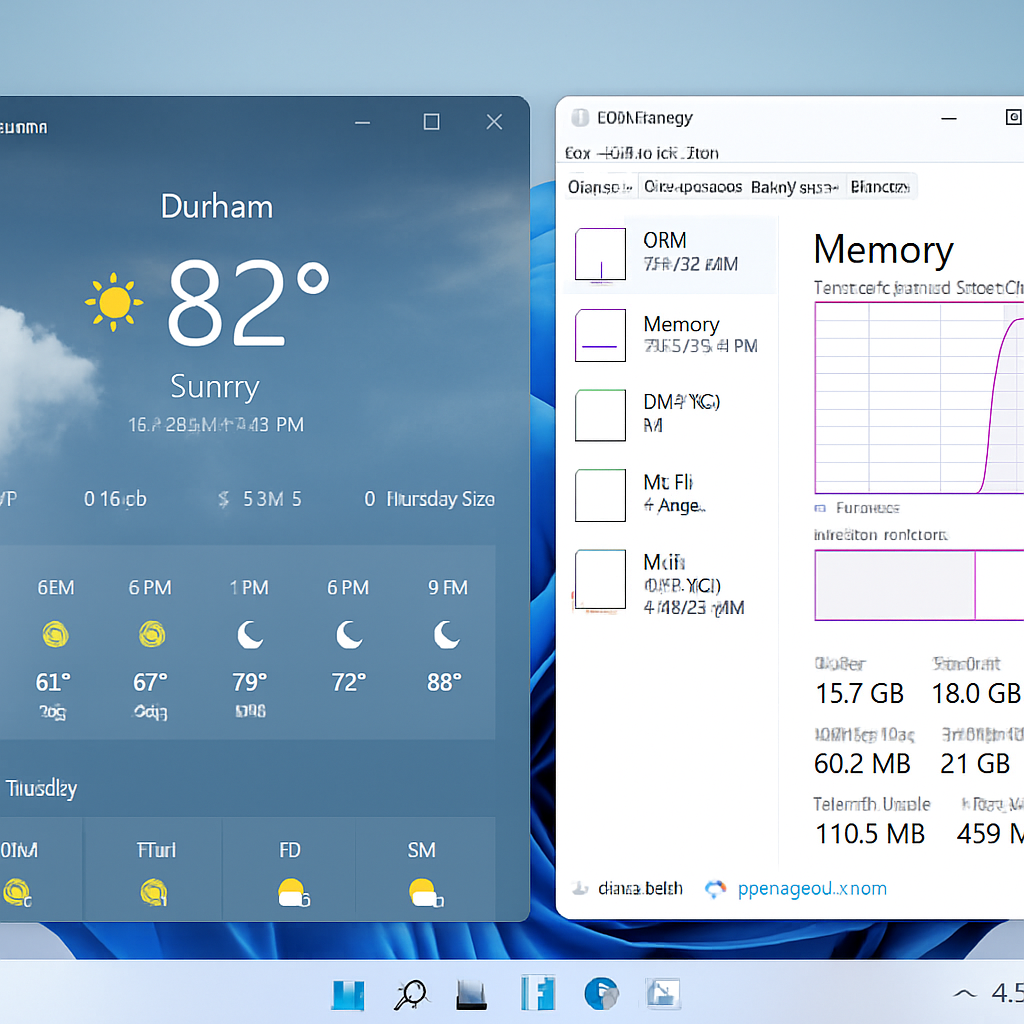
Recent analyses have revealed that Windows 11’s built-in Weather app is consuming an unexpectedly high amount of system memory. Tests indicate that the app uses over 1.2GB of RAM to display basic weather forecasts and maps, a significant concern for users with limited system resources.
The core issue lies in the app’s architecture. Despite its native appearance, the Weather app is essentially a web-based application utilizing Microsoft’s WebView2 framework, which relies on the Chromium engine—the same foundation as the Edge browser. This design choice results in multiple Chromium-based processes running concurrently, each adding to the overall memory usage.
For instance, upon launching the Weather app, memory consumption can quickly escalate to approximately 1GB, even without extensive user interaction. During idle periods, it maintains around 500–600MB of RAM usage. Engaging with interactive features, such as zooming into maps or navigating between forecast screens, can cause memory usage to spike to 1.5GB or more.
To put this into perspective, Apple’s native Weather app on macOS reportedly uses about 246.7MB of memory for similar functionalities, highlighting a stark contrast in efficiency between the two platforms.
Microsoft has acknowledged the need for optimization, especially for devices with 8GB of RAM. The company is reportedly planning to transition the Weather app to a more native implementation, aiming to reduce its memory footprint. However, these improvements are not expected to be deployed until late 2026.
In the interim, users concerned about system performance have a couple of options. They can disable the Weather widget from running in the background via Windows 11 settings or uninstall the app entirely. Alternatively, lightweight third-party weather applications available in the Microsoft Store may serve as more efficient substitutes.
This situation underscores the broader challenge of balancing feature-rich applications with system performance, particularly on devices with limited hardware capabilities. As Microsoft continues to refine Windows 11, the efficiency of bundled applications like the Weather app will be crucial in delivering a seamless user experience.