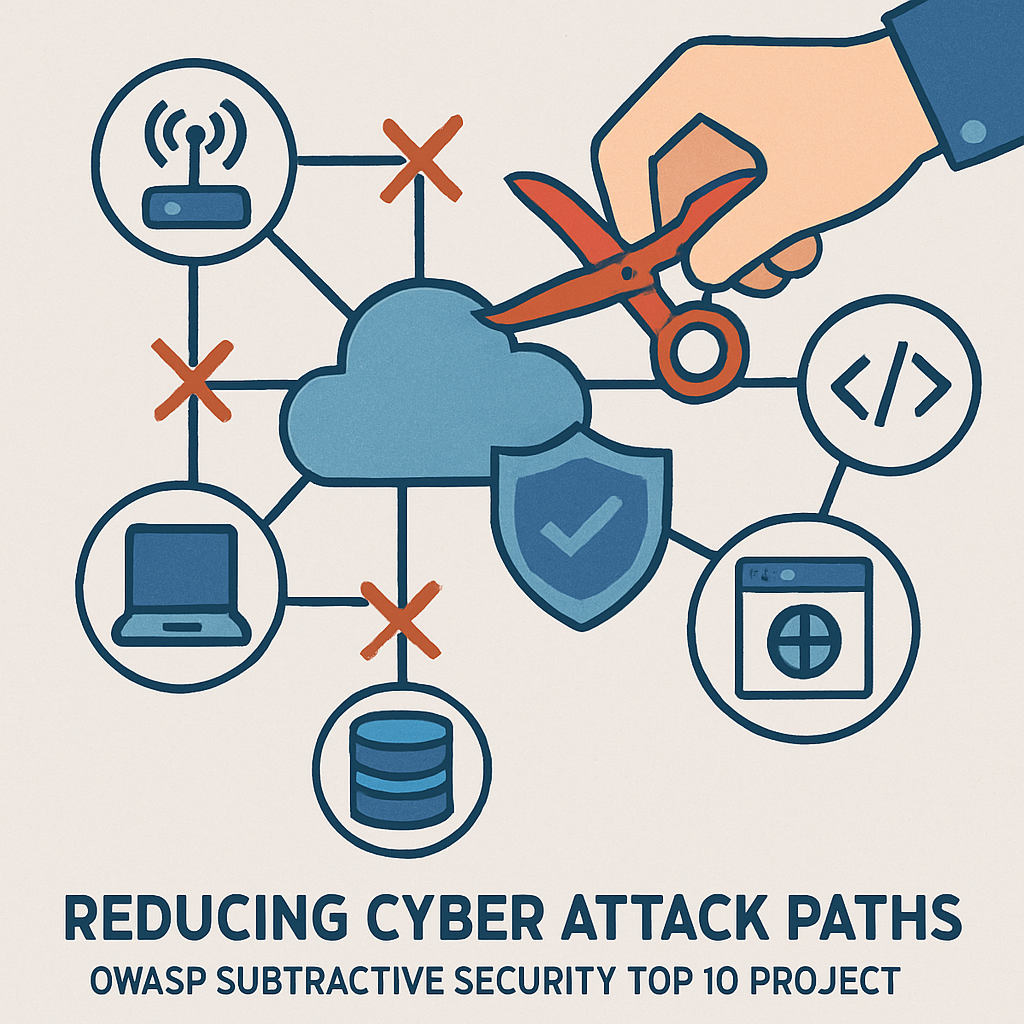
The Open Worldwide Application Security Project (OWASP) has unveiled the Subtractive Security Top 10 Project, a novel initiative aimed at proactively eliminating potential cyber attack vectors. This approach shifts the focus from traditional detection and monitoring to the removal of unnecessary access points and services, thereby reducing the avenues available to attackers.
Rethinking Cyber Defense Strategies
Conventional cybersecurity measures often emphasize the addition of security products, alerts, and access controls. In contrast, OWASP’s new project encourages organizations to consider what can be removed to enhance security. By eliminating redundant access, services, trust relationships, privileges, protocols, and network exposures, the attack surface is significantly reduced, making it more challenging for malicious actors to exploit vulnerabilities.
The Subtractive Security Hierarchy
OWASP’s framework prioritizes security controls based on their effectiveness in diminishing the enterprise attack surface:
- Architectural Deletion: This involves completely removing attack paths by disabling legacy protocols, turning off unused services, deleting dormant accounts, eliminating public-facing exposures, and revoking unnecessary administrative privileges.
- Architectural Constraint: When complete removal isn’t feasible due to operational needs, exposure is minimized through network segmentation, private endpoints, conditional access policies, permission boundaries, and privilege restrictions.
- Monitoring and Detection: While logging, SIEM platforms, endpoint detection and response tools, intrusion detection systems, and alerts remain important, OWASP emphasizes that detection alone doesn’t eliminate the underlying routes an attacker might exploit.
The core principle is: Delete > Constrain > Monitor. Removing attack paths is the most effective defense, while monitoring serves as the last line of defense for residual risks.
Architectural Principles of Subtractive Security
The project outlines ten key principles aimed at reducing the attack surface:
- Reduce Unnecessary Reachability: Eliminate network exposure and access routes not required for business operations.
- Reduce Unnecessary Trust Relationships: Remove excessive cross-system, identity, and service trust dependencies.
- Reduce Credential Exposure: Limit credential availability, reuse, storage, and transmission paths.
- Reduce Privilege Propagation: Prevent administrative rights and permissions from spreading across systems and identities.
- Reduce Executable Attack Paths: Remove services, protocols, applications, and configurations that attackers could exploit.
- Reduce Control-Plane Exposure: Restrict access to cloud, identity, infrastructure, and management interfaces.
- Reduce Attack-Surface Area: Decommission unused software, ports, accounts, APIs, and legacy components.
- Enforce Deterministic Communications: Allow only explicitly required inbound, outbound, and east-west traffic flows.
- Constrain Residual Attack Paths: Apply segmentation, private endpoints, conditional access, and permission boundaries where removal isn’t feasible.
- Measure Structural Improvement Through PER: Use the Path Erasure Rate (PER) to quantify eligible attack paths that have been structurally removed.
Introducing the Path Erasure Rate (PER)
To measure the effectiveness of these security improvements, OWASP introduces the Path Erasure Rate (PER). This metric calculates the proportion of eligible attack paths that have been structurally removed, providing a quantifiable measure of security enhancement. The formula is expressed as PER = |Perased| / |Peligible|, where Peligible represents actionable attack paths within the defined scope, and Perased represents the paths that have been eliminated.
By adopting the Subtractive Security Top 10 Project, organizations can proactively reduce their attack surfaces, making it more difficult for cyber adversaries to exploit vulnerabilities. This approach not only enhances security but also streamlines operations by eliminating unnecessary components, leading to a more resilient and efficient IT infrastructure.