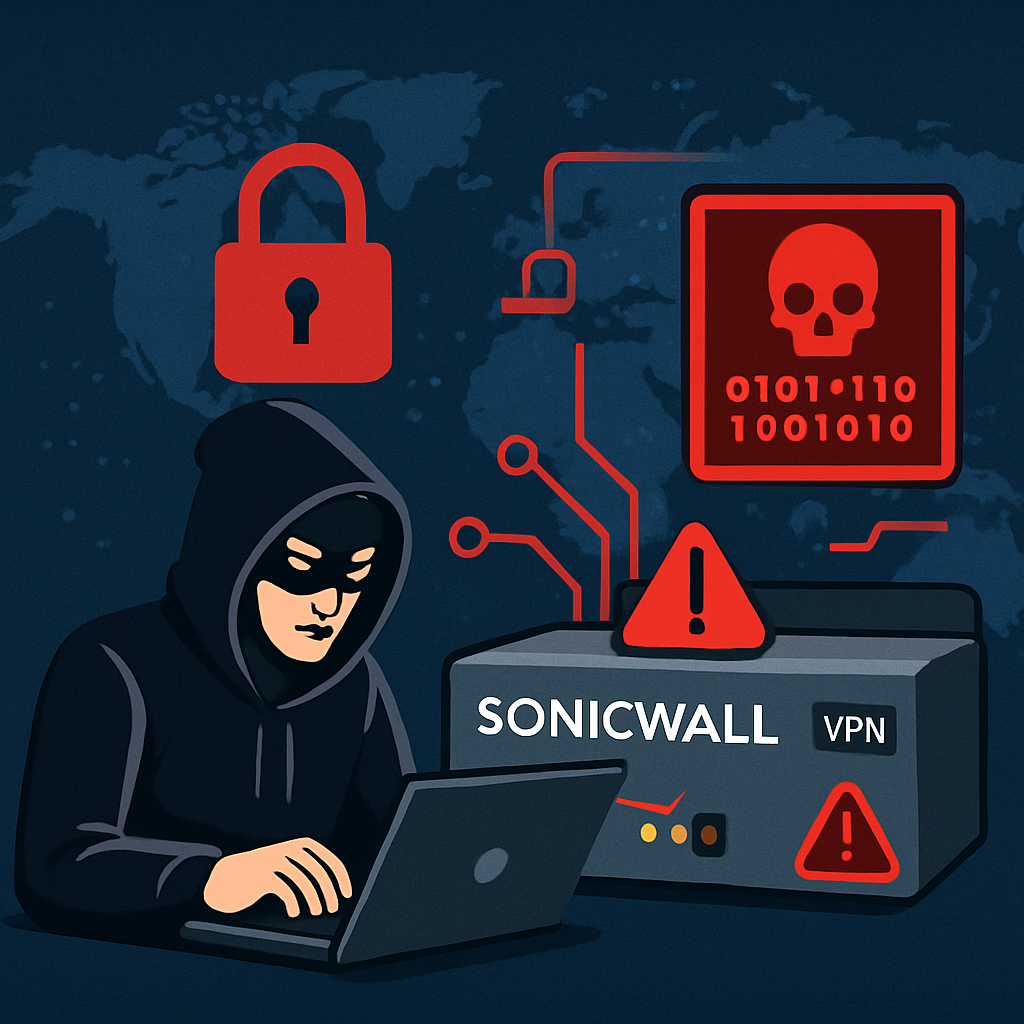
The INC Ransomware group has rapidly become a significant threat by exploiting vulnerabilities in SonicWall Secure Mobile Access (SMA) 1000 series VPN appliances. Since August 2023, the group has claimed over 830 victims, with a notable increase in activity observed in early August 2026. Recent attacks have targeted organizations across various sectors, including legal services, manufacturing, construction, technology, and healthcare, with a significant concentration in the United States. ([thehackernews.com](https://thehackernews.com/2026/06/inc-ransomware-claims-830-victims-since.html?utm_source=openai))
The vulnerabilities in question, identified as CVE-2026-15409 and CVE-2026-15410, allow attackers to execute arbitrary commands and gain control over affected devices. SonicWall released patches for these flaws in mid-July 2026. However, reports indicate that these vulnerabilities were exploited as zero-days prior to the patches’ release, with initial exploitation traced back to June 22, 2026.
Attackers have utilized these vulnerabilities to extract sensitive information, including high-value credentials, active session databases, and Time-Based One-Time Password (TOTP) multi-factor authentication (MFA) seed configurations. This access facilitates persistent presence within networks and enables lateral movement to internal systems. The attack chain often involves deploying tools such as the KNUCKLEBALL Python script, the Suo5 HTTP proxy, and a custom Java web shell named ORANGETAIL.
In addition to technical exploitation, INC Ransomware employs psychological tactics to pressure victims. Some organizations have reported receiving unsolicited communications from individuals claiming to assist with ransomware issues. These contacts, including phone calls from a person identifying as “Andrew,” aim to coerce victims into negotiations, often providing contact information like the email address info@helprans[.]com.
To mitigate the risk posed by INC Ransomware, organizations are advised to promptly apply the latest patches to their SMA 1000 appliances. Comprehensive threat hunting, credential rotation, and integrity verification are also recommended to ensure network security. Monitoring for unusual interactions with the /wsproxy endpoint and correlating such activity with internal authentication and lateral movement can aid in early detection of potential breaches.
The rise of INC Ransomware underscores the evolving landscape of cyber threats, where attackers swiftly exploit newly disclosed vulnerabilities to infiltrate networks. This trend highlights the critical importance of timely patch management and proactive security measures. Organizations must remain vigilant, as the rapid adaptation of ransomware groups to emerging vulnerabilities poses a persistent and escalating risk to global cybersecurity.