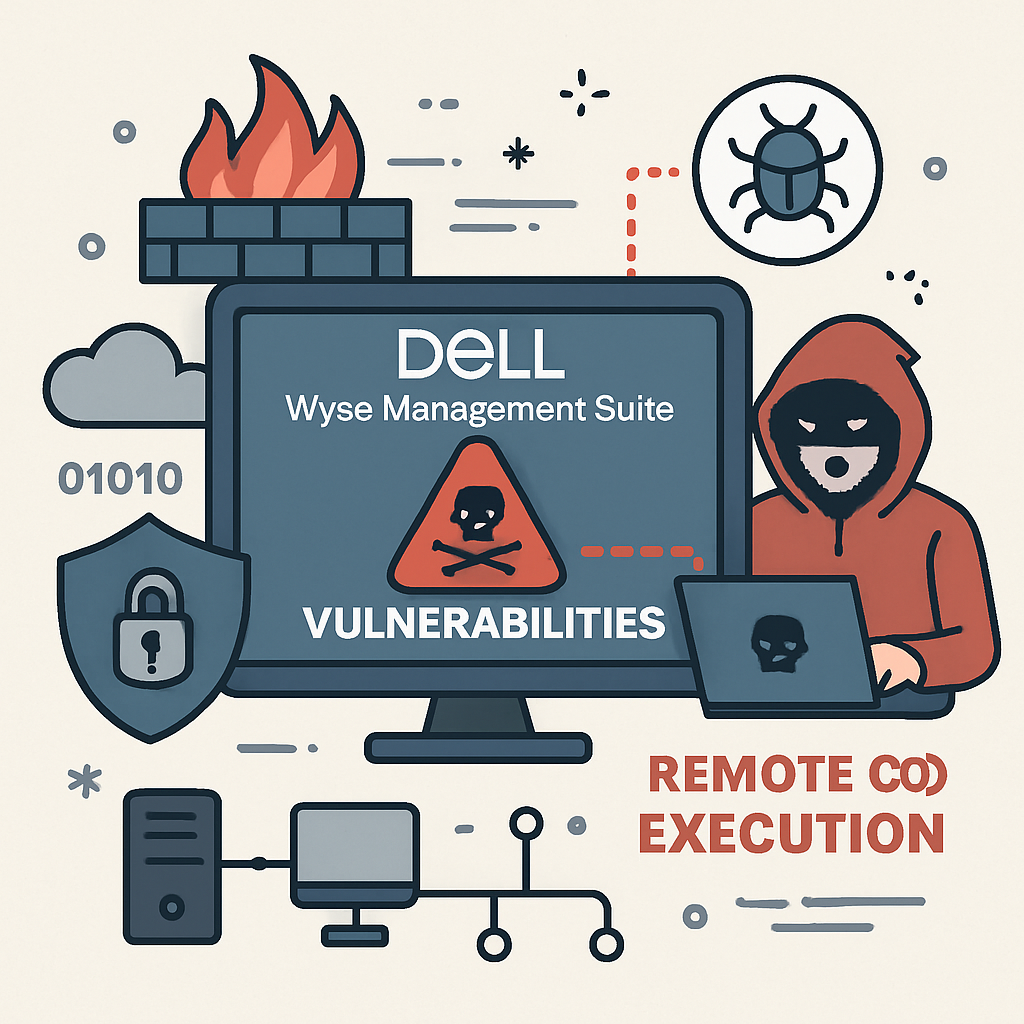
Dell Technologies has issued a critical security advisory addressing multiple vulnerabilities in its Wyse Management Suite (WMS), a platform widely used for centralized management of thin clients and endpoint devices. These vulnerabilities, present in versions prior to WMS 5.5 HF1, could be exploited by attackers to execute arbitrary code on affected systems, posing significant risks to enterprise networks.
Details of the Vulnerabilities
The most severe of these vulnerabilities, identified as CVE-2026-41120, carries a CVSS score of 9.8, indicating critical severity. This flaw is classified as an “Acceptance of Extraneous Untrusted Data With Trusted Data” vulnerability. It allows a low-privileged remote attacker to exploit the issue without user interaction, significantly increasing the risk of widespread exploitation. Successful exploitation could enable threat actors to execute malicious code across vulnerable systems, potentially leading to full control over targeted environments.
Another notable vulnerability, CVE-2026-49506, has a CVSS score of 7.2 and involves a path-traversal issue. This flaw permits a highly privileged remote attacker to manipulate file paths and access restricted directories. If exploited, it could also result in remote code execution, compromising the system’s integrity, confidentiality, and availability.
Implications and Mitigation
Both vulnerabilities underscore significant weaknesses in WMS’s input validation and access control mechanisms. In practical attack scenarios, an adversary could chain these flaws with other techniques to move laterally within a network, deploy malware, or exfiltrate sensitive data.
Dell has acknowledged the responsible disclosure of these vulnerabilities by security researcher Tien Phan. In response, the company released a patched version, Wyse Management Suite 5.5 HF1, on May 8, 2026, addressing both issues. Organizations utilizing affected versions are strongly advised to upgrade immediately to the remediated version to mitigate potential risks.
Beyond patching, security teams should review system logs for any signs of unusual activity, restrict remote access where feasible, and implement network segmentation to reduce potential attack surfaces. Monitoring for indicators of compromise related to unauthorized code execution or suspicious file access is also recommended.
This disclosure highlights the growing trend of attackers targeting enterprise management platforms due to their central role in controlling extensive networks. As such, timely patching and proactive monitoring remain critical defense strategies. Dell customers can access the updated version through the official support portal and are encouraged to follow Dell’s vulnerability response guidance to ensure their systems remain secure.
The emergence of these vulnerabilities in Dell’s Wyse Management Suite serves as a stark reminder of the critical importance of maintaining up-to-date systems and implementing robust security measures. As enterprise management platforms become increasingly attractive targets for cyber attackers, organizations must prioritize regular software updates, comprehensive monitoring, and stringent access controls to safeguard their networks against potential breaches.