Today marks the 25th anniversary of the original iPod, first unveiled by Apple on October 23, 2001. More than just a music player, the iPod helped steer Apple beyond its Mac roots, launching a new era in digital devices and reshaping music for millions.
The Birth of a Portable Music Revolution
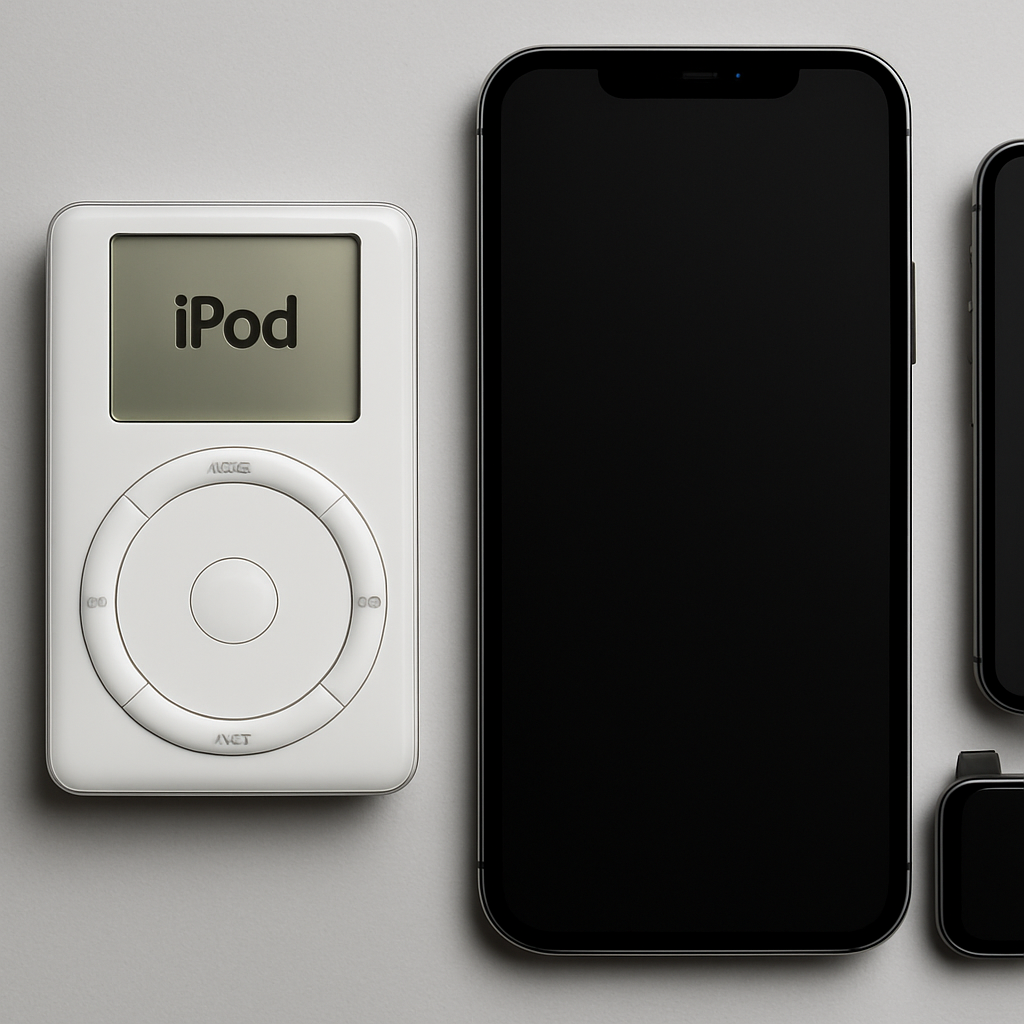
The original iPod debuted at a modest event at Apple’s Infinite Loop headquarters. Promoted as holding “1,000 songs in your pocket,” it offered 5GB of hard-drive storage, a mechanical scroll wheel, monochrome LCD display, and a battery life of up to 10 hours. It cost $399 and worked only with Macs, relying on FireWire for data transfer and charging. A CD’s worth of music could be copied in under 10 seconds, and a full 1,000-song library in less than 10 minutes. The iPod also doubled as external storage for files and documents.
Evolution: More Models, More Features
Over time, Apple refined both the design and capabilities. The second-generation model replaced the mechanical wheel with a touch-sensitive one. The third generation introduced the 30-pin Dock connector. In 2004, full-size iPods got color displays; 2005 brought video playback. That year also saw the debut of the iPod mini, which sported the now-iconic Click Wheel and came in several colors. The nano and shuffle lines soon followed, offering lighter flash storage, screen-free playback, even video and camera features. In 2010, one nano model doubled as a wearable with third-party watch straps.
Sales, Decline, and Discontinuation
By around April 2007, Apple had shipped 100 million iPods—just under six years after the first one hit households. By 2011, cumulative sales had reached over 304 million units. But Apple gradually began retiring models: the classic was phased out in 2014, nano and shuffle in 2017, leaving only the iPod touch. Its final update came in 2019, and in May 2022, it was officially discontinued. Apple stated that the functions of the iPod now live on in devices like the iPhone, Apple Watch, HomePod mini, Mac, iPad, and Apple TV, and that the spirit of the iPod continues across the entire product lineup.
Every so often, criticism over features, price, or utility greeted new models. Early owners complained about fingerprints, charging heat, sound quality compared to CDs, and lack of PC compatibility. Yet despite the skepticism, things that once felt like novelties—hard drives in your pocket, seamless syncing, compactness—became turning points for the industry.
November 10, 2001 marked the first day the original iPod was sold, shortly after its late-October announcement. From that point, Apple would build a family of iPods—mini, nano, shuffle, touch—each pushing the boundaries of portability and lifestyle appeal.
Looking ahead, the iPod’s legacy is in the foundation it laid: in sleek device design, in integrating storage and software, in defining what a mobile experience can be. The devices Apple sells today may do more, but the roadmap traces back to that first iPod. And as we consider the next generation—wearables, streaming, AI—its influence remains strong.
Understanding this history is crucial not just for nostalgia. The iPod’s evolution illustrates how consumer expectations shift—towards more convenience, fewer redundancies, broader integration. The question for Apple and competitors now isn’t what single gadget to build, but how to embed experiences across ecosystems without dependency on any one device. That’s what will define tech’s next 25 years.