More than 100 legitimate websites have been quietly compromised and weaponized to deliver LunexStealer (also known as Psychedelic Stealer), a powerful information-stealing malware. Late September 2026, Ukraine’s CERT-UA uncovered this carefully disguised campaign, attributed to threat cluster UAC-0277, which leverages malicious JavaScript injections to carry out its attacks.
How the Attack Works: Fake Verification & Dynamic Control
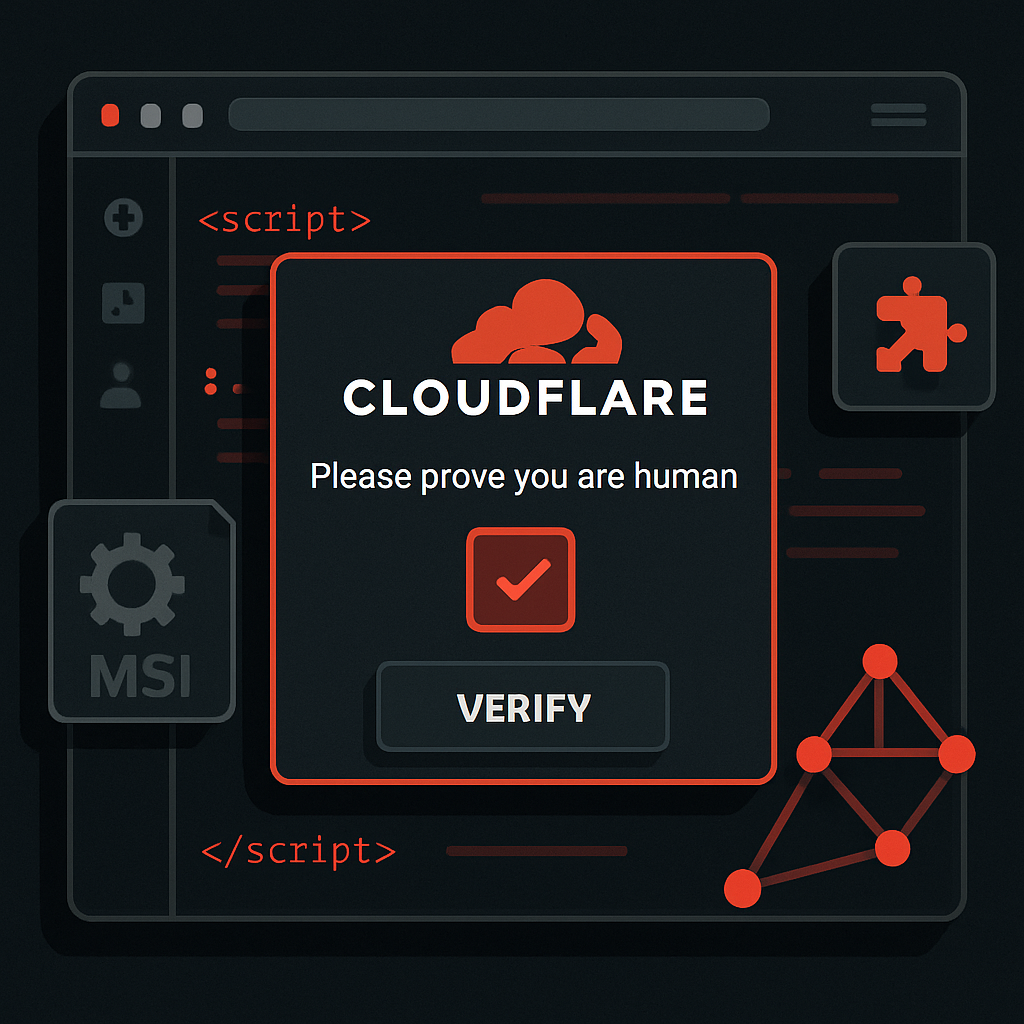
Visitors to the hacked websites are met with a counterfeit Cloudflare verification prompt that claims to confirm they’re human. In reality, accepting it triggers a malicious MSI package download. This attack vector employs what’s known as the “ClickFix” technique — the execution of a local command from the browser results in the stealthy installation of malware. CERT-UA saw attackers blend in with expected verification pages to lure users in.
The JavaScript loading these fake verification pages doesn’t come from a static source. Instead, it uses EtherHiding to fetch the domain and operating mode (inactive, passive tracking, or active phishing) from a smart contract living on the Polygon or Ethereum blockchain. In “Mode 2,” targeting Windows users who land via search engines, victims only see the prompt twice within 12 hours. If they fall prey, the MSI package drops LunexStealer onto their machine.
Variants & Components: Malware with Many Faces
Analysis has identified at least three distinct malicious MSI variants: one that installs LunexStealer directly; a second that circumvents Windows Account Control (UAC), adds Microsoft Defender exclusions, exploits a vulnerable signed AMD driver (“PDFWKRNL.sys”) to evade protections, and finally fetches LunexStealer; and a third that hijacks DLL loading by using a legitimate executable (“FnHotkeyUtility.exe”) to load a rogue DLL (“spkvol.dll”) which decrypts and runs the stealer.
The malware also drops a browser extension named LUNARAXE that disguises itself as “Microsoft Office Word Editor.” It steals cookies, browsing history, credentials, and allows remote browser control and arbitrary script execution. A secondary component dubbed NAIVEMESS—deployed based on instructions from the C2 server—lets the extension access the file system via PowerShell Native Messaging. It supports operations like reading, creating, and overwriting files, as well as executing them; data is transferred in Base64, directories are zipped when necessary.
LUNARAXE itself is modular. Its CORE module handles communication with the attackers, managing browser tabs, exfiltrating data (cookies, history, credentials), running scripts, and displaying overlays. The STEALER module captures credentials entered into web forms, and STRIP removes content security policy headers from HTTP responses to allow arbitrary JavaScript execution.
Strong Mitigations Advised
To protect against this campaign, CERT-UA recommends several technical controls: restrict the use of the Windows Run dialog for ordinary users via group policy; block non-admin users from installing MSI packages; monitor execution of “msiexec.exe”; make use of Microsoft’s vulnerable driver blocklist; limit browser extension installation only to those pre-approved. Microsoft urges enabling the Attack Surface Reduction rule that prevents abuse of signed but vulnerable drivers.
As of the advisory, CERT-UA has not confirmed whether any sensitive systems were fully compromised, nor revealed identities of the breached sites. The campaign is still considered active, with continued monitoring and defenses strongly encouraged.
Why this matters: This operation illustrates an increasingly sophisticated evolution in web-based social engineering. It marries supply chain tampering (compromised legitimate sites), blockchain-backed configuration, driver abuses, and browser extension malware—all in one package. As defenders, the watchwords are: limit privileges, strictly whitelist extensions and drivers, and treat every verification prompt as suspect. Moving forward, tracking this group’s infrastructure and monitoring for the signs described here will be crucial in stopping further spread.