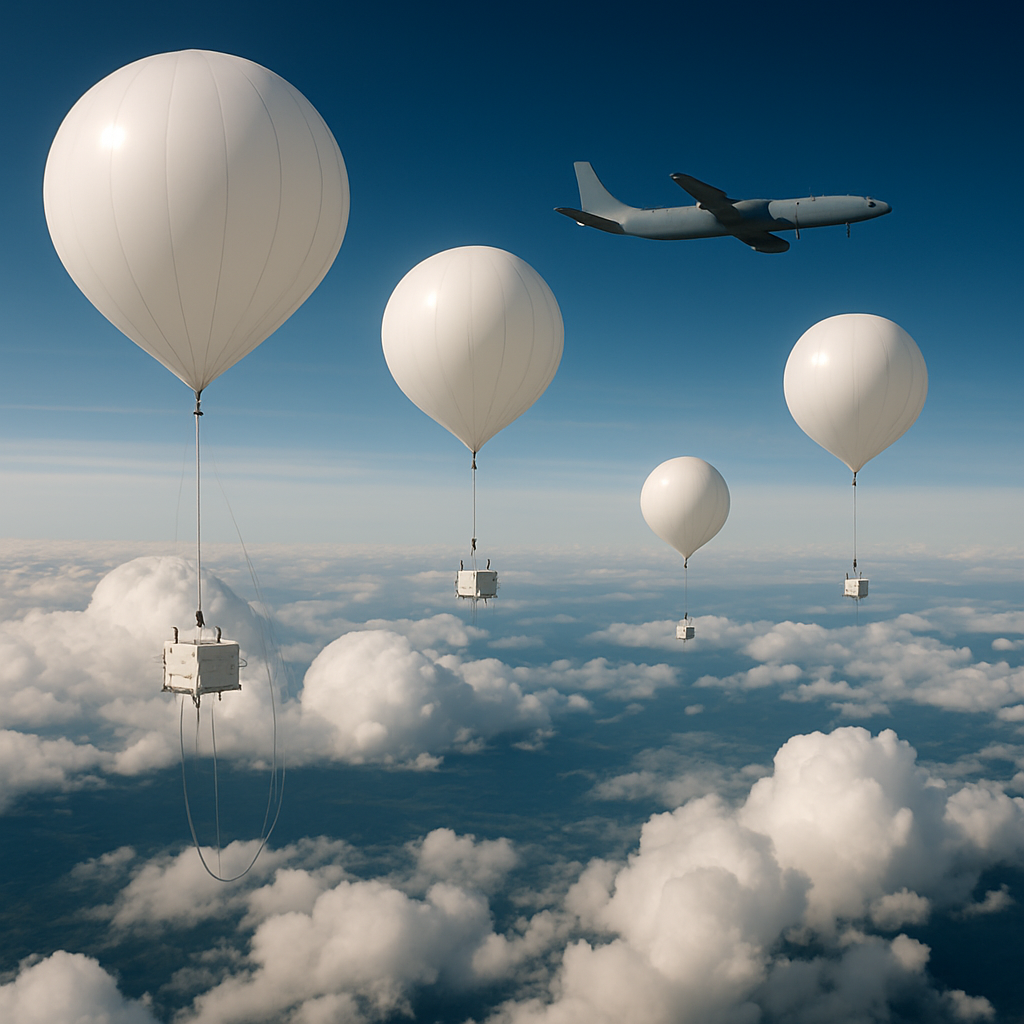
WindBorne Systems, the Redwood City outfit deploying thousands of atmospheric balloons worldwide, has secured a U.S. Air Force contract potentially worth up to $49 million to supply its balloon-based weather data streams. The agreement calls for modular, demand-driven purchases—only paying when and where data is needed—and has already yielded a $1.7 million initial order.
Startup’s Infrastructure & Capabilities
The startup, founded in 2015, already operates roughly 700 autonomous weather balloons globally. These devices gather atmospheric sensor readings and feed them into WindBorne’s own AI-powered forecasting model. The company sells this data to external clients while also using it to refine its internal prediction tools. This contract represents WindBorne’s largest to date.
A key technology milestone came this summer when WindBorne launched an unpowered balloon into the eye of a typhoon—guiding it via altitude control, ballast drops, and other dynamics rather than traditional engine-based navigation. That mission underscored both the maturity of its deployment and the operational value of coupling large-scale empirical data with deep learning weather models.
Why the Air Force Chose WindBorne
The contract, awarded without competitive bidding, reflects a determination by the U.S. government that WindBorne’s global data-collection capability uniquely meets current operational needs. It allows the Air Force to request data only in specific regions at prescribed times. Early orders will support both expansion of the company’s constellation of balloons and continued R&D to improve hardware performance.
WindBorne recently launched WeatherMesh 6, the latest version of its forecasting model. Benchmarks on its site claim WeatherMesh 6 outperforms the European Centre for Medium-Range Weather Forecasts’ simulations, which use traditional physics-based methods. The new model builds on advances in transformer-based architectures and access to large datasets, a pattern increasingly common among frontier AI weather systems.
WindBorne has also worked closely with federal agencies like the National Weather Service and the Navy. Its joint usage of AI-driven models and physical sensors offers an alternative to heavy supercomputing simulations that have long dominated weather forecasting.
The Air Force deal comes on the heels of a $37 million Series B raise earlier this year, money earmarked for accelerating growth in its balloon network and model development.
This contract firmly positions empirical data collection—especially from lightweight, high-altitude platforms—as central to next-gen weather forecasting.