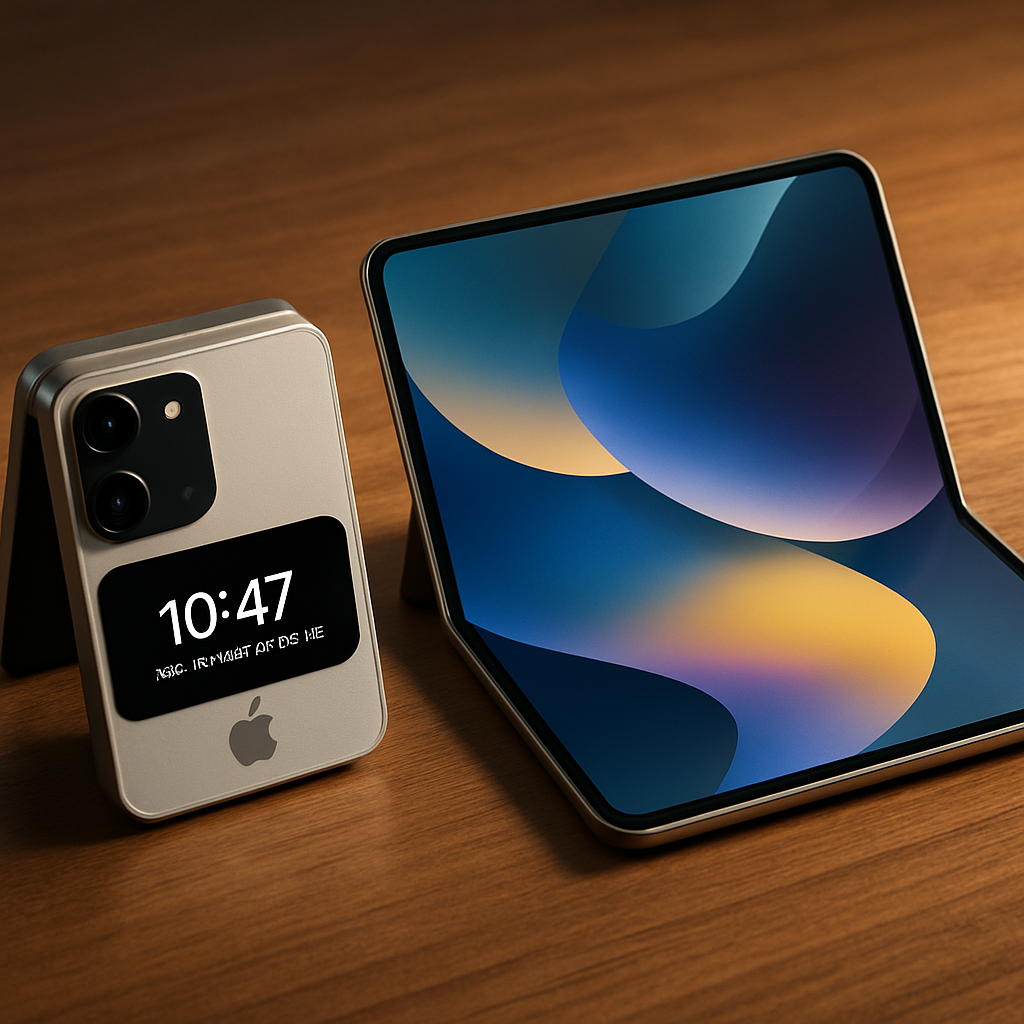
Long-time fans of Apple’s compact phones have new reason to hope. Following the discontinuation of both the iPhone mini and iPhone SE, Apple’s newly revealed iPhone Duo reintroduces a smaller option—only now with bendable appeal and a MacBook Pro-price tag.
The compact revival
For many loyal users, compact iPhones were once the gold standard of usability: small enough to pocket, light enough to carry, yet powerful enough for everyday work. Since the iPhone mini was sunsetted, a vocal segment of the Apple audience has missed the balance between portability and capability. The iPhone Duo appears poised to fill that niche—offering a neater footprint than the regular iPhone 17 models. It’s the kind of device that fits in dress pants without fighting for space, and brings back some of that one-hand convenience.
The Duo’s foldable trade-offs
The folding design adds a layer of ambition. While the Duo functions like a phone when closed, opening it transforms the screen into something closer to an iPad mini in behavior—ideal for tasks like reading, gaming, or sketching. But it’s not perfect. Despite supporting the USB-C Apple Pencil, it lacks support for the Pro version or any pressure-sensitive stylus features, limiting its usefulness for serious creators. And its ability to run full iPad-class apps—like Procreate—remains constrained; Procreate Pocket is available, but the full app experience isn’t.
On top of that, the price is a big punch. The base model starts at $2,000—a sum that forces users to weigh daily cost, longevity, and opportunity cost. Should one instead spend that much on a 14-inch laptop and still carry a phone? For many, the Duo’s price per day of ownership forces tough math.
Is it right for you?
Deciding whether the iPhone Duo is a logical purchase comes down to your phone habits. If you’re glued to iOS apps, travel frequently, often multitask on big screens, or play games on your phone, the Duo’s large folding footprint may feel like getting two devices in one. But users who primarily use standard phone features, or already carry tablets, may see more trade-offs than gains.
It’s especially meaningful to those of us who longed for the mini: smaller hands, one-hand usability, and a smaller footprint in pockets all matter. The Duo makes those possible again—though with concessions in cost and form.
Ultimately, the iPhone Duo is a bold experiment: a pint-sized revival with fold-out ambition and premium pricing. Whether it will dominate the foldable market or serve a more niche crowd remains to be seen. But for anyone who’s missed the mini, it’s a rare and intriguing option—even if it comes with a rarefied price. The bigger question now: how many users will cross the $2,000 line for something both compact and foldable?