Security Operations Centers (SOCs) are grappling with an alarming dynamic: artificial intelligence (AI) isn’t just energizing defenses—it’s transforming attackers’ workflows. AI is enabling threat actors to iterate faster, troubleshoot errors mid-operation, amplify reconnaissance, rebuild privilege escalation paths, and loop through failures until something works. What’s changing is not the tools themselves, but how cheaply and quickly threat actors can pivot in the middle of an attack. Internal defenders are still, for the most part, being forced to rebuild from scratch for each alert. That’s no longer scalable in this new attack paradigm.
How AI has reshaped attacker workflows
In early 2025, state-aligned groups were treating generative AI as a productivity tool—using it to translate, craft scripts, debug them, and accelerate research. But by late that year and into 2026, usage began shifting: models were being used in malware, to bypass two-factor authentication systems, and to stealthily manage entire ransomware campaigns from recon through to ransom demands. In one major case, adversaries used AI both to identify a flaw in an admin tool and to build exploits capable of bypassing protections by mid-2026. Security firms attribute discovery, development, and reconnaissance to AI assistance.
Meanwhile, the defenses remain caught in delayed or siloed workflows. The gap between attacker trial-and-error loops and defender ticket-based incident handling widens daily. Attackers can test, adjust, and adapt in seconds. Defenders acknowledge alerts in minutes—but then spend hours rebuilding situational context. Teams re-derive identity and device information. They chase scattered logs. They reconstruct strategies that were never properly documented. And often, the rationale behind actions or why something was dismissed gets lost.
What defenders lose in handoffs
Most SOCs break down into five core functions: threat intelligence, threat hunting, detection engineering, investigation, and remediation. All face distinct challenges—but nothing exposes gaps like their handoffs. With each interface: intelligence passes off to hunters, hunters to detection engineers, engineers to analysts, analysts to containment teams—the clarity of what was known, what was assumed, what was true or unknown erodes. Key information often drops out: who the actor is, what evidence was collected and what was missing, what confidence level supports each hypothesis, and the constraints on action.
An example: a finance user signs in from an unfamiliar network with approved multifactor authentication. Soon after, a mailbox rule forwards everything externally, and a strange data-access pattern emerges. Threat intelligence notices a trend of supply-chain phishing, but that context is lost by the time the alert hits the analyst—who sees only discrete logs about login, forwarding rules, and data transfers. The remediation team, unaware of broader context, opts to disable the account—which also disrupts payroll. All parties involved did their jobs, and all lost insight. Worse still, the next analyst faces the same anomaly without any memory of what came before.
This is where the idea of a “unicorn analyst” enters: someone who alone ties together identity, detection logic, endpoint security, cloud and business constraints. In organizations depending on that kind of figure, critical knowledge lives in one person’s head. When that person moves on or burns out, the runbook goes with them. Over time, noisy rules proliferate, blind spots persist, and identical investigations start fresh every shift.
Toward a stateful SOC
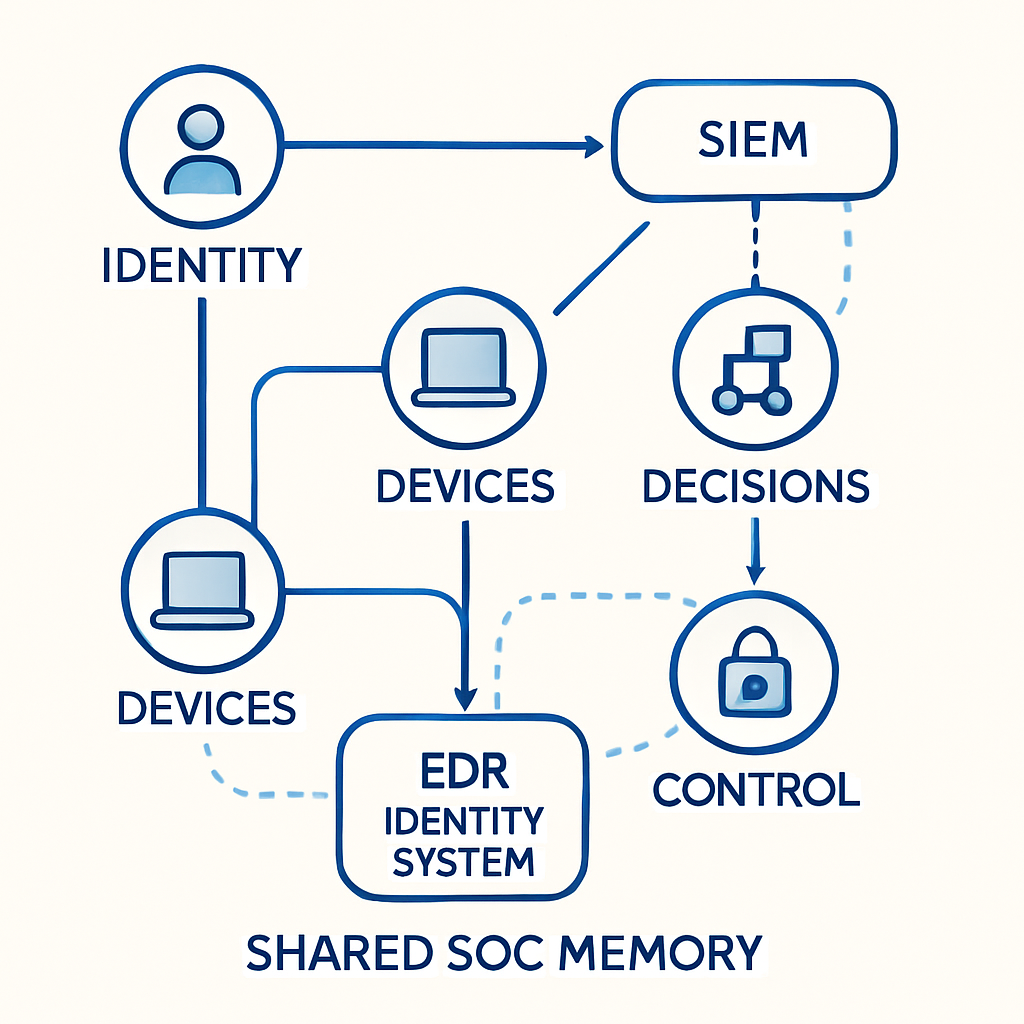
The fix lies in building a SOC that remembers. Instead of resetting at every alert, SOCs need shared operational memory—structured, persistent institutional record across five states: environmental (devices, identities, relationships), evidence (what was observed, when, by whom), decision (hypotheses, alternatives, confidence), control (who can act, what actions, approvals), and learning (how mistakes inform rule hunts, playbooks, detections). When these states flow through threat intelligence platforms, SIEMs, endpoint security tools, identity systems, and case management, handoffs cease being reset buttons.
That means acknowledging uncertainty: marking gaps, missing telemetry, unknown endpoint coverage. It means building in controls around who approves what and under what confidence levels—not letting automated agents overreach simply because they sound certain. And it means capturing lessons: when an alert is later refuted, the evidence, assumptions, and root cause should be stored and fed back into detection and hunting workflows—not filed away in closure notes that never see daylight again.
The outcome? Analysts arrive already dealing with structured cases, equipped with prevailing hypotheses, aware of what is unknown, carrying forward auditorable and actionable context. Measurement should shift too: not how many alerts were triaged or hours spent, but whether cases preserved missing visibility, whether resolutions were aligned with impact, whether learning loops closed.
New federal guidance—like the updated version of incident response standards—reinforces this shift, defining incident response as part of the broader risk management fabric. Waiting for full autonomy is letting attackers dictate terms. Better to secure the memory of the system now: track blind spots, assign ownership of actions before they matter, record evidence and decisions, share context—and stop starting over.
Building a stateful SOC isn’t just a technical upgrade. It’s a strategic imperative. As attackers leverage AI to force-feed iterations into their intrusion cycles, defenders who rely on yesterday’s playbooks end every alert reset at a disadvantage. What to watch: how teams operationalize memory (toolchain, roles, governance), how they measure what they used to miss—and whether investments in shared context start closing feedback loops before the next breach.