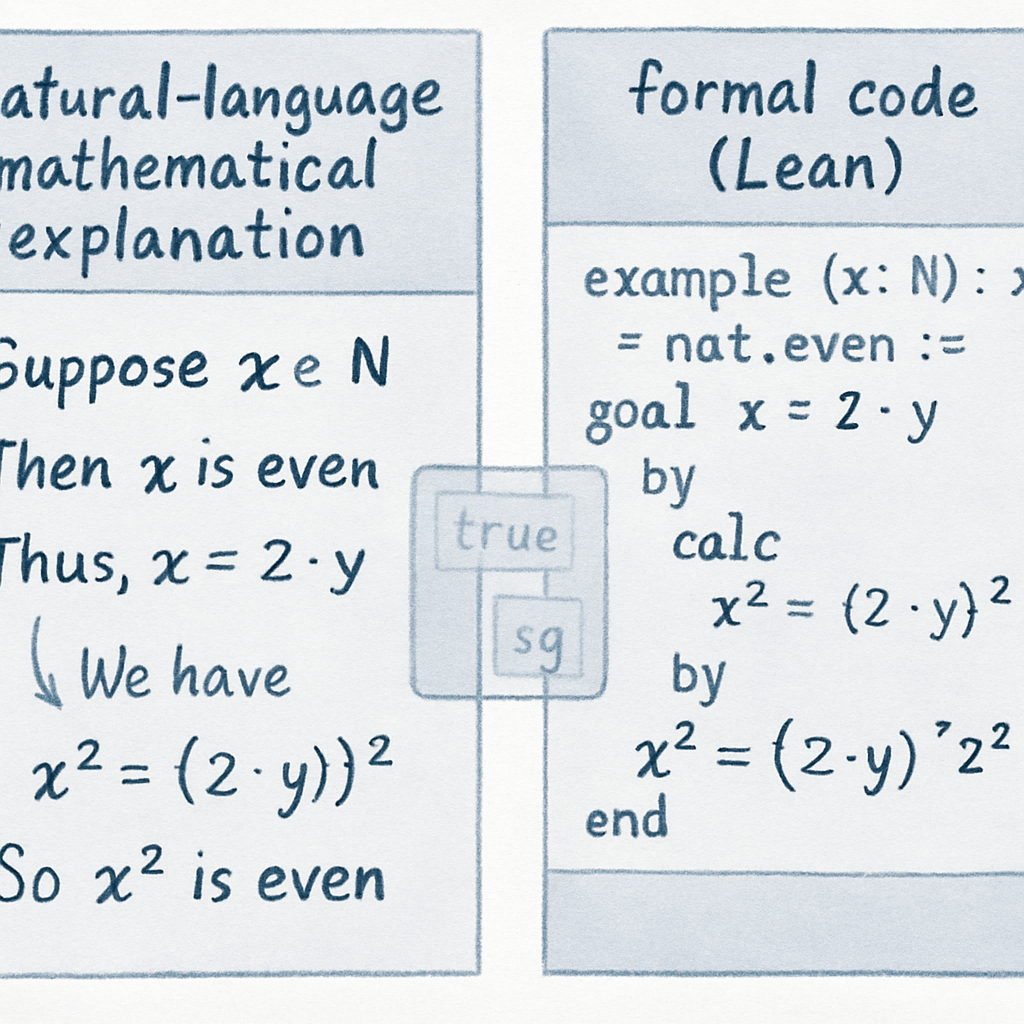
OpenAI has recently made public a collection of purported solutions to some of mathematics’ toughest unsolved problems. But while the lab noted it worked with elite mathematicians to ensure its work met rigorous expectations, experts say it hasn’t lived up to them. Key promises around transparency, formal rigor, and human understanding remain only partially fulfilled.
The Stakes: AGMAI’s Expectations vs. OpenAI’s Reality
The Advisory Group on Mathematics and Artificial Intelligence (AGMAI), comprising nine leading researchers coordinated via Princeton University’s Institute for Advanced Study, published a set of principles in late September aimed at guiding frontier labs tackling deep mathematical challenges. Among the group’s core recommendations: don’t use proprietary models on difficult proofs, make proofs transparent and comprehensible to human experts, provide formal verification wherever possible, and help the broader mathematical community internalize new results. AGMAI also emphasized the importance of releasing machine-readable metadata to link human-readable proofs with formal artifacts.
OpenAI’s recent release of 719 manuscripts reportedly addressing tough math problems suggests some alignment with those principles—for instance, including some explanations of how models arrived at their solutions and moving quickly to publicize results. However, shortfalls are apparent: only 10 of those manuscripts included the model’s “chain of thought,” and less than half of the proofs had formal verification.
Lost in Translation: Natural Language vs. Formal Proofs
A paper from Cambridge and King’s College London scrutinizes OpenAI’s approach, especially the divide between narrative explanations and formal proof code. The study identified discrepancies in at least two cases tied to a problem derived from the Navier–Stokes equations—central to fluid dynamics—where the natural language account didn’t match up to the Lean code meant to formally certify the claim. AGMAI’s guidance urges strict peer review when proofs are developed through such “autoformalization” by AI, warning that models translating their own work can introduce hidden inconsistencies.
Another concern raised by mathematicians is that while models may be solving problems autonomously, the people crafting the prompts often aren’t engaging with the outputs in ways that matter. Researchers like Terence Tao and Melanie Wood have pointed out that there is little evidence these teams are ready to answer questions, present the results, or place findings in broader mathematical contexts at the point of release. For many proofs, human understanding seems to lag release—raising risks for misinterpretation or misuse.
AGMAI’s principles also call for labs to support the mathematicians who will ensure that AI-generated proofs are meaningful in practice. OpenAI’s releases barely show this kind of investment: metadata linking narrative and formal proof is mostly absent, and community engagement appears limited.
In short, while OpenAI has taken steps toward greater openness and rigor, mathematicians argue it has not yet met the standards required to ensure its proofs are reliable, digestible, and integrated into ongoing research.
This matters because mathematical proof isn’t just about solving a problem—it’s about establishing knowledge that others can verify, build on, and apply. Without human validation and rigorous formalization, “solutions” may turn out to contain subtle errors or misalign with core mathematical definitions. What we’re seeing is a shift in how foundational math gets done—but that shift still depends on longstanding norms of verification, peer engagement, and clarity.
What to Watch For: Whether OpenAI begins routinely publishing its chain of thought nearly universally; how many proofs are fully formalized; whether the metadata to tie narrative and code becomes standard; how engaged prompt designers are in explaining proofs beyond solving a target; and how the broader math community evaluates the proofs in seminars, peer review, and practical application.