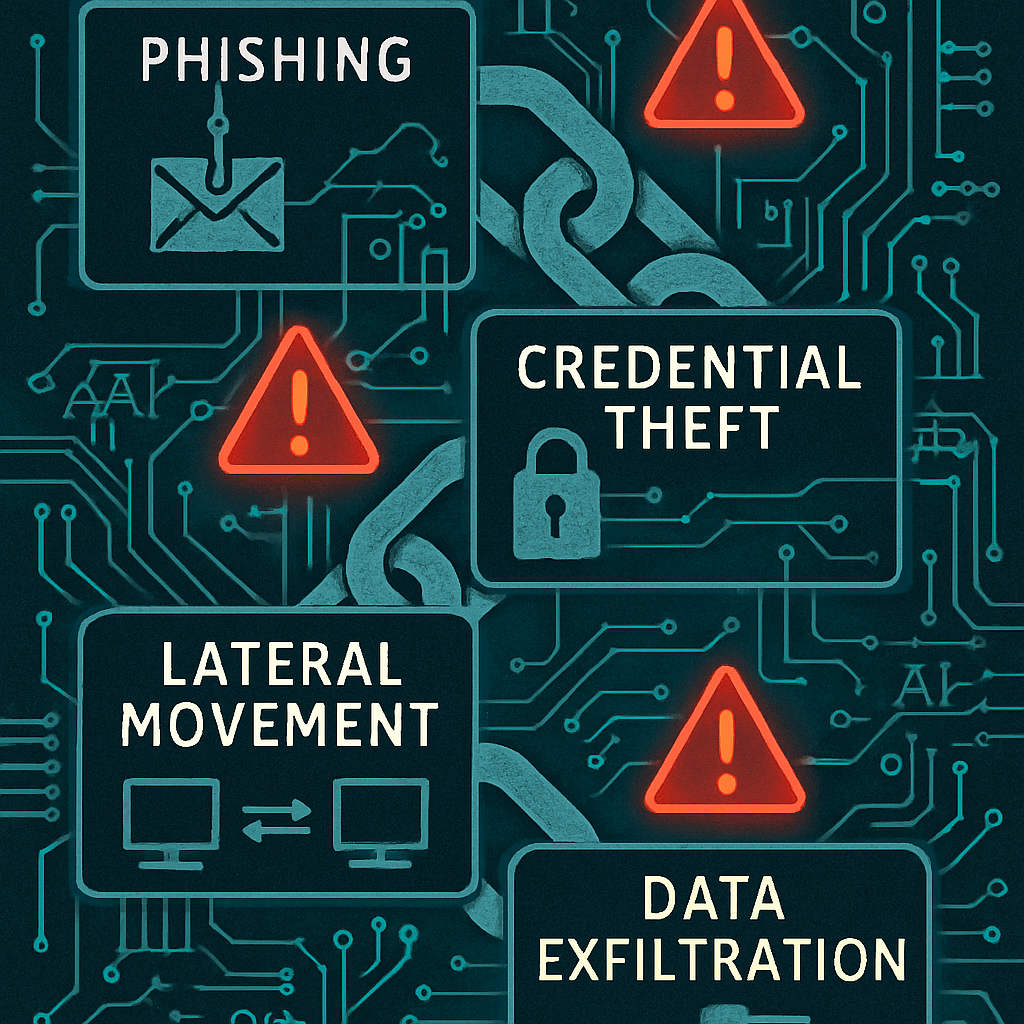
Security teams typically assess defenses by testing individual threats: phishing emails, vulnerable credentials, or misconfigurations. But that approach is increasingly inadequate. Real-world attackers—often AI-augmented—don’t rely on single techniques. They string many together: credential theft, privilege escalation, lateral movement, data staging, and exfiltration. You can harden each individual control, yet leave gaps that enable a full chain to succeed. That’s the true exposure.
The Exposure Gap Between What We Test and What Attackers Use
Many organizations have consolidated libraries of attack techniques, mapped to frameworks like MITRE ATT&CK. Mature security programs will run these techniques one by one—evaluating detection and response for each isolated event. But this misses something crucial: it doesn’t tell you what happens when an attacker links techniques in sequence. A system might catch phishing. It might catch credential abuse. But can it catch when phishing leads into credential abuse, leads into lateral movement, and so on? The “attack surface” testing model typically can’t simulate that continuity and often fails to expose how intruders can slip through chains of controls.
Recent data makes that especially worrying. Nearly all security leaders surveyed—93 percent—reported a business-impacting cyberattack in the past year even though many believe their defenses are validated. AI is also making chains tighter. Attackers are moving faster once inside a network in 88 percent of cases, and 84 percent say that disconnected tools and fragmented testing leave gaps that adversaries exploit. These numbers suggest that having strong controls in isolation doesn’t guarantee that you’ll stop a coordinated attack chain.
Attack Chaining: Simulating How Breaches Actually Happen
Attack chaining aims to simulate full multi-stage intrusions, not just individual steps. Instead of cherry-picking techniques, defenders construct sequences where each action depends on the outcome of the previous one—harvested credentials, valid logins, open ports inform what comes next. If one stage succeeds or fails, the path adapts accordingly. The goal: mirror how a red team operates, but in continuous, automated fashion, rather than episodic and expensive tests.
This method brings together several capabilities. Conditional chaining logic lets defenders build reusable, branching attack paths; live attack path maps render every pivot or hop in real time; transparent findings show which steps mattered and which controls stood firm; scope and safety mechanisms ensure testing doesn’t stray into unintended systems; and social engineering is treated as a first-class element—with phishing, fake pages or lures leading directly into the next stages of the chain.
This end-to-end visibility lets organizations see not just whether any single control failed, but whether a realistic attack could traverse their environment right now. It transforms security testing into something continuous, prioritized, and closely aligned with likely threats rather than hypothetical ones.
Two Modes: Operator-Led and Autonomous
There are two major ways defenders can run these chained simulations. The operator-led model lets human experts design attack chains, specify conditional logic, control scope, and interpret findings—like a traditional pentest, but far more frequent and structured. Then there’s the autonomous model. Here, a dedicated AI agent is given objectives and constraints. It orchestrates attacks itself—deciding step order, generating phishing content, choosing exploitation paths based on what the environment yields, adapting on the fly—all within predefined rules.
Both modes use the same underlying engine and controls, meaning you maintain governance even when automating. Results feed into exposure scoring tools, offering a constantly up-to-date view of how vulnerable you might be to full-blown breach scenarios—not just individual threats.
The bottom line: organizations that believed their defenses were solid because they passed individual tests often failed exactly where tests didn’t go—along the chains attackers forge. As AI accelerates how fast an intruder moves from access to objective, the need to test how techniques link becomes ever more urgent. Attack surfaces are made of scattered weaknesses; attacks are built as connected chains. Testing must catch up to what it’s actually defending against.
What this means: The trend toward attack chaining isn’t just theoretical—it’s emerging as the standard for threat simulations. As tools mature, teams adopting this approach will likely outpace those relying only on isolated technique testing. To stay resilient, security strategies must evolve to meet the chain, not just the link.