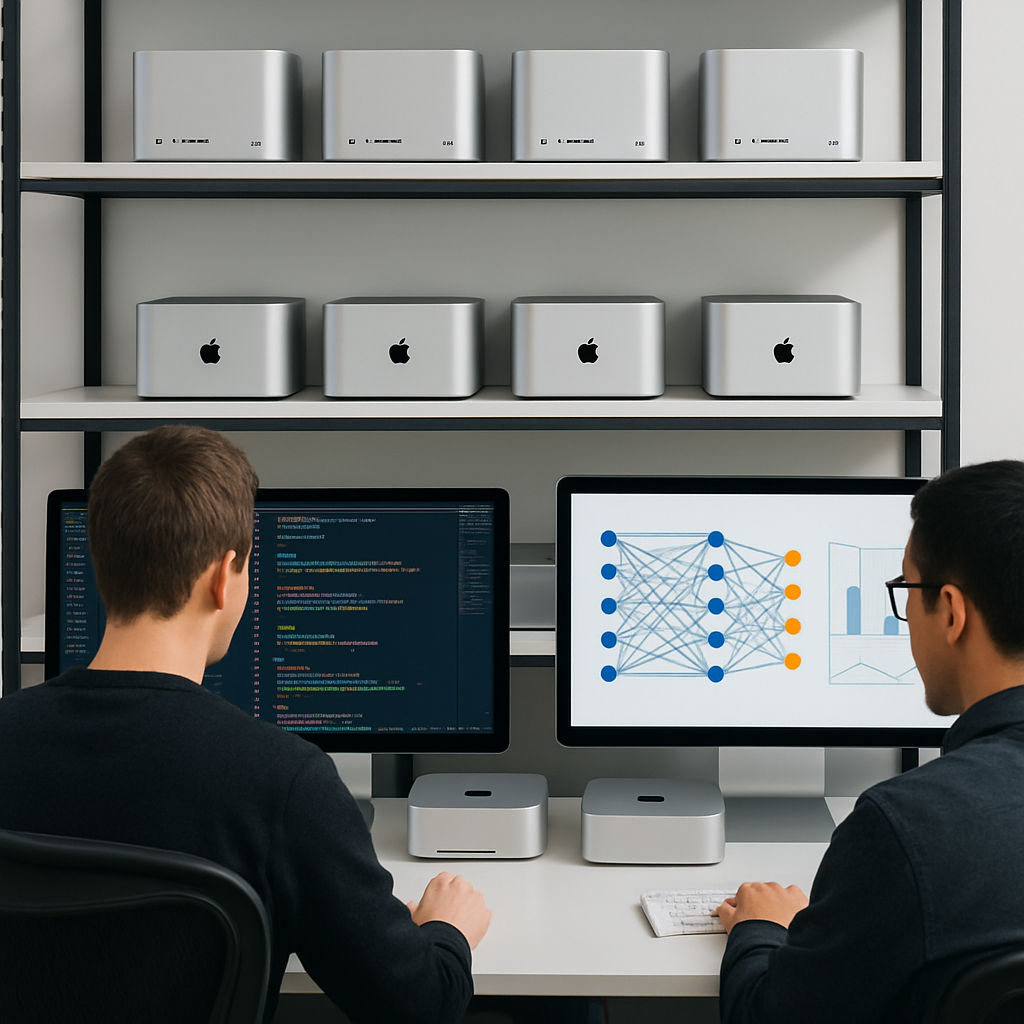
Mac Mini and Mac Studio units are in short supply, with Apple quoting wait times of 10 to 12 weeks for fully maxed Mac Studios. The price tag for a top-tier model hovers around $18,299 before taxes. These delays and steep costs stem partly from supply chain bottlenecks—including tighter supply of memory and storage components. However, there’s another force quietly pushing demand higher.
AI Isn’t Building Supercomputers With Macs
High-profile AI firms are snapping up Mac Minis and Studios in bulk. OpenAI has acquired tens of thousands of them, and Anthropic leases Mac Minis through AWS. Still, it’s not because these machines are serving as the backbone of their infrastructure. They’re not being clustered together to act like data center-grade servers or supercomputers.
Instead, these Macs are being used for repeatable, energy-efficient tasks—programming, testing, reinforcement learning, and especially making stuff tailored for macOS environments. They provide compute resources for processes that require large amounts of repetition rather than raw, massive parallel computation. The unified memory architecture also helps, especially when CPU and GPU need to share data rapidly.
Developers and CI/CD: The Real Mac Revenue Drivers
A survey by MacStadium among U.S.-based mid-market and enterprise teams reveals where much of the demand lies. Many firms use 26 or more physical Macs to support continuous integration and continuous deployment workflows—automated stages where code is built, tested, and packaged for release. In fact, although most teams have only 5–50 engineers, the average inventory of Macs per organization is 81 due to these CI/CD needs.
Entry-level Mac Minis still make up about 80% of Mac Mini sales, including models equipped with higher-end processors. But the survey also shows 83% of respondents say their Mac infrastructure costs have gone up since adopting AI-assisted tools. It’s not about running large AI models—it’s about baking AI into normal development workflows.
The Limits and the Niche
Macs are not replacing big AI infrastructure work. Apple itself builds highly specialized servers for workloads too heavy for Macs to handle. These are not offered as services for external customers. The demand for cloud or managed Mac setups is growing, with about half of surveyed organizations planning to shift to cloud or managed environments within a year, while only 18% want to scale up their own hardware capacity.
Despite their limitations, Macs occupy a well-defined slot in the AI development pipeline. They’re great for development, testing, and edge-case reinforcement learning—tasks where shared memory and cross-functional compute between CPU/GPU are more important than brute force.
Apple didn’t stumble into this by accident. With Apple Silicon and the Neural Engine, the company has been designing efficient, capable chips for years. What’s surprising is how AI’s rise has revealed just how useful smaller, energy-efficient machines can be when paired with the right workflows.
What this means: AI isn’t just about giant models and massive data centers—many of the decisions influencing tech investment are quieter yet equally important. Demand for Macs is rising not because they’re becoming GPUs-on-steroids, but because AI is reshaping software development practices. Watch how Apple and others evolve offerings for CI/CD, hosted Mac services, and unified memory workflows—these may be where the impact shows up next.