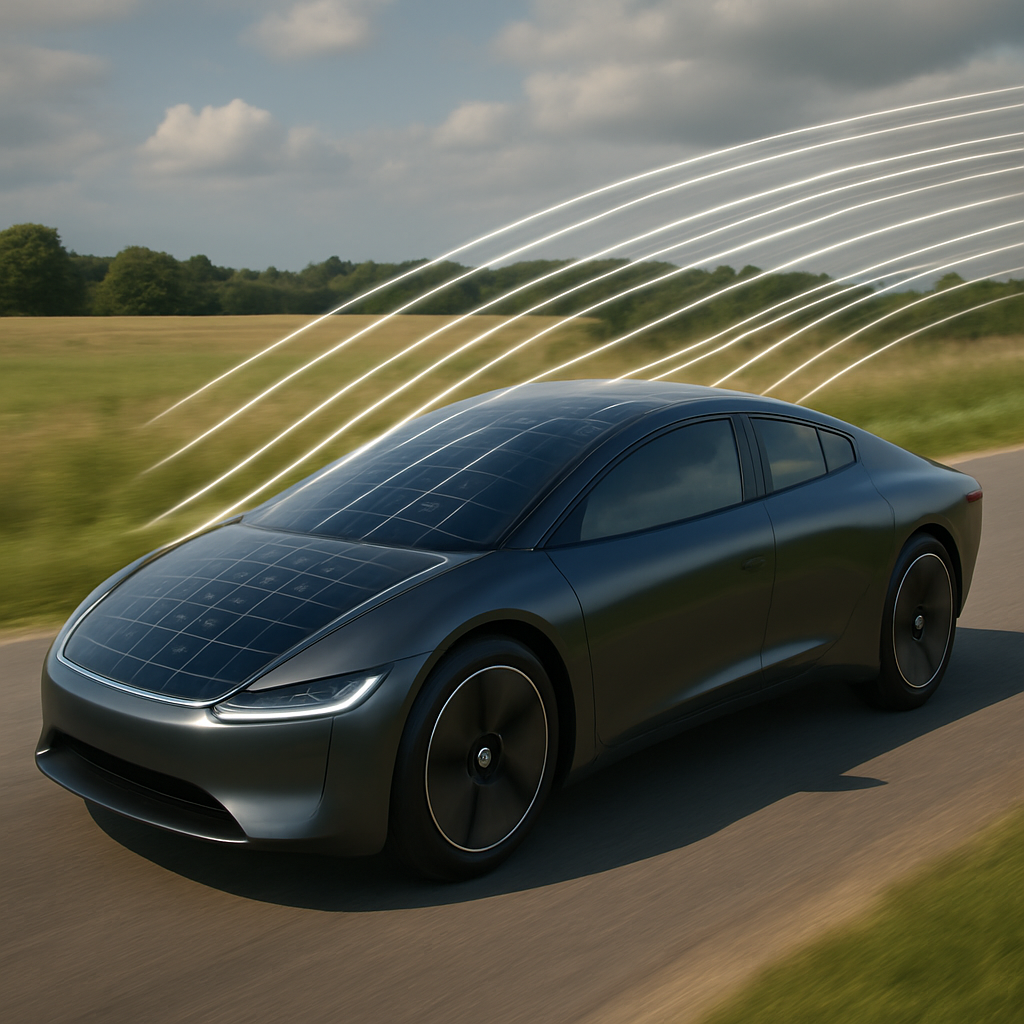
Volkswagen has revealed a prototype electric vehicle dubbed Mission Efficiency capable of reaching around 323 miles per gallon equivalent (MPGe) under ideal conditions. The automaker demonstrated that capability on a 794-mile drive from its Wolfsburg facility to Vienna, charging only once and finishing with 104 miles (168 km) of range left. That translates to energy consumption of 7.51 kWh per 100 miles, or roughly 279 MPGe in real-world terms.
Design choices borrowed from previous experiments
The car’s extreme efficiency stems from its radical aerodynamic styling and stringent weight savings. Volkswagen used the same electric motor and battery as found in its ID. Polo, helping place the prototype close to production readiness. The body adopts a teardrop profile featuring a Kammback roofline to reduce drag to a remarkable coefficient of just 0.158, while keeping the frontal area compact at 2.08 square meters.
Inside, the Mission Efficiency embraces minimalism, taking cues from EV startup design trends. There’s no built-in infotainment system or internal speakers; instead, drivers are expected to supply their own devices and use a portable Bluetooth speaker. Lightweight materials and stripped-down features throughout support both lower mass and higher efficiency.
Trade-offs & niche suitability
Several compromises were required to hit these efficiency marks. The rear seats are tiny—suitable only for people under about 5-foot-3 (1.6 meters)—and the tight wheel arches, designed to reduce drag, likely sacrifice ride comfort. Side mirrors remain conventional rather than replaced by cameras, since they provide better depth perception despite being aerodynamically inferior.
Solar panels on the roof and trunk lid add just about 18 extra miles (30 km) of range, but only under ideal conditions: flat ground, sunny sky, and steady speeds around 42 mph (68 km/h). Though the prototype is dubbed “near production,” Volkswagen hasn’t confirmed plans to manufacture it. The EV portends something of a halo car—its kind of engineering showcase rather than mass market offering.
For perspective, the Mission Efficiency is nearly twice as efficient as today’s most efficient production EV, the Lucid Air Pure. Lucid’s model achieves around 420 miles of range using an 84-kWh battery under EPA ratings, whereas Volkswagen’s prototype suggests over 400 miles of range from its 54.9-kWh battery—but without official rating. Both figures reflect very different scales, though: the prototype is much smaller and far more focused on efficiency than practicality.
Why this matters—and the road ahead.
Volkswagen’s Mission Efficiency serves as proof that EVs can push past current efficiency norms through radical aero design, weight reduction, and minimalist features. While most consumers demand comfort, infotainment, spacious driving, and ride quality, cars like this glue into view as low-impact solutions, especially for city travel or lightweight commuter use. It also shows how much efficiency gain is left unexplored in existing EV designs.
Companies will need to decide whether to integrate such efficiency-driven engineering into production models or to reserve it for concept vehicles. For mission-critical sectors like delivery, micro-mobility, or emerging markets, this approach may turn into more than a halo—it could redefine viable range, cost, and sustainability thresholds. Keep an eye on whether Volkswagen scales this, or if imitators take up this playbook in upcoming years.