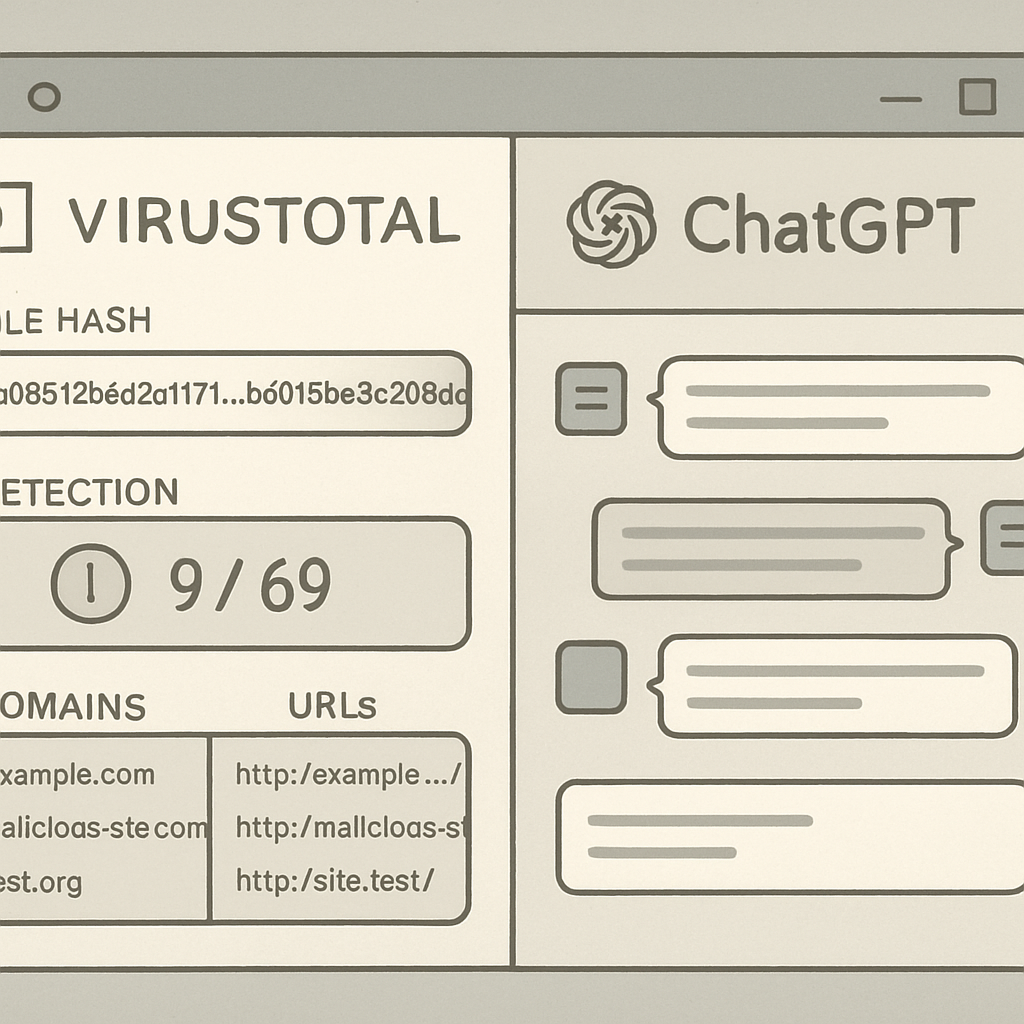
VirusTotal has launched VirusTotal AI (VTAI), a new integration that allows users to pull threat intelligence directly into ChatGPT for analyzing suspicious files, URLs, domains, and IPs. This pairing streamlines investigations by enabling report retrieval and explanation of detection results, complete with visibility into source, date, and threat coverage.
How the VirusTotal-ChatGPT Link Works
The integration is powered by the Model Context Protocol (MCP), a framework that lets AI tools interoperate with external threat services. Users enable this via ChatGPT’s Developer mode, connecting through OAuth. Interestingly, a VirusTotal API key isn’t required; access is controlled by one’s workspace and account settings.
When a file is attached and approved, the system checks its hash against VirusTotal’s database before uploading anything. If the file is already known, it returns the existing report. Unknown files are submitted only after confirmation. This ensures report lookups are distinct from file submissions. Even though querying existing reports hits rate quotas, uploading new files only matters for contribution limits—not lookup quotas. Users can also resume work on previously submitted files without resending them, thanks to saved query receipts.
Limits, Privacy, and the Role for Analysts
URL, domain, and IP re-analysis are supported when permissions allow, with unique request identifiers to follow up on interrupted investigations. Still, just because a file shows up with zero detections doesn’t mean it’s safe. Pending analysis or missing reports signal unknown status rather than assurance. The system doesn’t settle disputes—it merely provides data.
Privacy concerns are front and center. Anything submitted—including documents, credentials, internal code, or detailed URLs—might be exposed to VirusTotal’s partners or the wider threat intelligence community. Thus, sensitive material should never be uploaded without appropriate authorization. Also, the access granted by VTAI is free within set quotas, governed by the account connection—not per-chat.
For cybersecurity professionals, the integration simplifies access to evidence and report information, but it’s not a replacement for a full investigation. Key factors like when a report was created, how widely it covers the threat landscape, and other context must be assessed before taking action such as blocking, isolating, or escalating.
The integration builds on VirusTotal’s earlier AI tools, such as Code Insight for malware analysis, but underscores that AI-aided report access is not a substitute for human judgment. Whether something is safe or not still requires careful review.
Closing Analysis: This integration is a major step forward in merging conversational AI with threat intelligence. By embedding VirusTotal data directly into ChatGPT, analysts gain faster, more context-rich insights—especially valuable in fast-moving incident response. But its utility hinges on understanding its limitations. Watch carefully for how organizations balance ease of access with privacy risks, how thresholds for “unknown” status are handled, and whether workflow efficiencies actually reduce detection times in practice.